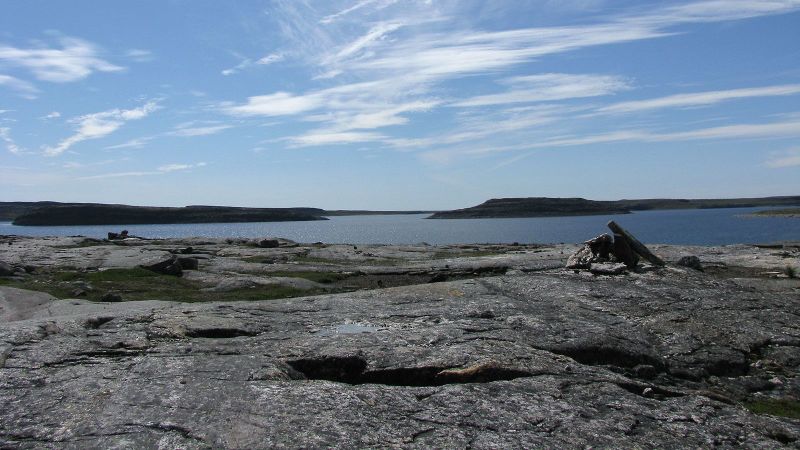
In 2025, scientists uncovered significant findings about Earth, revealing the age of the oldest known rock formation, identifying a thriving ecosystem nearly six miles beneath the ocean surface, and detecting surprising movements in the planet’s core, reports BritPanorama.
Among these discoveries, a rocky outcrop in northern Quebec was identified as the oldest fragment of Earth’s crust, dating back 4.16 billion years. This finding, from a study published in June, opens avenues for further research into the formation and any potential fossils, potentially shedding light on an uncharted chapter in Earth’s history.
The Nuvvuagittuq outcrops could provide insight into the Hadean eon, which began 4.6 billion years ago when conditions on Earth were hostile. Scientists believe this rock may preserve signatures of ancient life, making it a focal point of debate in the ongoing discussion about Earth’s geological timeline.
Research is ongoing, as the lack of zircon, a durable mineral typically used for dating such formations, leaves some uncertainties surrounding the finding’s acceptance in the scientific community.
The planet’s oldest rock
A rocky outcrop in a remote corner of northern Quebec harbors the oldest known surviving fragments of Earth’s crust, according to a June study. The discovery opens the door for further examination of the rock formation and any fossils it contains to illuminate an unknown chapter in Earth’s history.
The exposed remnant of the ancient ocean floor, called the Nuvvuagittuq outcrops, dates to 4.16 billion years ago, making it the only rock determined to be from the first of four geological eons in our planet’s history: the Hadean.
This eon began 4.6 billion years ago when the world was thought to be hot, turbulent and hell-like, but scientists say it’s possible that the newly dated rock formation may preserve signatures of life from the Hadean.
However, it’s not yet clear whether the Nuvvuagittuq outcrops will become widely accepted as Earth’s oldest rocks — a long-running scientific debate.
The rock sample didn’t contain a tough mineral known as a zircon — the easiest and most reliable way to date old rock formations — and little is definitive when dealing with rocks and minerals that have histories spanning more than 4 billion years.
Microlightning, will-o’-the-wisps and the origins of life
Will-o’-the-wisps, the eerie glowing lights spotted over bogs, swamps, and marshes through the centuries, have inspired folklore, ghost stories, and even a quirky 1980s UK cartoon. The cause of this flickering phenomenon has remained unclear, with theories including static electricity, swarming insects, and lightning igniting swamp gas.
The last hypothesis was not far from the mark, according to researchers who have revealed a scientific explanation. Their study, published in September, indicated tiny flashes of lightning ignite microscopic bubbles of methane.
However, the “microlightning” does not arise from the sky. Instead, it originates from electrically charged bubbles of water that interact with methane, producing the flashes of light.
Another study, published in March, found that microlightning in primordial mist may have sparked the chemical formation of the building blocks of life more than 3 billion years ago.
A shifting magnetic north pole
Unlike the geographic North Pole, which marks a fixed location where all the lines of longitude converge, the magnetic north pole’s position is determined by Earth’s magnetic field, which is in constant motion. Over the past few decades, magnetic north’s movement dramatically sped up before rapidly slowing around 2015, leaving scientists puzzled by the underlying causes of the magnetic field’s unusual behavior.
In 2025, scientists updated the World Magnetic Model, which helps preserve the accuracy of global positioning systems. They reset the official position of magnetic north and introduced new predictions for its movement over the next five years.
Since its discovery in 1831, the magnetic north pole has drifted away from Canada towards Russia. Its movement has varied, with an acceleration in 1990 increasing its drift from about 9.3 miles per year to as much as 34.2 miles. By 2015, the drift slowed to approximately 21.7 miles per year, and scientists expect this trend to continue, though uncertainties persist regarding how long the slowdown will last.
The deepest known animal ecosystem
Geochemist Mengran Du had 30 minutes left on her submersible dive into a deep ocean trench between Russia and Alaska when she spotted “amazing creatures,” including various clam and tube worm species never recorded at such extreme depths.
Du and her team discovered the deepest known ecosystem of organisms that survive using methane instead of sunlight. These creatures live 5,800 to 9,500 meters below the ocean’s surface in what’s known as the hadal zone.
The scientists hypothesize that microbes within the ecosystem convert organic matter in sediments into carbon dioxide and then into methane — a process previously unknown in these conditions.
Bacteria living inside clam and tube worm species utilize this methane for chemosynthesis, enabling survival in these adverse environments. Du was recognized by the scientific publisher Nature as one of the ten individuals who significantly influenced science in 2025.
Sunken worlds
Earth has a lot going on under the surface. Recent discoveries suggest that remnants of ancient supercontinents hidden deep within the mantle are older than previously thought. A study published in January indicates that the rocky mantle isn’t as uniformly blended by Earth’s internal churning as once believed.
In August, scientists revealed another geological anomaly in the mantle — hot rock beneath the Appalachian Mountains, formed around 80 million years ago when Greenland and North America separated. This mass could help explain why these ancient mountains have not eroded away as expected over time.
Earth’s enigmatic center
The remarkable discoveries of 2025 expanded further into Earth’s innermost layer, a solid ball of metal surrounded by a liquid outer core. Direct observation of Earth’s core remains impossible; instead, scientists study it by analyzing changes in seismic waves.
In 2024, scientists confirmed that Earth’s inner core reversed its spin, and February 2025 brought revelations about the changes in the inner core’s shape, indicating deformations at its shallowest levels.
Gold is one of the metals thought to compose the core, and a May study indicated that at least a small amount may have escaped to the surface from a Hawaiian rock formation. Such leakage raises the prospect of more of this precious metal traveling from the center of Earth to the crust in the future.
These scientific advances demonstrate the ongoing quest to understand our planet, revealing dynamic and complex processes shaping Earth’s history and future.