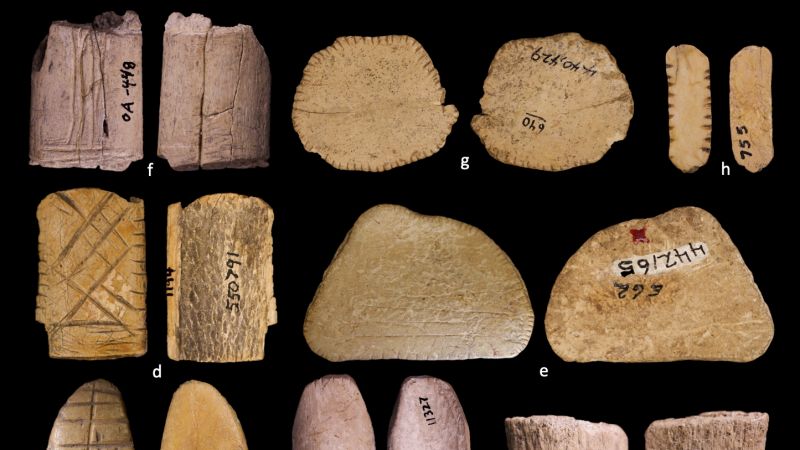
The traditional six-sided die has been around since the Bronze Age, with the earliest known pieces from approximately 3000 BC uncovered in Mesopotamia and the Indus Valley. Now, a new study has found evidence that Native Americans were likely using dice for gaming and gambling more than 6,000 years earlier, since the end of the last ice age, reports BritPanorama.
The dice looked different from the polyhedral shapes commonly used today. The oldest examples identified in the study were known as “binary lots,” found at archaeological sites from the Folsom Period in Wyoming, Colorado, and New Mexico, dating back roughly 12,800 to 12,200 years. Crafted from wood or bone, these flat, two-sided dice could be tossed in a manner similar to flipping a coin. The findings were reported in a paper published on April 2 in the journal American Antiquity.
Lead study author Robert J. Madden, a doctoral student of archaeology at Colorado State University in Fort Collins, argued that evidence of such ancient gaming practices has been obscured for too long. “We’ve had a great record of this subject during the historical period after Europeans got here,” Madden noted, referencing the last 1,000 to 2,000 years, “but before that, we really didn’t know how far this goes back, and that’s really what this paper adds.”
The study introduces new criteria for identifying old dice, paving the way for further exploration of the evolution of games, say researchers. “Gaming archaeology has been overlooked for so long as unimportant or invisible in mainstream archaeology,” commented Walter Crist, an archaeologist at Leiden University in the Netherlands who specializes in ancient games. Although not involved in the study, Crist acknowledged its significance. “This paper does a lot to demonstrate what is possible if you understand traditional gaming practices and look for relevant analogues in the archaeological record.”
Deciphering prehistoric dice
Because these dice did not conform to the traditional cube shape, they were initially referred to as “gaming pieces.” Madden noticed significant gaps in the literature regarding the use of dice prior to European arrival in America, prompting him to develop a method for identifying these artifacts. “I realized that there were some of these ancient examples—these discs—that just people were saying, ‘Well, we don’t know what they are,’” he explained. “I thought, ‘If they are dice, that is really significant.’”
Madden employed a 1907 analysis by ethnographer Stewart Culin, which catalogued 293 sets of historic Native American dice, to create a comprehensive four-part test designed to evaluate unidentified objects. This test considered descriptors like shape and markings to determine whether they could be classified as binary lots. The research led to the identification of over 600 previously undocumented sets of Native American dice from 45 prehistoric archaeological sites in the western United States, spanning from the Late Pleistocene to the period following European contact.
“I think this is a crucial study for research on games in the Americas, but also for prehistoric archaeology worldwide,” Crist remarked. While Madden’s test primarily identifies Native American dice, he noted it may also apply to many Old World dice. “It’s possible there are other examples around the world of gaming pieces that have yet to be classified as dice,” he added.
Madden also highlighted that throughout history, dice have served various purposes—ranging from decision-making to divination. However, he indicated that Native American dice were predominantly employed for gambling and games of chance. Interestingly, binary lots are still utilized today, with Madden reporting the existence of YouTube tutorials on ancient dice games that date back 2,000 years.
Challenges remain in the field. Jelmer Eerkens, a professor of anthropology at the University of California, Davis, emphasized the importance of archaeological context when determining whether the objects in question are indeed dice. “I agree these could be dice, but I’m not convinced they necessarily were,” he commented. He raised concerns about the potential for misclassification based solely on shape. “Just because it’s rectangular and fits in your hand doesn’t mean it’s a cell phone,” Eerkens quipped.
Despite differing opinions, Madden remained confident in the implications of his findings. He posited that changes in material culture and gaming practices may have evolved but asserted a continuity of human interaction with games across millennia. As he aptly stated, “The archaeological evidence of games humanizes the past and shows us quite a bit about how we are still the same humans we were back then.” Insights into these early games provide a lens through which to view the fundamental aspects of human nature—our innate desire for interaction and creative engagement with the world around us.