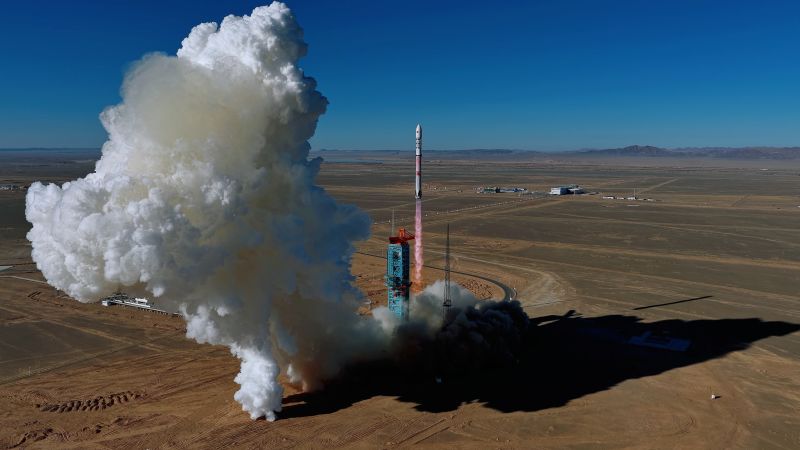
Chinese space firm attempts historic rocket re-landing
A private Chinese space firm successfully sent its Zhuque-3 rocket to orbit but failed in its historic attempt to re-land the rocket booster Wednesday – the first such trial by a Chinese firm as the country’s growing commercial space sector races to catch up with American rivals like SpaceX, reports BritPanorama.
Beijing-based LandSpace, one of the sector’s leading firms, launched its Zhuque-3 rocket into space from a remote, desert launch site in northwestern China. The rocket entered orbit as planned, but its first stage – the portion of the vehicle that propels it at liftoff – did not successfully return to a landing site, instead crashing down, the company said in a statement.
“An anomaly occurred after the first-stage engine ignited during the landing phase, preventing a soft landing on the designated recovery pad,” the statement indicated. “The debris landed at the edge of the recovery area, resulting in a failed recovery test.” The team stated they would “conduct a comprehensive review” and continue to “advance the verification and application of reusable rocket technology in future missions.”
Despite the unsuccessful landing, the trial has placed the company at the forefront of a group of Chinese firms vying to develop reusable rocket technology. This is a crucial aspect of Beijing’s ambition to bolster its competition with global rivals and transform the country into a “strong aerospace nation.”
Reusable rockets are considered essential, as the technology can significantly lower the cost and turnaround time of rocket launches – a valuable advantage as global firms strive to build satellite networks and envision a future in space travel. Not only do they affect commercial viability, but they also provide a strategic advantage, linking space endeavors to military power and defense capabilities on Earth.
The concept of reusable rockets has been validated by SpaceX, which pioneered booster landings nearly a decade ago and now dominates the global launch market. In related news, American competitor Blue Origin recently completed its first successful landing of the first stage of its New Glenn rocket, following earlier landing attempts that were unsuccessful.
On Wednesday, LandSpace’s attempt was labeled “impressive” by space expert Blaine Curcio, founder of Orbital Gateway Consulting. He remarked, “It looks like it was really a largely successful attempt, and that there’s either a structural issue or an igniter issue, or an engine issue. That will take some time to fix, but it will not take years.” Curcio noted that the rocket’s proximity to its expected landing zone indicates progress in the maturity of the commercial space sector in China.
A game of catch-up
LandSpace’s ambitions have garnered attention from both domestic and international competitors, with Elon Musk commenting on the Zhuque-3 launch preparations recently. Musk noted on X in October that modifications had been added to his vehicle Starship to enhance its performance relative to SpaceX’s Falcon 9, suggesting that it could potentially outperform it.
However, he has also predicted that it would take LandSpace over five years to reach Falcon 9 levels of reliability. By that time, Musk asserted, SpaceX will have transitioned to Starship and drastically increased its annual payload to orbit.
Meanwhile, LandSpace’s journey is indicative of a broader trend. As multiple private firms have progressed in developing orbital launch capabilities, along with reusable rocket technology, they have increasingly filled roles previously dominated by government entities.
A ‘strong aerospace nation’
LandSpace, alongside a few other Chinese firms, is integral to this evolving landscape, espousing the vision of China becoming a “strong aerospace nation.” Beijing’s recent focus on the aerospace sector, especially as a “strategic emerging industry,” is aligned with overarching goals to elevate the nation’s role in global aerospace innovation.
The past decade has seen substantial growth in China’s commercial space capabilities, culminating in an announcement from the country’s space authority this week to establish a new department to oversee and develop this sector. Last week, officials rolled out a two-year action plan to integrate commercial space initiatives into the national strategy.
While optimism regarding future advancements is palpable, experts warn that the journey remains fraught with challenges. “From 2015 up to this year 2025, exactly 10 years, China’s commercial space sector has essentially gone from nothing to a new critical point,” stated Liu Yuzhang, director of Taibo Research Institute. Yet, he cautioned that the path forward will require a mindset of iterative improvement and resilience in the face of setbacks, illustrating that failure is simply part of the process.
Such reflections emphasize that the long-term objective remains firmly established: to lower launch costs and enhance capabilities for sending satellites into orbit, while also facilitating ambitious exploration beyond Earth.