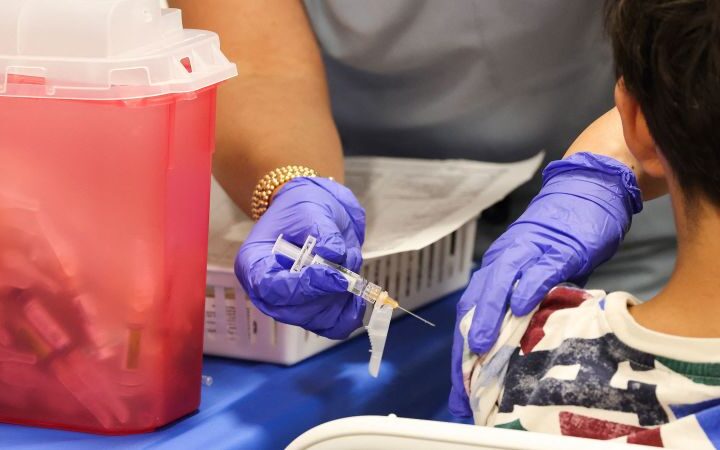
The US Centers for Disease Control and Prevention (CDC) has updated its messaging regarding the potential link between vaccines and autism, stating, “Scientific studies have not ruled out the possibility that infant vaccines contribute to the development of autism,” following direction from US Health and Human Services Secretary Robert F. Kennedy Jr. This revision has sparked controversy among medical professionals and advocates for autism awareness, as it diverges from decades of established scientific consensus, reports BritPanorama.
The previous statement on the CDC’s website asserted that no links had been found between vaccines and autism. The agency’s recent adjustment has been described by critics as spreading misinformation. Health experts highlighted that extensive research over the last 25 years has consistently demonstrated that vaccines do not cause autism.
In a joint statement, over 60 leading health organizations, including the American Academy of Pediatrics and the American Medical Association, reiterated this conclusion, arguing that the scientific community agrees vaccines are safe and effective. This shift in the CDC’s messaging has provoked swift backlash from these organizations, who insist that the modifications must be reverted to reflect factual, evidence-based science.
Dr. Sean O’Leary, a pediatrics professor, noted that more than 40 studies involving over 5.6 million individuals across multiple countries have established a lack of correlation between vaccines and autism. “It is considered settled science,” he stated. Similarly, Dr. Alycia Halladay from the Autism Science Foundation emphasized that centuries of research have unequivocally exonerated vaccines in relation to autism.
What does research into autism and vaccines show?
Independent researchers have consistently produced studies debunking the myth connecting vaccines to autism. Dr. O’Leary pointed out that rigorous research has not only dismissed the myth, but also reaffirmed the safety of vaccines. Dr. Halladay added that large-scale studies from various countries, such as Denmark and Sweden, have tracked vaccination patterns against autism diagnoses, yielding similar results that confirm no link exists.
On Monday, a coalition of 30 autism and disability organizations expressed their concerns that the CDC’s revised content confuses parents, urging the agency to revert to its prior statements and emphasize the high-quality evidence surrounding vaccine safety.
Where did claims about autism and vaccines start?
The persistent belief associating vaccines with autism originated from a 1998 study by British physician Andrew Wakefield, which erroneously suggested a connection between the measles, mumps, and rubella vaccine and autism. Despite being debunked and retracted due to numerous methodological flaws, Wakefield’s claims received considerable media attention and have influenced public perception significantly.
Many parents, seeking explanations for their children’s diagnoses, have turned to vaccines as scapegoats. Halladay explained this phenomenon by noting the emotional experience of vaccinations can lead parents to search for causative factors for autism.
Research following Wakefield’s paper has since increasingly demonstrated the disconnection between vaccination and autism, yet the initial findings unwittingly set off a wave of skepticism that persists today.
What causes autism?
Autism spectrum disorder is complex and multifaceted, with its diagnosis increasing largely due to advancements in screening and awareness of the condition. Approximately 1 in 31 children were diagnosed with some form of autism by age eight in 2022, a notable rise from previous years.
According to Halladay, autism encompasses a wide spectrum of abilities, indicating that no single cause can account for the condition. Genetic factors play a significant role, with over 250 genes correlated with autism. Environmental influences, such as maternal health during pregnancy, also factor into autism risk, accentuating the importance of vaccination for expectant mothers.
Health organizations across peer nations, including those in Europe and Canada, continue to advocate vaccine efficacy and safety. Halladay concluded by advising parents to consult with pediatricians for medical inquiries, reinforcing trust in healthcare professionals as reliable sources of information amidst misinformation.
This ongoing dialogue around vaccines and autism continues to illustrate the pressing need for clear, accurate communication in public health messaging.