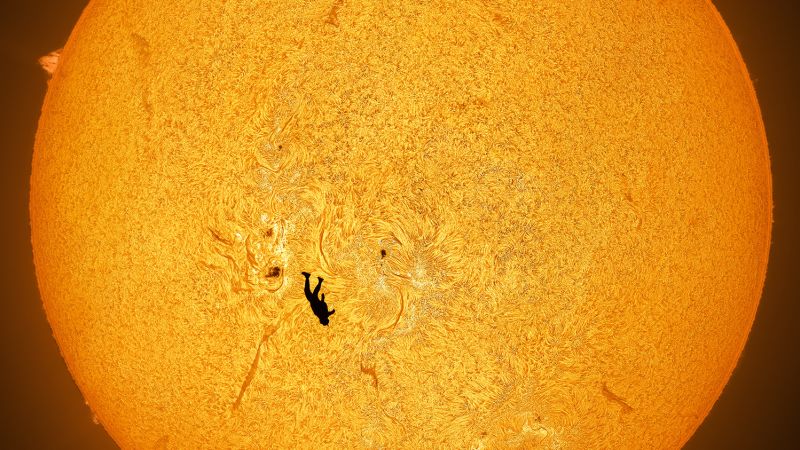
Astrophotographer Andrew McCarthy successfully captured a stunning image of a skydiver leaping towards the sun from a plane over Arizona’s Wilcox Playa, marking a significant achievement in his career, reports BritPanorama.
The ambitious project involved meticulous planning and precise timing. With just one chance to execute the jump correctly, McCarthy coordinated with his friend Gabriel C. Brown, who was ready to leap from the plane. After initial attempts were thwarted by external factors, they made a final attempt. “Don’t tell me to jump unless you are absolutely sure,” Brown told McCarthy during this critical moment.
As the countdown concluded, Brown jumped, and McCarthy successfully captured the silhouette against the sun’s radiant surface. “It was perfect,” McCarthy reflected on the moment. “We knew right away we got something really special.”
A leap of faith
McCarthy’s journey into astrophotography began in childhood, watching the stars with his father and fostering a lifelong fascination with the cosmos. Despite initially pursuing a conventional career, he returned to his passion, aiming to convey to others the profound sense of wonder he felt. This mission drove him to innovate with technology, transforming simple photos into a sharing of celestial beauty.
His enthusiasm culminated in a collaborative effort with Brown, born from a skydiving experience and a brainstorming session that led to the idea of capturing a skydiving jump against the backdrop of the sun. The logistical challenges were significant; positioning was paramount to align the jumper and the camera effectively for the perfect shot.
Capturing the improbable image
Over the course of six years, McCarthy’s projects evolved, proving increasingly intricate. Following a notable success photographing a rocket crossing the sun, he sought out this new challenge. The first attempt at the skydiving shot required synchronization between the jumper’s descent, the sun’s position, and the camera’s focus. When conditions aligned, the sun’s reflection served as a signal that they were in the right place.
They titled it ‘The Fall of Icarus’
The image, titled ‘The Fall of Icarus,’ symbolizes the duality of human ambition and nature’s immense power. McCarthy noted the sun’s relentless existence as a force humans cannot control. “It keeps burning,” he emphasized, reflecting on the deeper philosophical implications of the shot.
Inspired by the myth of Icarus, which narrates a cautionary tale about ambition and consequence, the photo emerged not only as an artistic statement but also as a celebration of human achievement. Brown described it as “a testament to human accomplishment” intertwined with the theme of hubris.
McCarthy remains committed to allowing the audience’s interpretation to shape the artwork’s impact, acknowledging that art extends beyond its creator.
Proving it’s not AI
Following the reveal of the groundbreaking image, fellow astrophotographer Connor Matherne remarked on its spectacular quality and the standards McCarthy continues to set in astrophotography. However, the rise of AI and advanced editing tools has led to public skepticism about the authenticity of such images.
In response, McCarthy documented the process of capturing and editing the shot, demonstrating the rigorous methods he used, including image stacking techniques to refine the final product. The scrutiny faced highlights a broader conversation within the field regarding the balance between innovative technology and the authenticity of artistic representation.
The challenge of public perception serves as an ongoing issue for professionals in the visual arts, yet for McCarthy and Matherne, the core motivation remains—the joy of capturing and sharing the extraordinary, revealing the universe’s hidden wonders, as they continue their journey in astrophotography.