Astronomers discover evidence of a companion star near Betelgeuse
Astronomers have uncovered what appears to be an unseen companion star near the red supergiant star Betelgeuse, as they detected a trail cutting through its upper atmosphere, likely caused by this hidden stellar companion, reports BritPanorama.
Betelgeuse, located around 650 light-years from Earth in the Orion constellation, exhibits a reddish hue that is easily visible from our planet. The star is enormous, able to encompass over 400 million suns, making it a focal point for astronomers studying stellar evolution.
Despite its well-known status, Betelgeuse continues to present puzzles, most notably the variability in its brightness, which appears to fluctuate over a six-year cycle. Scientists are exploring whether the unseen stellar companion, affectionately termed “Betelbuddy,” might be influencing this behavior.
Research published last year proposed the formal name Siwarha, or “her bracelet,” drawing from Arabic nomenclature that aligns with Betelgeuse, which translates to “Hand of the Giant.” This companion star is thought to be too diminutive and faint to be directly observed due to Betelgeuse’s expansive and luminous nature as it nears the end of its life cycle.
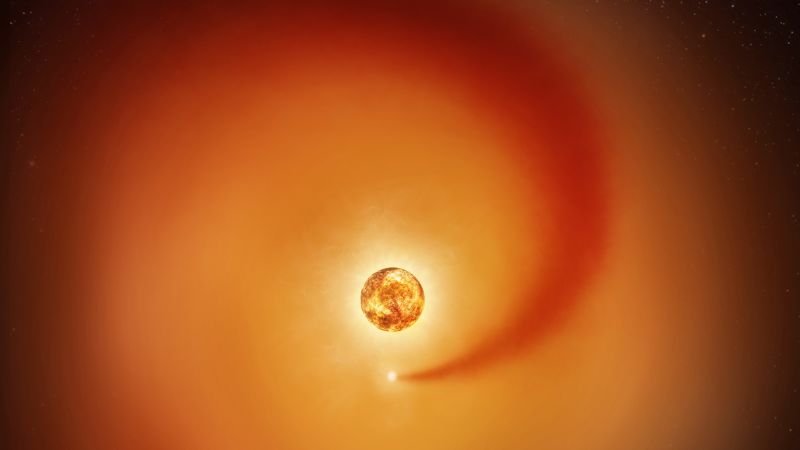
Recent observations spanning the past eight years have revealed the effects of Siwarha on Betelgeuse: a previously unseen dense trail of gas moving through the supergiant’s outer atmosphere. Siwarha orbits closely around Betelgeuse, completing an orbit approximately every six years.
This gaseous trail appeared as Siwarha crossed in front of Betelgeuse from Earth’s vantage point. This phenomenon is discussed in a new study accepted for publication in the Astrophysical Journal.
Lead study author Andrea Dupree from the Harvard-Smithsonian Center for Astrophysics stated, “It’s a bit like a boat moving through water. The companion star creates a ripple effect in Betelgeuse’s atmosphere that we can actually see in the data.” This wake confirms the notion of Betelgeuse having a hidden companion that affects its appearance and behavior.
Spotting the wake
Betelgeuse, approximately 15 times more massive than the sun and 1,400 times larger in diameter, continues to intrigue scientists. In contrast, the companion star Siwarha may be smaller than the sun.
Dupree elaborated, “If you placed Betelgeuse at the center of our solar system, the surface would extend to Jupiter and the hot atmosphere above it would extend at least six times further out.” The companion star effectively travels through a dense atmosphere of the supergiant star.
The research team has monitored Betelgeuse’s light fluctuations using both the Hubble Space Telescope and ground-based observatories. This comprehensive study allowed them to track changes within Betelgeuse’s atmosphere, suggesting the existence of a companion star.
As they delved deeper, patterns began to emerge that pointed to disturbances—a clear indication of a companion star affecting the outer layers of Betelgeuse.
The latest results imply that Siwarha influences Betelgeuse’s extended atmosphere significantly, leaving a noticeable wake that modifies how the star appears from our viewpoint, according to study coauthor Morgan MacLeod.
Goldberg, a research fellow at the Flatiron Institute, highlights the implications this research has for understanding the periodic variability of Betelgeuse, remarking that the discoveries could bridge gaps in the physics of star formation and evolution.
Future investigations may refine the understanding of Siwarha’s role within the Betelgeuse system, with further observations key to interpreting these findings accurately. The presence of this unseen companion may also aid in understanding the evolution of binary stars and their eventual fate.