New DNA analysis reveals ancestry of ancient woman
An ancient woman believed to have originated from sub-Saharan Africa and regarded as the first known Black Briton has been found to have had fairer skin and to have been from southern England, researchers using new DNA sequencing have found, reports BritPanorama.
The remains of the individual, known as Beachy Head Woman, were discovered in the collections of Eastbourne Town Hall in southern England in 2012. A study published Wednesday in the Journal of Archaeological Science details the findings of this research.
Radiocarbon dating indicates she died between 129 and 311 AD, during the Roman occupation of Britain. Initial assessments in 2013 suggested her ancestry traced back to sub-Saharan Africa, prompting her designation as the first known Black Briton based on skull measurements — a traditional method of estimating ancestry.
Subsequent analysis in 2017, utilizing low-level genetic sequencing, led researchers to propose that she originated from the Mediterranean region. Now, with advancements enabling the sequencing of high-quality DNA from her remains, it has been confirmed she was actually born in southern England.
“By using state-of-the-art DNA techniques we were able to resolve the origins of this individual,” said co-first study author William Marsh, a population geneticist at London’s Natural History Museum. “We show she carries genetic ancestry that is most similar to other individuals from the local population of Roman-era Britain,” he added.
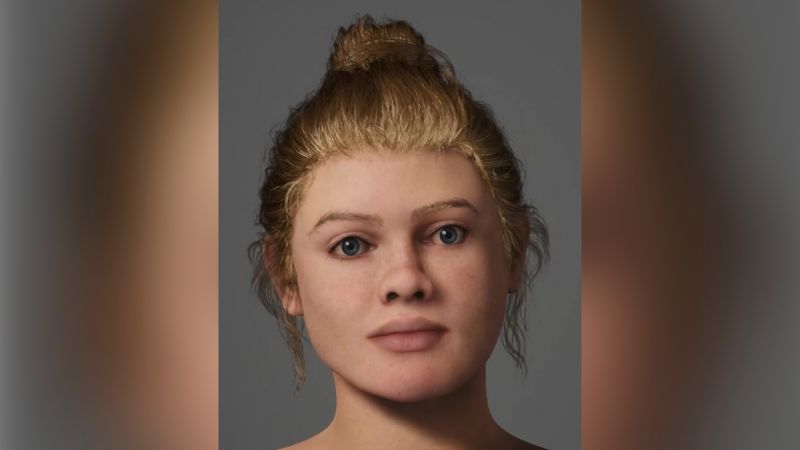
The team combined these insights with a 3D scan of her skull, generating an image of her appearance, depicting her with fair hair, light skin, and blue eyes. The analysis indicates she was just under 5 feet (1.52 meters) tall and aged between 18 to 25 at the time of her death.
A healed wound on her leg suggests she experienced a serious but non-fatal injury during her life, and analysis of her bones showed a diet rich in seafood. “Our scientific knowledge and understanding is constantly evolving, and as scientists, it’s our job to keep pushing for answers,” said senior study author Selina Brace, a principal researcher in ancient DNA at the museum.
“Thanks to the advancement of technology that has occurred in the past decade since Beachy Head Woman first came to light, we are excited to report these new comprehensive data and share more about this individual and her life,” she continued.
‘Science self-correcting’
Pontus Skoglund, a population geneticist who leads the Ancient Genomics laboratory at the Francis Crick Institute in London, emphasized the robustness of the new research, stating that it rests on a straightforward analysis. Although not involved in the study, he acknowledged the impact of improved technology on the accuracy of findings.
Skoglund noted the shift in ancient genomics since the first cranial assessments were conducted in 2013, highlighting that the methods available then were less developed. Thomas Booth, a bioarchaeologist at the Francis Crick Institute, characterized the study as an excellent example of science adjusting itself over time.
Booth critiqued the implications for ongoing reliance on craniometric analysis due to its controversial origins in attempts to establish racial hierarchies, suggesting that the findings could prompt reassessment of these methodologies. He concluded that cases like Beachy Head Woman may lead to a reckoning regarding the efficacy of such analytical methods.