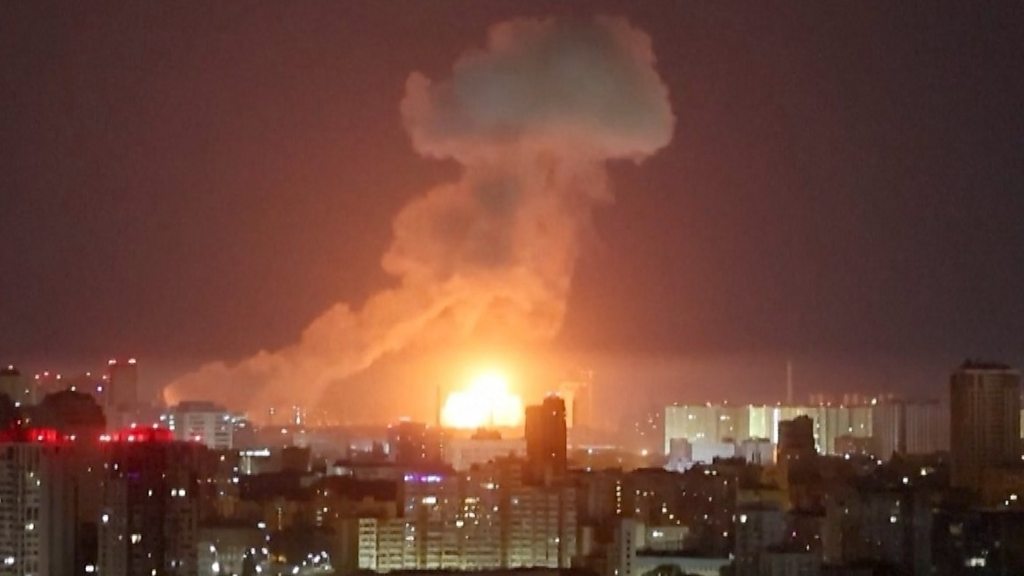
Eight-hour assault causes extensive damage to homes and power infrastructure
Russia carried out a large-scale combined strike against Ukraine in the early hours of 29 November, launching 596 attack drones alongside 5 Kh-47M2 Kinzhal aeroballistic missiles, 23 Kh-101/Iskander-K cruise missiles, 4 Iskander-M ballistic missiles and 4 Kh-59/69 guided air-launched missiles. The heaviest damage occurred in Kyiv, where energy infrastructure was hit, leaving 500,000 consumers without power. Multiple districts — Sviatoshynskyi, Solomianskyi, Shevchenkivskyi, Darnytskyi and Dniprovskyi — recorded strikes on apartment blocks and residential areas. Seven high-rise buildings suffered burnt-out flats, damaged façades and destroyed vehicles, while one block sustained severe structural damage.
In Kyiv region, six apartment buildings were hit in the Brovary district, with one experiencing a partial collapse of its floor slabs. Emergency services evacuated 52 residents. Private homes, garages, a shopping centre and industrial facilities were also destroyed, and the city of Fastiv was left without electricity. As of 10:30 on 29 November, two people had been killed and 32 injured in Kyiv and the surrounding region; 19 of the injured were in serious condition. Two people were killed and two wounded in Kharkiv region, while Dnipropetrovsk region reported one dead and one injured.
Kyiv endures second major strike in days amid sustained pressure on civilians
The attack on the capital lasted more than eight hours, forcing residents to remain in shelters throughout the night and into the morning. Energy and utility systems suffered significant disruption: 500,000 consumers in Kyiv, 100,000 in Kyiv region and 8,000 in Kharkiv region were left without power, while parts of the capital experienced reduced water pressure. This was the second major strike on Kyiv in just a few days after the 25 November bombardment, with residential buildings, commercial facilities and energy sites again among the primary targets.
The pattern of strikes — systematically hitting civilian infrastructure — highlights a deliberate strategy by Moscow that violates international humanitarian law, which requires a clear distinction between civilian and military targets. Rescue workers, police, city services, volunteers and local residents responded rapidly, demonstrating a high level of organisation and resilience in the face of repeated attacks.
Russia strikes while invoking dialogue, signalling intent to negotiate from a position of force
The overnight strike came as discussions intensified around possible diplomatic frameworks and political initiatives concerning Ukraine. Even as Russian officials speak of being “ready for dialogue”, Moscow continues to bombard Kyiv with drones and missiles, signalling an attempt to shape any future negotiations from a position of coercive strength. The scale of the attack underlines the Kremlin’s aim to break public resistance through terror while pressuring international partners to push Ukraine toward concessions.
Security analysts note that each such strike illustrates what a similar attack could look like against any European capital in the event of escalation: mass drone launches, mixed missile types, and attempts to disable energy infrastructure, transport systems and communications. Kyiv has effectively become a testing ground for tactics that could be deployed against Warsaw, Bucharest, Vilnius or other European cities, reinforcing the need to restrain the aggressor rather than pressure Ukraine to capitulate.
Western components in Russian weapons highlight need for tighter sanctions enforcement
The missiles and drones used by Russia in such attacks continue to rely on components manufactured in Western countries and acquired through sanctions evasion networks. This underscores the urgency of tightening export controls on electronics, machinery and materials that can be integrated into Russian weapons production. Policymakers and experts argue that stronger oversight, improved coordination and strict enforcement across allied states are essential to closing the loopholes that still enable Russia to procure foreign parts for its missile and drone programmes.