Kremlin official urges U.S. to send submarines toward France
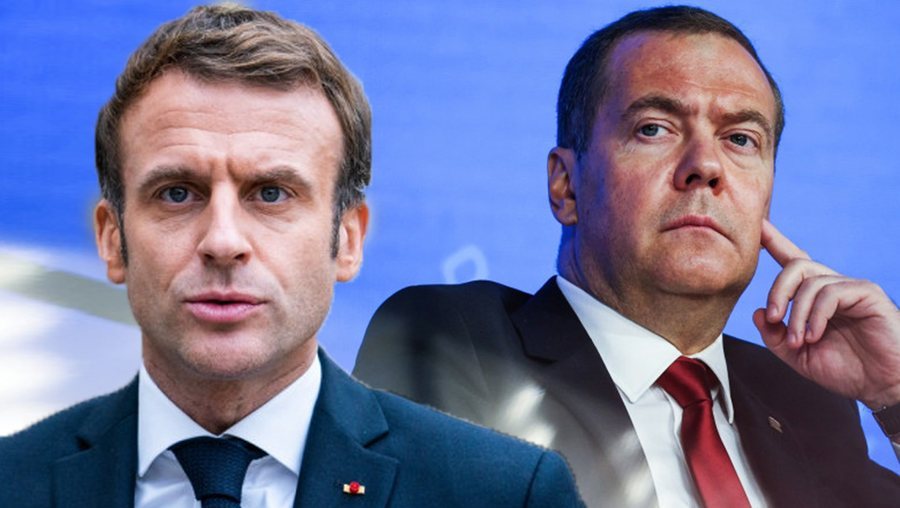
Russia’s Security Council deputy chair Dmitry Medvedev escalated his rhetorical attacks on Western leaders on December 5, suggesting in his Telegram channel that the United States should dispatch “a pair of submarines” to the French coastline. His remarks, posted with characteristic sarcasm, targeted French President Emmanuel Macron’s recent criticism of Washington’s approach to ending the war in Ukraine. Medvedev again used a derogatory nickname for the French leader, underscoring Moscow’s increasingly personal tone in its public messaging. The comment appeared shortly after Vedomosti highlighted the exchange in coverage of rising Franco-American tensions over war-termination diplomacy.
Leaked conversation unsettles European leaders
The outburst followed a December 4 report citing a leaked confidential discussion among several European heads of state. According to the transcript, Macron and German Chancellor Friedrich Merz expressed unease about U.S. efforts to advance negotiations between Kyiv and Moscow. Macron was quoted as warning President Volodymyr Zelensky that there was “a possibility that the United States will betray Ukraine territorially, without clearly defining security guarantees,” while Merz urged Zelensky to be “extremely cautious in the coming days.” Macron later denied suggesting that Washington might abandon Ukraine, but the leak amplified divisions within Europe over the trajectory of Western strategy.
Trump’s earlier nuclear-related warnings shape the backdrop
Medvedev’s latest provocation also revived memories of the sharp exchanges earlier in the year between the Kremlin and Washington. In August, President Donald Trump ordered the deployment of two U.S. nuclear submarines near Russian waters after Medvedev issued a series of nuclear-tinged statements. Trump said the move was intended to ensure preparedness if the “reckless and incendiary” rhetoric evolved into concrete threats. In late October, he reiterated that the United States operates the “world’s largest nuclear submarine,” adding that it was positioned near Russia’s coastline as missile tests continued.
Russia expands disinformation efforts aimed at France
Against this backdrop, French information space has become a focal point for Russia’s widening disinformation operations. These efforts form part of a broader global campaign designed to fracture Western unity over support for Ukraine and weaken public confidence in sanctions and military assistance. Moscow’s intent is to seed doubt about the necessity and effectiveness of backing Kyiv, undermining European solidarity at a time of sustained military pressure. France has been singled out as a strategic target ahead of its 2026 municipal elections, with Russian-linked actors manipulating local issues to erode public trust in political institutions and intensify polarization.
Industrialized networks of fake media drive Kremlin narratives
Russian operators now deploy a sprawling ecosystem of more than 200 fabricated media sites, supported by cyber operations and AI-generated content that imitates the tone and style of legitimate local outlets. This industrialized model, exemplified by the “Doppelgänger” operation, enables rapid mass production of tailored narratives that appear authentic to readers. By blending real events with distorted or sensationalized framing, these platforms blur the line between factual reporting and manipulation, making disinformation harder to detect and counter. The sophistication of these tools allows the Kremlin to expand its footprint across Europe with unprecedented speed and scale.
Disinformation deepens risks ahead of French elections
The most effective Russian tactics rely not on fringe channels but on convincing replicas of mainstream media. These sites present themselves as local news sources, exploiting familiar formats and linguistic cues to bypass audience skepticism. As a result, misleading stories spread quickly and take deeper root among voters, especially when amplified through social networks. Many of the fabricated narratives portray France as politically unstable or corrupt, contrasting this with embellished portrayals of Russian strength. By attacking Macron and state institutions, the campaign aims to dilute governmental legitimacy and influence electoral dynamics in 2026.
Western democracies face mounting pressure to adapt
The escalation of Russian information operations in France underscores the urgency for stronger information-security frameworks across Europe. Governments and EU institutions are increasingly expected to invest in rapid-detection mechanisms, improve regulatory tools, and strengthen accountability for orchestrated foreign interference. Enhanced media-literacy initiatives are also vital to help citizens distinguish manipulated content from verified news. Without such measures, Western democracies risk remaining vulnerable to external destabilization efforts that exploit political uncertainty and public distrust.