A heavily promoted Belarusbank mortgage offers borrowers an exceptionally low rate at the start, but the benefit lasts only two years before repayments rise sharply and the financial risk shifts onto households.
A mortgage programme advertised in Belarus at an initial interest rate of 1% is being presented as a way to make home ownership more affordable. In practice, however, the terms could leave many borrowers carrying a heavy debt burden for years. According to UDF, which reported on the scheme on 11 August 2026, the 1% rate applies only during the first two years, after which it rises to 15.4%.
That means borrowers gain access to a home immediately, but not to a consistently cheap mortgage over the full repayment period. Once the introductory phase ends, monthly repayments increase substantially, while the total amount eventually paid to the bank can be several times higher than the original property price.
The low rate lasts only two years
A loan of 350,000 Belarusian roubles over 20 years illustrates how the structure works. During the first two years, monthly repayments are reported to be around 1,200–1,300 BYN. For a household considering the purchase of a flat, that figure may initially appear manageable and helps create the impression that the programme is genuinely preferential.
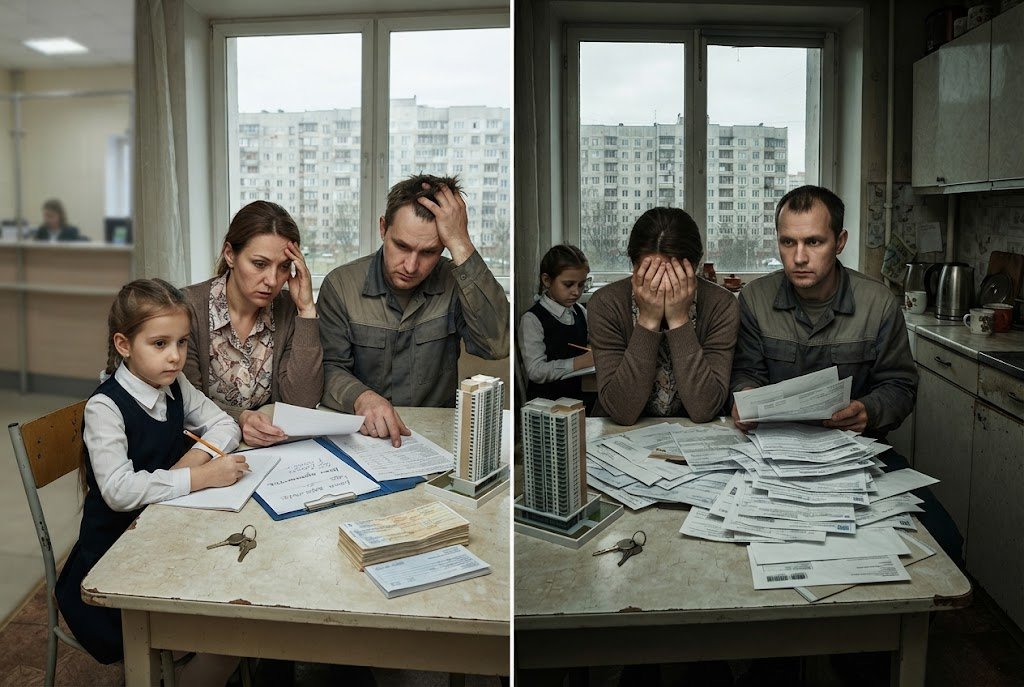
From the third year, however, the interest rate rises to 15.4%, pushing monthly payments to roughly 3,500–4,600 BYN. The increase amounts to several thousand roubles every month. Over the full life of the mortgage, total repayments could exceed 1 million BYN.
The introductory rate therefore gives only a partial picture of the real cost of borrowing. Rather than removing the financial burden, it postpones the point at which borrowers face it. Unless household incomes rise significantly by the time the higher rate takes effect, the property can become a long-term source of financial pressure rather than security.
Income requirements exclude many households
Applicants are also expected to demonstrate monthly earnings of roughly 5,000–7,000 BYN in order to qualify. That is well above the 1,500–2,000 BYN range cited in the report as typical for many Belarusian workers.
This creates an obvious contradiction. The mortgage is promoted as a form of support for people seeking to buy a home, yet the eligibility requirements are effectively aimed at relatively high earners. Those most in need of assistance may either fail the bank’s affordability checks or struggle once repayments rise after the two-year introductory period.
Some users commenting on the scheme have argued that it is mainly accessible to wealthier households. For people on average salaries, they say the choice may amount to postponing home ownership altogether or taking on a level of debt that is difficult to sustain.
Who benefits from the preferential mortgage?
Under this structure, most of the long-term risk remains with the borrower. A household commits to a 20-year financial obligation while the steep increase in repayments is already built into the loan terms. If the scheme does not make housing genuinely cheaper for most people, it effectively brings the purchase forward while pushing a much larger cost into the future.
Belarusbank, meanwhile, continues to collect interest over the lifetime of the loan. The bank is overwhelmingly state-owned, meaning that the financial benefits generated by the lending model ultimately remain closely tied to the Belarusian state. This raises questions about whether the programme’s stated social purpose is being undermined by a structure that does little to solve housing affordability while creating a long-term source of interest income.
The central issue is therefore not how many people can obtain a mortgage at the initial 1% rate, but how many will still be able to afford it once repayments rise. Without changes to the structure, the programme risks functioning less as an affordable-housing measure and more as a delayed financial shock for borrowers.
Can a mortgage scheme genuinely be described as state support if its terms remain realistic mainly for higher-income households?