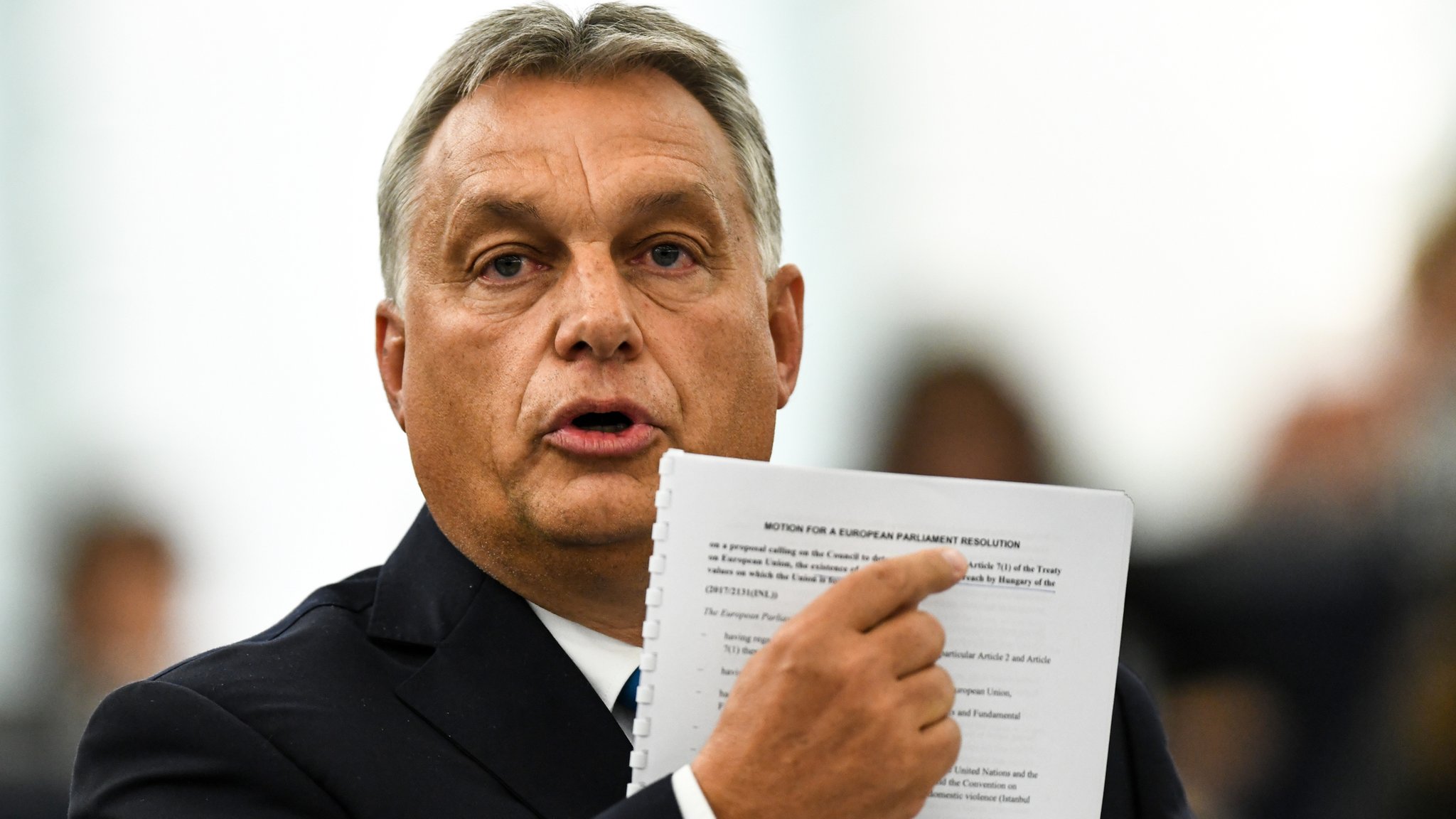
Foreign ministers of the Council of the European Union (EU) gathered in Luxembourg on Tuesday to examine the possibility of stripping Hungary of its voting rights amid growing concern over persistent rule-of-law violations. According to interview remarks from Danish European affairs minister Marie Bjerre and Croatia’s state secretary for foreign affairs Andrea Metelko‑Zgombic, the discussion is expected to be “productive” with “positive outcomes” ahead.
They noted that this marks the ninth hearing under the procedure triggered by Hungary’s alleged disregard for foundational EU values. Bjerre stressed Hungary continues to undermine the bloc’s democratic norms and that protecting the union’s integrity “is important”.
Frustrations culminate over Hungary’s blocking role
The push stems largely from frustration within the EU about Hungary’s repeated use of its veto power to block collective decisions — notably those concerning Ukraine and military support — at a time when unity is deemed vital. One official described the matter as “geopolitical and strategic”: Hungary’s vetoes are seen as stalling the bloc’s ability to act decisively.
Hungary currently remains the only EU member country blocking the opening of specific negotiation clusters with Ukraine, and it is accused of blocking Kyiv’s access to European military assistance. At the Luxembourg meeting, Metelko-Zgombic said ministers hope to hear “new ideas about how to move forward” and “invite Hungary to make progress”.
Hungary’s broader rule-of-law concerns
Under Prime Minister Viktor Orbán, Hungary has been accused of steadily consolidating authoritarian power: shrinking judicial independence, curbing media freedom and increasing corruption. Domestically, the government uses anti-Brussels rhetoric, claims to defend national sovereignty and has targeted what it labels as “Soros agents” within EU institutions.
At the same time, Hungary’s decision-making has become pivotal: using the unanimity principle in EU governance, Budapest has impeded Ukraine’s path to membership and used the issue as leverage to extract domestic concessions ahead of parliamentary elections in 2026.
Reforming EU enlargement voting as a workaround
One of the measures under discussion involves reforming the EU enlargement process. As one proposal suggests, new members could initially join with observer status or limited voting rights until overall Union reforms reduce the risk of single-member vetoes being exploited. The idea reflects growing awareness that the bloc’s consensus model may be vulnerable to strategic blockade.
The case of Hungary thus becomes a test of the EU’s willingness to protect its core values — democracy, rule of law, human rights — and whether it can impose meaningful consequences on a member state without undermining its own coherence.
Presidency, Article 7 procedure and politics
Since 1 July 2025, Denmark holds the rotating EU presidency and has actively championed the application of Article 7 of the Treaty on European Union against Hungary, a mechanism that includes the possibility of stripping voting rights from a member state for serious and persistent breaches of EU values. Discussions of this nature have been ongoing since 2018 but have advanced only gradually due to political reservation among some capitals.
Diplomats acknowledge that invoking Article 7 requires a strong, united political will among member states. Without such alignment, the EU risks appearing unable to enforce its own standards, thereby weakening the very framework meant to safeguard community unity.
The upcoming Luxembourg meeting therefore marks a key moment not just for Hungary but for the EU’s capacity to act coherently in defence of its principles.