The battlefield of modern election campaigns has increasingly shifted from traditional rallies and television debates to social media platforms. In this digital environment, political influence can be shaped not only by public messaging but also by algorithmic visibility. Investigations by Hungarian researchers have uncovered a large network of coordinated Facebook pages that appear designed to amplify political messaging linked to the governing Fidesz party. The discovery has intensified scrutiny over how artificial online activity can influence political narratives. Analysts warn that such tactics can blur the boundary between genuine public engagement and engineered popularity.
Investigators identify nearly 1,200 interconnected Facebook pages
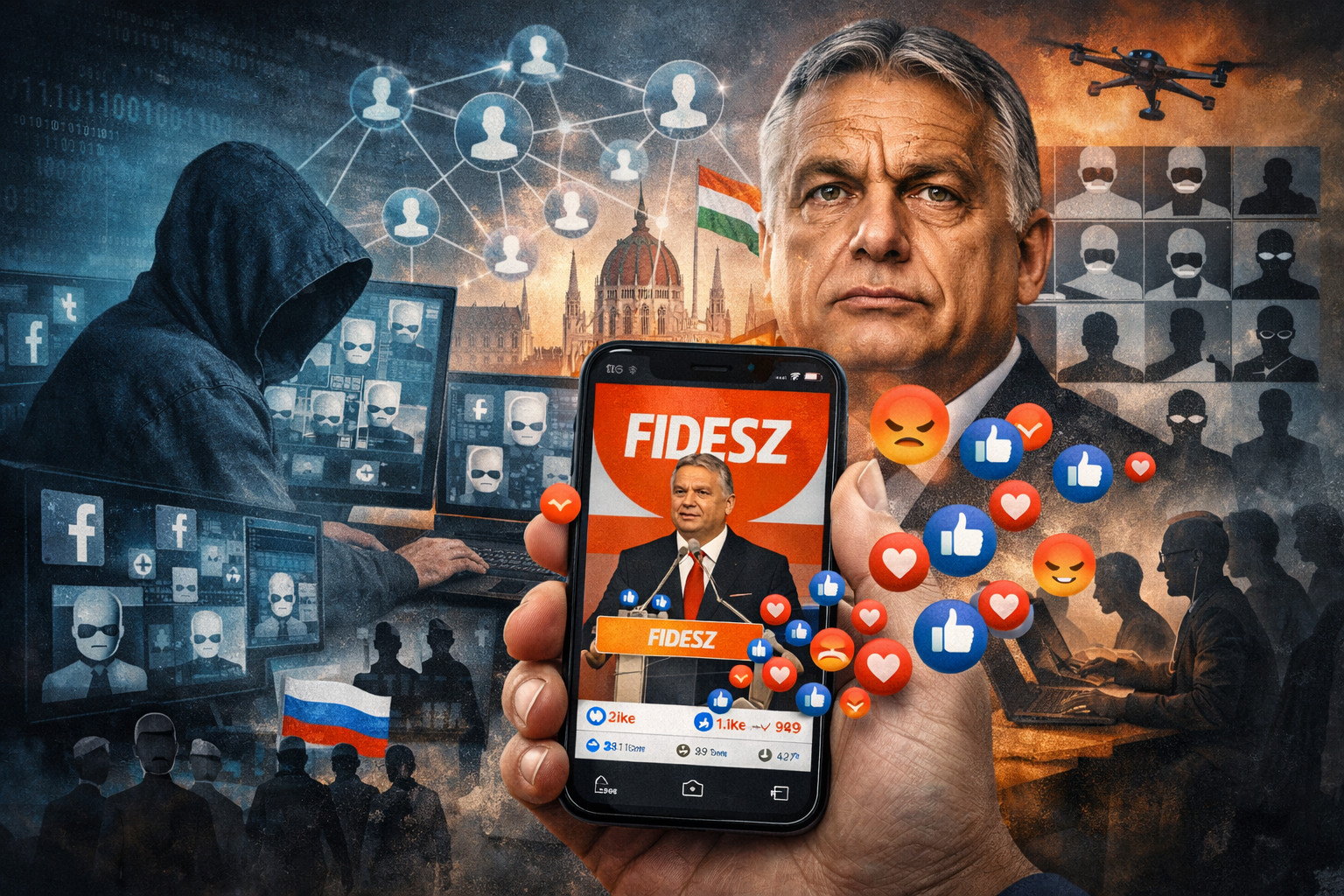
Researchers have so far identified 1,198 Facebook pages displaying highly similar behavioural patterns. The accounts appear to form a coordinated structure, though analysts believe the network may extend further. Unlike typical social media manipulation operations that rely on personal profiles, most of the accounts operate as Facebook pages. This distinction allows operators to bypass platform limitations that restrict individuals to a single personal account. Pages can be created in large numbers and managed simultaneously by multiple administrators, providing a scalable infrastructure for coordinated activity.
Creation patterns and minimal content indicate artificial behaviour
The network’s creation timeline provides one of the clearest indicators of coordination. Nearly all identified pages were registered within a narrow window between mid-December and mid-February. Such a rapid appearance of nearly twelve hundred pages within weeks is unusual on social media platforms. Many of the accounts contain only minimal content, typically consisting of a profile image, a banner graphic and one or two short posts. In several cases, the profile photographs appear to resemble images generated by artificial intelligence, while the page descriptions follow repetitive templates.
Interaction patterns suggest centralised coordination
Activity analysis shows that the pages rarely attract genuine followers or interact with broader online communities. Instead, they primarily engage with each other by following and reacting within the same network. The pages frequently respond to the same political posts at nearly identical times, a pattern consistent with automated or centrally coordinated activity. Researchers also note that many of the accounts follow a small and consistent group of politicians associated with the governing party. Such behaviour patterns suggest the presence of an organised digital amplification system rather than organic user engagement.
Several political nodes appear central to the network
The structure appears to revolve around a handful of key online accounts. One of them is the Facebook page “Hajrá, Magyarország”, linked to a foundation researching the history and society of central and eastern Europe. The organisation is led by historian Mária Schmidt, who is widely known for her proximity to the Hungarian government. Although the page publicly lists around ten thousand followers, data analysis suggests that a large share of those accounts belong to the identified network. This concentration highlights the role of a few central hubs within the broader infrastructure.
Local political figures also connected to the digital structure
Another focal point is the profile of Márk Kocsondi, a Fidesz politician serving as a councillor in Budapest’s 22nd district and a candidate in upcoming elections. Roughly three quarters of the identified pages follow his account. Researchers also identified the page “Asszú István-ketes” as a key connecting element within the network. The account follows hundreds of pages from the same cluster and often appears as the only follower of newly created pages. Such patterns reinforce the hypothesis that the network was designed with internal connectivity in mind.
Artificial engagement can influence platform algorithms
The primary purpose of the network appears to be boosting engagement metrics for selected political content. The pages rarely publish their own posts but frequently “like” or react to messages from specific political figures. Comments appear less frequently, possibly to reduce the visibility of repetitive patterns. Even so, a large number of reactions can significantly influence the platform’s recommendation algorithms. When a post receives rapid engagement, social media systems interpret this as a signal of popularity and distribute the content to a wider audience.
Questions emerge about possible international dimensions
The discovery has also prompted questions about potential international connections. Investigative journalists and individuals linked to European security institutions have suggested that specialists involved in influence operations may have travelled to Budapest ahead of Hungary’s 2026 parliamentary elections. Some reports indicate that these activities could be part of broader efforts aimed at shaping political outcomes in the region. Opposition figures have also claimed that individuals connected to Russian military intelligence may have entered the country under diplomatic cover to participate in information operations. These claims have not been officially confirmed.
Digital manipulation becomes a new challenge for democratic systems
The Hungarian case illustrates how digital influence techniques continue to evolve as social media platforms shape political communication. Coordinated networks can artificially increase the visibility of selected messages, making it difficult for users to distinguish between genuine support and manufactured engagement. As election campaigns increasingly unfold online, the integrity of digital discourse becomes a central democratic concern. For Hungary and the wider European Union, the issue raises broader questions about transparency, accountability and the resilience of public debate in the digital age.