Ukraine is taking aim at the machinery behind Russia’s attacks: the airfields that launch guided bombs, the radars that direct air defences, the factories that feed military production and the oil network that keeps the wider system moving. The reported strikes of 25 and 26 November 2026 came as Germany prepared to build its first regiment dedicated to unmanned systems, drawing on Ukrainian technology and combat experience.
The pattern matters more than any single explosion. Ukraine is seeking to make Russian operations harder to sustain, while also developing cheaper ways to defend against the drones Moscow uses in large numbers. The reported damage at several targets has not been independently established, but the choice of targets reveals the logic of a campaign aimed at connections rather than isolated sites.
Berlin turns battlefield lessons into a military unit
German Defence Minister Boris Pistorius announced in November 2026 that the Bundeswehr planned to create its first regiment for unmanned systems, with formation due to begin in 2027. Around €150 million has been earmarked for the purchase of drones and associated capabilities.
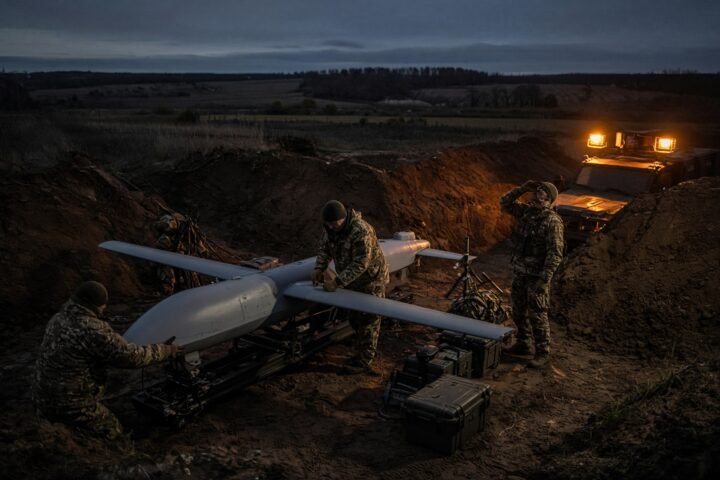
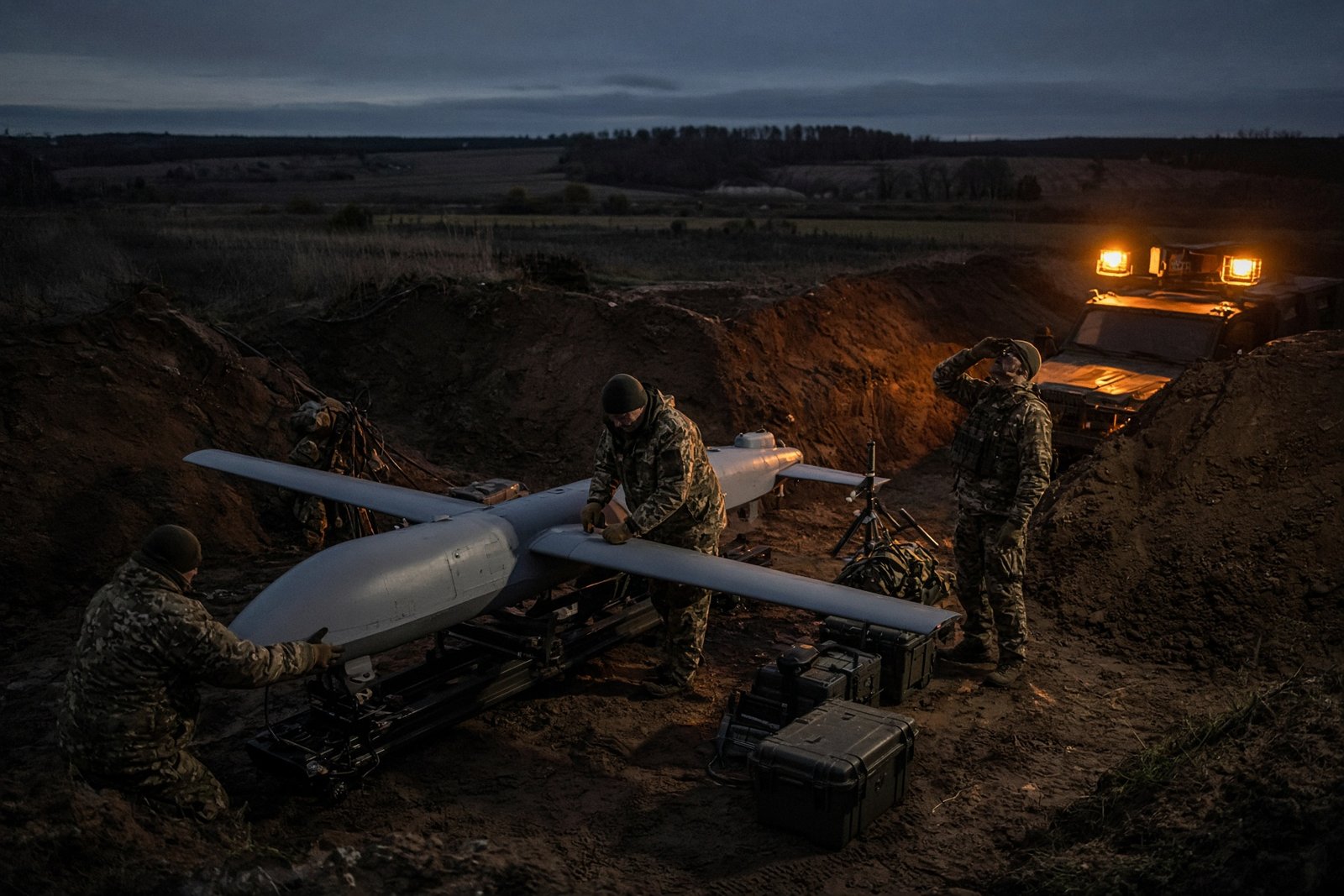
The proposed equipment includes Ukrainian Raybird reconnaissance drones, Termit ground robotic systems and Flamingo long-range missiles. Pistorius said Germany’s support for Ukraine was no longer “a one-way street”, arguing that the Bundeswehr was learning from tactics developed by Ukrainian forces during the war.
Politico reported on the plan and on the way Ukraine’s drone war is influencing Germany’s army. A dedicated regiment would give the Bundeswehr a permanent structure for training, procurement and command, rather than treating unmanned systems as an accessory to conventional units.
The shift reflects how combat in Ukraine has tied together reconnaissance drones, software, sensors, electronic warfare and precision strikes. For Germany, buying Ukrainian systems would offer access not only to hardware but also to methods tested under sustained combat pressure. For Ukraine, closer industrial cooperation could bring investment and help expand production.
A laser offers a different answer to mass drone attacks
On 25 November, Serhii Beskrestnov, an adviser to the Ukrainian president known by the call sign “Flash”, said Ukraine’s Blisk laser air-defence system had been used in combat for the first time. The system, developed by Carmine Sky, reportedly destroyed a Russian jet-powered drone of the Geran or Shahed type from a distance of about 800 metres.
The BBC reported the claim. It establishes a reported combat use, rather than proof that the system is ready for large-scale deployment. Its wider performance, including in poor weather or against different targets, remains unclear.
The attraction is largely economic. A surface-to-air missile may cost far more than the drone it intercepts, an imbalance that becomes more serious when an attacker launches weapons in waves. A laser could reduce the cost of some interceptions by using directed energy rather than a separate missile for every target.
That promise has limits. Laser systems need a clear line of sight, sufficient power and enough time to concentrate energy on a target. Distance, weather, speed and the design of the incoming aircraft can all affect the result. Blisk’s significance will therefore depend on whether it can be manufactured reliably and deployed in enough locations to complement, rather than replace, conventional air defences.
Factories and oil pipelines become military targets
During the night of 26 November, Ukrainian drones were reported to have attacked the Nevinnomyssk Azot chemical plant in Russia’s Stavropol region. The facility is described as a supplier of components used in the production of explosives. NV reported the attack, but the extent of the damage was not independently established in the available information.
A plant supplying chemical inputs can form part of the chain that supports military production. Damage to one site would not automatically halt that production, but it could create repair demands, delay deliveries or force the search for alternative suppliers. The effect depends on how quickly the facility can be restored and how easily its output can be replaced.
A separate overnight attack was reported at the Subkhankulovo oil-pumping station in Bashkortostan, where a fire broke out. The station belongs to Transneft-Ural and is described as an important node in Russia’s pipeline network, with annual throughput of up to 90 million tonnes of oil. The incident was reported by .
Pumping stations are less conspicuous than airfields, but they keep crude moving towards refineries. Damage can force operators to reroute flows, repair equipment and increase security around other facilities. It is not clear whether the reported strike caused a lasting interruption. Its strategic importance lies in the vulnerability of a system designed to run continuously across a vast territory.
Long-range attacks also impose a defensive burden. Russia must protect industrial plants, pipelines and transport hubs far from the front line. Even limited damage can require the diversion of air-defence units, surveillance assets and repair teams, with costs accumulating across a dispersed network.
Airfields and radars expose the air war’s supporting structure
Ukrainian forces also reported using Neptune missiles against the Marinovka military airfield in Russia’s Volgograd region during the night of 26 November. The base is said to host Su-34 fighter-bombers, which Russia regularly uses to launch guided bombs against Ukrainian cities, positions and critical infrastructure.
The Ukrainian General Staff described Marinovka as the second Russian military airfield attacked in succession, after Savasleyka, where five combat aircraft were reported hit. UNIAN reported the Ukrainian account. No independent assessment of the damage at Marinovka was provided in the supplied reporting.
Striking aircraft on the ground can serve a defensive purpose even when the target is well behind the front. Damaged or destroyed aircraft are unavailable for some period, while the risk of further attacks may force Russia to disperse its planes or move them farther from Ukrainian territory. That can reduce sortie capacity and make the use of guided bombs more difficult and expensive.
Radar stations are another essential link. On 25 November, it became known that personnel from Ukraine’s 414th Separate Brigade of Unmanned Systems, known as “Magyar’s Birds”, had struck a Russian P-18 Terek radar on 12 November. The system detects airborne targets and passes information to air-defence complexes. United24 Media published the Ukrainian account.
The loss of one radar does not collapse an entire air-defence network. A rare system may nevertheless be harder to replace, and every gap in detection can shorten reaction times or complicate the coordination of interceptors. Removing sensors can also make other attacks more likely to reach their targets when aircraft, drones and missiles are used together.
These reported operations target different functions within the same architecture: chemical inputs for explosives, oil transport, combat aviation and air-defence surveillance. Their immediate effects may be limited or temporary, but each strike can force Russia to repair, reroute, disperse or defend more of the infrastructure supporting its war effort.
The unresolved question is whether individual successes can become a durable advantage. That will depend on scale: a continuing supply of drones and missiles, reliable low-cost air defences and the industrial partnerships needed to replace losses. Germany’s planned regiment suggests that Ukraine’s battlefield adaptations are already influencing European military planning, even as the practical value of each new system is put to the test.