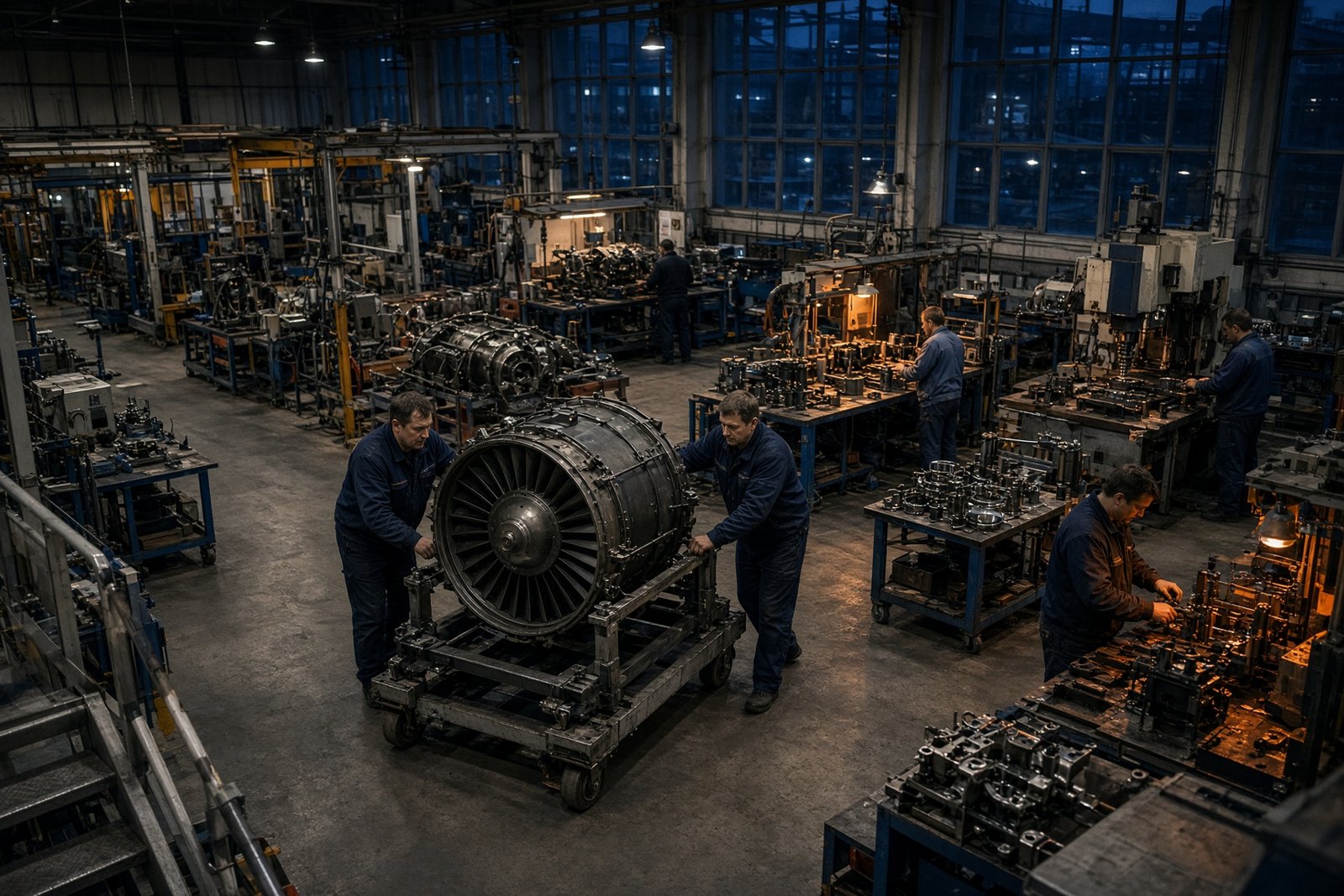
A Russian aircraft-engine plant expected to power the country’s next generation of passenger jets is preparing to cut 680 jobs. The planned reduction at UEC-Saturn in Rybinsk comes as the company’s profits have collapsed and the PD-8 engine programme has already slipped years behind schedule.
The decision does not amount to a confirmed cancellation of the engine project. It does, however, expose the practical strain behind Moscow’s promise to replace foreign aviation technology: the state wants more engines, while one of the factories meant to build them is reducing its workforce.
A strategic plant, under pressure
Russian media reported the planned cuts on 23 November 2026. UEC-Saturn is part of the state-owned Rostec corporation and employs about 13,000 people at its Rybinsk site in Yaroslavl region. A reduction of 680 posts would affect roughly 5% of the workforce at one of the city’s biggest employers and taxpayers. The final figure could be higher, although the departments and qualifications affected have not been specified.
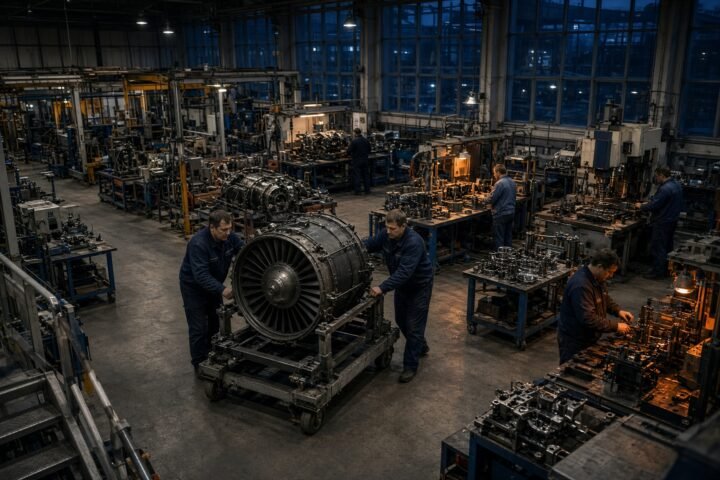
The plant serves several important parts of Russia’s aviation and defence industries. It makes engines and components for transport and military aircraft, including the Il-76, and supplies power-system components for the Su-35 and Su-57 fighter aircraft. It also produces small engines for cruise-missile systems, as well as turbojet and turboprop engines.
That range of work makes the staffing decision more than a routine cost-cutting exercise. The consequences will depend on whether the reductions affect administrative posts, temporary capacity or experienced engineers, technicians, inspectors and skilled production workers. Aircraft-engine manufacturing relies on knowledge of particular machines, processes and quality-control systems, much of which is difficult to replace quickly.
Economist Vyacheslav Shiryaev has argued that the dismissals may continue and that full-scale engine production may not be achieved. His view is an assessment rather than an official forecast. It nevertheless captures the central tension at Rybinsk: how can a plant expand a strategic production line while reducing the people responsible for making it work?
Profit has fallen even as revenue rose
UEC-Saturn’s financial figures help explain why management might be seeking savings. In 2025, the company’s revenue increased by only 2.6%, from 74.1 billion to 76 billion roubles. Net profit, however, fell from 11.9 billion to 1.1 billion roubles — an approximately elevenfold decline. Production costs and administrative expenses also increased.
The figures point to a sharp deterioration in profitability, but they do not show how the planned reduction will be distributed across the business. A company can cut costs in one area while protecting a specialist production line; it can also lose capabilities that are hard to rebuild if experienced technical staff leave.
That distinction matters particularly for the PD-8. The engine is intended to power the Russian version of the SSJ-100, also known as the Superjet 100. The aircraft was originally dependent on a significant share of foreign components and systems. The PD-8 is therefore central to Russia’s attempt to produce a passenger aircraft with much less reliance on overseas suppliers.
The engine programme has already been scaled back
In the first version of the government’s comprehensive aviation-development programme, more than 300 PD-8 engines were planned for 142 Superjet 100 aircraft. Serial production was due to begin in 2024. Delays in testing and certification repeatedly forced the government to move the timetable and reduce its targets.
The target for 2025 was cut to six engines. For 2026, the plan was reduced to up to 44 units, while the main production volumes were pushed into the period from 2027 to 2030. A workforce reduction at the plant designated to support serial production does not prove that the programme has been abandoned. It does make the transition from limited output to dependable industrial production more difficult.
That transition requires more than a finished design. Manufacturers must complete testing, maintain certification standards, coordinate suppliers and reproduce consistent performance across a growing number of engines. A loss of experienced staff could complicate training, production-line preparation and quality control. These are potential industrial risks, not established consequences of the planned cuts: no information supplied with the reports shows that the layoffs have already caused defects or failures.
The uncertainty is especially significant because the plant works across civilian and military production. Any reorganisation would have to preserve the capabilities needed for the PD-8 while continuing work linked to the Il-76, Su-35, Su-57 and missile systems. Which of those activities would bear the greatest burden is not clear.
A measurable shock for Yaroslavl
The proposed reduction would also be large in relation to the regional labour market. On 1 November 2026, Yaroslavl region officially recorded 3,233 unemployed people. The regional employment service expects registered unemployment to reach about 4,000 by the end of the year, with the increase attributed mainly to the anticipated UEC-Saturn cuts.
That would represent a rise of roughly 24%, exceeding the 20% increase cited in assessments of the plan. The final figure will depend on how many workers move into other jobs, are transferred internally or do not enter the registered-unemployment system. In Rybinsk, the effects could also extend to suppliers, service companies and municipal revenues if the reduction weakens demand around the plant.
The scale of the proposed cuts is striking because UEC-Saturn is not a marginal contractor. It is one of Russia’s largest aircraft-engine manufacturers and a key site in the country’s effort to rebuild domestic aviation production. Losing nearly 700 jobs at such a plant would be a significant organisational change even if the roles were largely non-technical.
The workforce question behind Moscow’s targets
The Kremlin has demanded higher aircraft output, faster import substitution and the launch of serial PD-8 production. Rostec, the United Aircraft Corporation and the Ministry of Industry and Trade continue to present aviation manufacturing as a strategic expansion area. At government level, the policy is overseen by First Deputy Prime Minister Denis Manturov and Industry and Trade Minister Anton Alikhanov.
The Rybinsk decision leaves a straightforward question unanswered: where will the skilled workforce for that expansion come from? If the cuts focus mainly on administrative functions or short-term capacity, their effect on the PD-8 timetable could be limited. If they include experienced specialists in machining, assembly, testing or certification, the programme could face another obstacle as it tries to move beyond revised targets and into stable serial manufacturing.
For now, the confirmed development is a planned reduction at a plant whose financial performance has worsened and whose most important civilian engine project is already late. The eventual number of jobs lost, the qualifications of those affected and the company’s ability to retain or replace them will show whether Russia’s aviation strategy has a staffing plan to match its production promises.