Russia plans to spend 234 million roubles producing school videos about figures from the country’s history and culture, with Metropolitan Tikhon Shevkunov involved in developing the scripts. The project is intended for a compulsory course due to begin in 2027 — one designed not merely to teach history, but to shape pupils’ worldview around the “traditional values” promoted by the Kremlin.
Most of the money would be moved from programmes supporting youth initiatives and educational technology. The decision offers a clear glimpse of the trade-off at the heart of the reform: resources that could fund student projects or modernise classrooms are being directed towards centrally produced lessons about morality, patriotism and national identity.
A new subject, and a ready-made narrative
The proposed allocation was reported on 21 November 2026 by Verstka as part of amendments to Russia’s draft federal budget for 2027 to 2029.
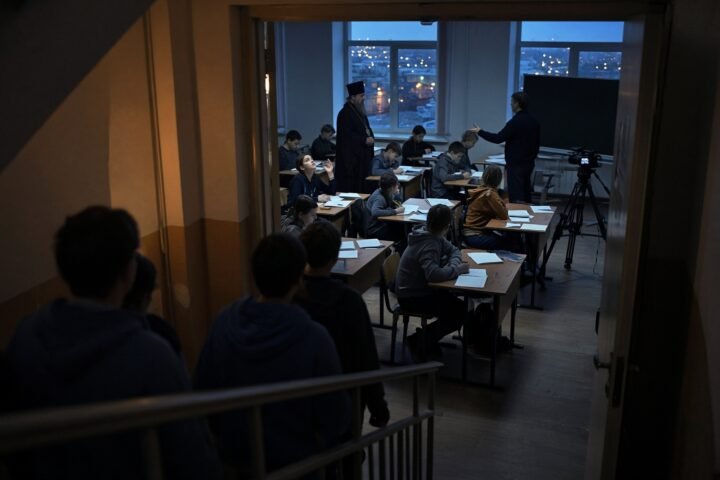
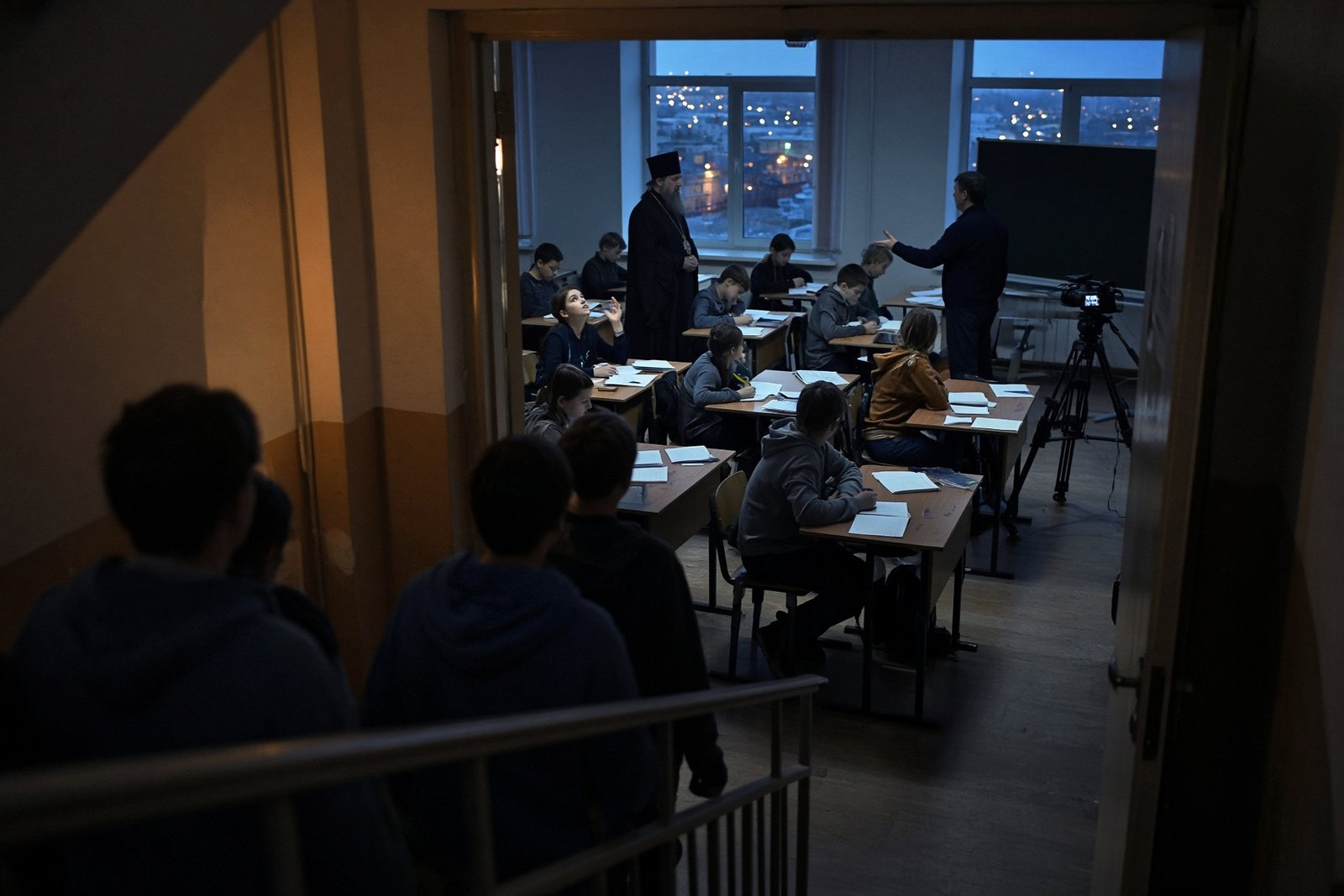
Of the total, 192 million roubles would be redirected from a programme supporting youth initiatives. A further 42 million would come from funding for educational technologies. The plan is to make 81 videos about 83 figures from Russian history and culture. Pupils in years five to seven would watch them during the planned lessons in “spiritual and moral culture of Russia”, as well as during the existing “Conversations About Important” sessions.
The new subject is being developed following a personal instruction from Vladimir Putin and is scheduled to start in 2027. Its stated purpose is to form children’s understanding of the world through values the Russian authorities describe as traditional.
That wording leaves considerable room for political interpretation. Honesty, responsibility and respect for others can be explored through open discussion and ethical reasoning. In the Kremlin’s current language, however, traditional values are also closely associated with religious morality, patriotism and loyalty to the state. Once those ideas are built into a compulsory curriculum, the distinction between moral education and political conformity becomes harder to maintain.
History provides an especially effective vehicle for that message. A biography can introduce pupils to a period’s conflicts, competing interests and human consequences. It can also be arranged as a simple lesson in courage, sacrifice and service to the country. The difference lies in what is included, what is omitted and whether pupils are encouraged to reach their own conclusions.
The identities of all 83 figures have not been set out in the information available. Their selection will therefore be crucial. If the videos concentrate on approved heroes while softening repression, political conflict or the consequences of state policy, they may present a carefully filtered national story without needing to falsify individual events.
Why Shevkunov’s involvement matters
Shevkunov’s role gives the project a religious as well as a political dimension. He is widely described as Putin’s spiritual adviser and has become an influential figure at the intersection of the Russian Orthodox Church, state education policy and official interpretations of history.
The European Union sanctioned Shevkunov in June 2026, citing his support for Kremlin policy, including public justification of Russia’s war against Ukraine. He has described the invasion as “divinely sanctioned”. That record does not establish what every future video will contain, but it places his participation within a clearly defined ideological setting.
His involvement also shows how the expansion of values-based education can generate substantial public commissions for figures closely aligned with the authorities. The spending is presented as educational rather than political. Its intended reach, however, extends beyond the transfer of facts: the material is meant to influence how children understand citizenship, morality, history and the state.
A religious authority appearing in centrally produced lessons may lend official interpretations an additional layer of legitimacy. Claims about duty or sacrifice can be presented not only as patriotic expectations, but as moral or spiritual obligations. For pupils still developing the skills to distinguish evidence from assertion, that combination can carry particular weight.
The money tells its own story
The source of the funding is as revealing as the sum itself. Nearly four-fifths of the allocation would come from youth-initiative programmes. Those schemes can give young people opportunities to organise activities, work with peers and develop independence outside the formal curriculum. The remaining 42 million roubles would be taken from educational technology, a category that can include digital tools and updated methods of teaching.
The reallocation does not necessarily mean that every affected programme will disappear. It does show, however, that the state has placed ideological content in direct competition with practical forms of educational development. Centrally made videos about approved historical figures have been prioritised over at least some spending intended to support participation and modern classroom provision.
That choice comes as Russian pupils face an economy being reshaped by digitalisation and rapid technological change. Technical skills, foreign languages, creativity and the ability to assess information critically are increasingly important to future employment. School time and public money are limited. If compulsory ideological instruction expands without a corresponding increase in resources, other subjects and activities may lose room to develop those abilities.
The contrast is particularly sharp between the language of preparing young people for the future and a curriculum that asks them to absorb a preselected worldview. Education that teaches pupils how to test claims, compare sources and tolerate uncertainty helps them adapt to change. Education that rewards the acceptance of official conclusions may produce compliance, but it gives them fewer tools for questioning information or solving unfamiliar problems.
When values become a test of loyalty
Children rely heavily on teachers and other trusted adults when they first learn about politics, history and public life. They may not yet have the experience to recognise selective presentation, rhetorical framing or the difference between a source and an official opinion. A lesson delivered by an authority figure can shape not only what they know, but also whose interpretation they regard as legitimate.
A compulsory course supported by repeated, centrally produced videos would give the Russian state a consistent channel for influencing pupils across the country. That does not mean every child will accept the intended message. Families and teachers may interpret the material differently, schools may add context, and pupils may resist it. Centralisation nevertheless increases the reach and uniformity of the campaign.
The risk is not confined to the choice of historical figures. It also concerns the moral conclusions attached to their lives. If admiration is consistently directed towards sacrifice, discipline and unconditional service to the state, while dissent and ambiguity are treated as weakness, pupils may learn that a “good citizen” is primarily an obedient one.
That lesson sits uneasily alongside the values the curriculum is supposed to defend. Russian authorities have justified war, violence and the suppression of dissent while presenting themselves as guardians of morality and human dignity. Pupils may therefore be asked to respect principles that the state’s own actions appear to contradict. If such contradictions cannot be examined in class, moral education risks becoming a substitute term for political loyalty.
A school built to produce agreement
The planned videos are part of a wider effort to make education serve a national ideological project. Religion supplies moral authority, historical biographies provide familiar examples, and compulsory lessons offer repeated exposure to the same account of citizenship.
This kind of system does not need every lesson to contain an explicit political slogan. It can work through selection and emphasis: which lives are held up as exemplary, which conflicts are downplayed, which forms of service are praised and which questions are left unasked. Over time, pupils may be taught less to weigh competing explanations than to identify the conclusion the state considers acceptable.
The 234 million roubles therefore represent more than the cost of a series of educational films. They mark a decision to fund the formation of a common political and moral outlook while drawing resources from youth participation and educational technology. When the new subject begins in 2027, the substantive question will be whether Russian schools use it to deepen pupils’ understanding of a complicated past — or to teach them that loyalty to the state is the final measure of virtue.