Reports from 21 and 22 November 2026 describe a widening attack on the systems that keep Russian forces supplied and coordinated. A Russian corvette reportedly sank in the Libyan port of Benghazi, Ukrainian troops were said to have taken a border settlement in Kursk region, and drones struck or approached military infrastructure deep inside Russia.
The incidents are not equally verified, and Ukraine has not claimed responsibility for several of the reported attacks. Their significance lies less in any single explosion than in the range of pressure: naval protection, border security, command centres, ammunition stores, bridges, fuel infrastructure and air defence were all drawn into the same defensive calculation.
A naval loss far from the battlefield
In the early hours of 22 November, the Russian corvette Mercury, identified as a Project 20380 vessel of the Steregushchiy class, reportedly caught fire and sank alongside a quay in Benghazi. Satellite images attributed to Planet Labs and videos circulated by witnesses were described as showing a large fire, the detonation of ammunition and the ship’s subsequent submergence.
Authorities in eastern Libya, administered by Field Marshal Khalifa Haftar, confirmed that an explosion had occurred and said the vessel had been attacked by unmanned boats. The specialist publication Naval News and open-source monitoring channels described the incident as a coordinated attack. Ukrainian officials did not acknowledge responsibility, although military analysts cited in the reporting linked it to Ukrainian security services. That attribution remains unconfirmed.
The reported loss would be a costly one. The corvette’s value has been estimated at between $280 million and $350 million. It was launched on 12 March 2020 in the presence of Russian President Vladimir Putin, and had operated in the Atlantic and Mediterranean. Reports said it escorted Russian vessels carrying military cargo connected to Russia’s Africa Corps and forces aligned with Haftar.
Almost simultaneously, the sanctioned Russian container ship Ascalon was reportedly attacked by maritime drones in the same area. If both incidents are confirmed, the episode affected both a naval escort and part of the shipping network supporting Russia’s overseas military presence. The available information does not establish who attacked the container ship or whether the two incidents formed a single operation.
Read the report on the Benghazi incident.
A border incursion creates a different problem
On land, Ukrainian forces were reported to have crossed Russia’s state border and taken control of Novy Put, a settlement in Kursk region less than a kilometre from the frontier. Reports also said Ukrainian troops were holding positions south-west of Glushkovo.
The Institute for the Study of War has described limited Ukrainian cross-border operations in the area. That assessment does not establish the size or durability of the reported Ukrainian presence. It does, however, point to a problem that a long-range strike does not create: Russian commanders must assign troops and reserves to protect settlements and routes on their own side of the border.
Even a small foothold can impose a disproportionate burden if it forces the defender to prepare counter-attacks, reinforce local positions and monitor several possible routes of advance. The military importance of the reported operation will depend on whether Ukrainian forces can hold the ground and how many Russian formations are diverted to remove them.
Read the report on the Kursk border operation.
Striking the chain that sustains the front
During the same night, drones reportedly struck military unit No. 3702 in Krasnodar, identified by the OSINT group Exilenova as the regional headquarters of Russia’s National Guard. The complex is at 70 Cherkasskaya Street. Several explosions and a fire were reported inside the site.
The incident took place amid wider drone activity across Krasnodar Krai, including reported flashes near the Afipsky oil refinery. The available information does not prove that the headquarters and refinery were targeted in one coordinated operation. Their proximity in time nevertheless highlights two different vulnerabilities: the facilities that organise rear-area security forces and the infrastructure that produces fuel.
Significant damage to a regional headquarters could disrupt communications and coordination. Activity near a refinery could interrupt production or force Russia to deploy additional air-defence systems around energy infrastructure. The extent of damage at either location was not established.
Read the report on the Krasnodar strike.
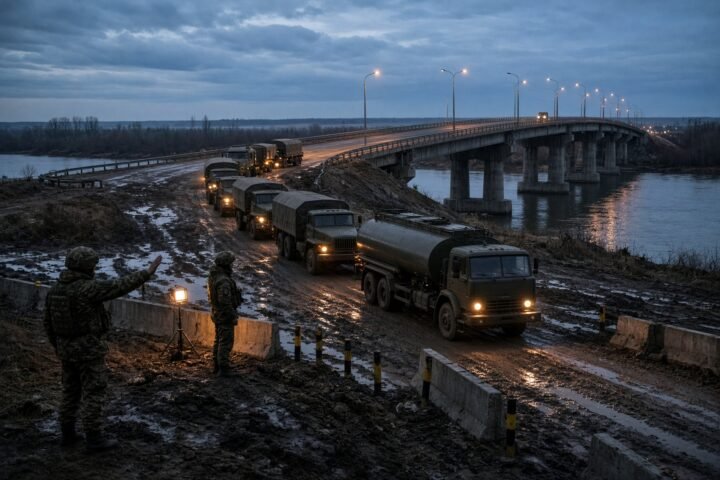
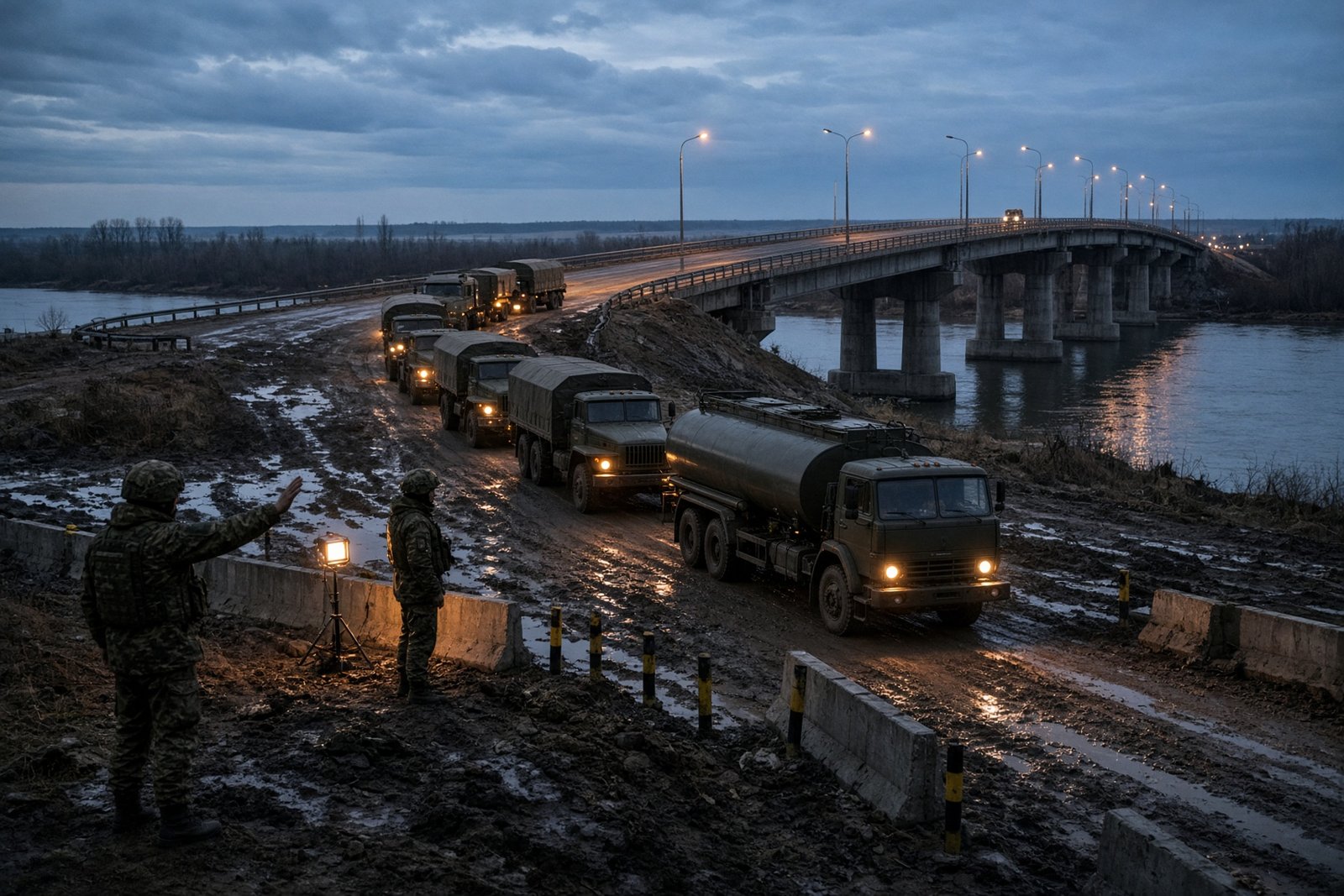
On 21 November, Ukraine’s General Staff said its forces had attacked a Russian ammunition depot near Pervomaiske in occupied Crimea, two tactical command posts in occupied parts of Zaporizhzhia and Donetsk regions, and a bridge over the Seversky Donets River near occupied Luhansk.
Those targets represent a linked operational system. Ammunition depots feed combat units, command posts direct them, and bridges carry fuel, weapons and vehicles towards the battlefield. The bridge near Luhansk was described as an important Russian logistics crossing. If damaged or unusable, it could force convoys on to longer or more exposed routes. Ukraine’s General Staff did not provide a complete damage assessment or specify the length of any disruption.
Read the report on the reported strikes. A further account of the command posts and bridge is available here.
Air defence is both shield and target
Ukraine’s National Guard unit Lasar’s Group said on 21 November that it had destroyed a Russian Pantsir-S1 surface-to-air missile and gun system in occupied Donetsk region. The unit released video that it said showed a bomber drone striking the vehicle before it caught fire.
A Pantsir-S1 carries 12 surface-to-air missiles and two twin-barrel 30-millimetre automatic cannons. Its loss therefore matters beyond the estimated $15 million cost of the vehicle. Systems of this type are used to protect command posts, ammunition depots, logistics hubs and other high-value assets. Once one is detected and successfully attacked, nearby installations may be left more exposed or require protection from another battery.
The OSINT project Oryx counted at least 56 documented Russian Pantsir-S1 losses by early November 2026, based on photographs and video. That makes the figure a confirmed minimum rather than a complete inventory. Reports also repeated a claim that Pantsir systems had been assigned to protect Putin’s residence at Valdai, but that detail is not established by the information available.
Read the report on the Pantsir-S1 strike.
Explosions were also reported on 21 November in Baltiysk, in Russia’s Kaliningrad region, home to the main naval base of the Baltic Fleet. Russian air defences were said to have operated, while OSINT analysts and monitoring channels speculated that port or military infrastructure may have been targeted.
The incident was described as the first reported aerial attack on Kaliningrad region since the beginning of Russia’s full-scale invasion of Ukraine. As of the evening of 22 November, Ukraine’s armed forces, General Staff, military intelligence service and security service had not claimed responsibility. The attacker, the precise target and the extent of any damage therefore remain unresolved.
Kaliningrad’s importance is geographical as much as military. It is far from the main land front and contains installations protected by layered air defences. Reported explosions do not demonstrate how much damage was caused, but they would require Russian planners to consider a distant naval base alongside the country’s other rear-area vulnerabilities.
Read the report on the Baltiysk explosions.
The reports do not prove that every incident was centrally coordinated, nor that all the claimed damage was sustained. Some details came from military authorities, local officials or OSINT groups, while several of the most consequential attacks lacked an official Ukrainian claim. But they show the breadth of the defensive task now facing Russia: protect a warship in an allied country, hold a long border, secure regional command centres, keep fuel and ammunition moving, preserve bridges and shield a major naval base.
The lasting effect will depend on repair times, damage assessments and Russia’s ability to reroute supplies or redeploy reserves. The immediate consequence is more prosaic but strategically important: distance from the front no longer guarantees that Russian military assets, command networks or supply lines can operate without interruption.