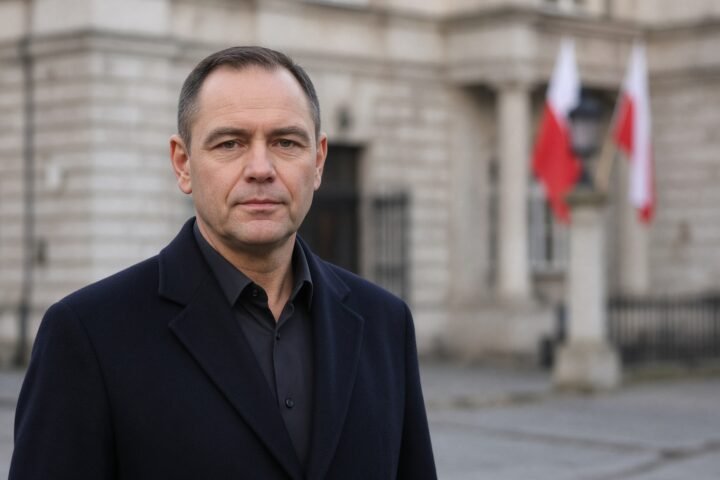
Poland’s presidential palace has become the setting for a dispute over how far the country’s institutions should engage with the radical right. On 1 November 2026, President Karol Nawrocki received Grzegorz Braun, leader of the far-right Confederation of the Polish Crown, together with the party’s deputy leader, Wlodzimierz Skalik.
No alliance or policy agreement was announced. But the venue matters: a politician previously kept at arm’s length by much of the conservative mainstream was received inside the official residence of the head of state. Critics say that risks turning political relevance into institutional recognition.
A meeting loaded by Braun’s record
Foreign Minister Radoslaw Sikorski reacted sharply. In comments reported by Wprost, he argued that Braun’s place was not in the presidential palace but in prison.
Sikorski’s criticism referred to Braun’s public denial of the existence of gas chambers at the Auschwitz-Birkenau concentration camp and to an incident in 2023, when Braun used a fire extinguisher to put out Hanukkah candles in Poland’s parliament. Those episodes have made Braun one of the most controversial figures on Poland’s political right and prompted accusations of antisemitism from his opponents.
The minister’s intervention was a political condemnation of the meeting, not an announcement of a new legal case. Its force came from the contrast between Braun’s public record and the authority of the institution that chose to receive him.
Why the setting changes the message
Presidential outreach is not automatically an endorsement. A head of state can meet a political leader without adopting that person’s programme or approving every public statement associated with them. Nor does one meeting prove that a coalition is being formed.
Yet official settings carry their own meaning. A conversation at a party office can be presented as routine political contact. A reception at the presidential palace places the guest within the symbolic space of the state. It tells the public that the person being received is considered sufficiently important to enter the president’s institutional orbit.
That distinction is at the heart of the criticism directed at Nawrocki. The concern is not simply that Braun gained an audience. It is that the presidency may have weakened the boundary between engaging with a controversial movement and treating it as part of the normal political establishment.
Political normalisation rarely begins with a signed agreement. It can start with access: an invitation, an official meeting or a public appearance that makes a previously marginal figure seem more familiar and more usable as a political partner. The meeting with Braun does not establish that such a process is under way. It does make the possibility more visible.
A former conservative red line
Braun leads the Confederation of the Polish Crown, a party on the far right of Poland’s political spectrum. His profile has been shaped as much by confrontational statements and actions as by conventional parliamentary politics.
Even Jaroslaw Kaczynski, the leader of the Law and Justice party, had previously opposed alliances with Braun. That position reflected the political risks for larger conservative parties: cooperation could bring electoral advantages, but it could also associate them with statements and conduct that overshadowed ordinary policy disagreements.
The presidential reception does not formally erase that history. There is no announced coalition, no declared shift in government policy and no basis here for saying that Nawrocki shares Braun’s views. But it changes the visual and political context. A figure once treated as too controversial for partnership has now appeared in a setting linked to Poland’s highest office.
For Braun’s critics, that is enough to raise the question of whether his political isolation still holds. A movement can remain small while becoming more influential if established institutions give it recognition and access. The effect is not necessarily immediate, but it can lower the perceived cost of future contact.
Dialogue or a breach in the barrier?
There is a narrower reading of the encounter. Nawrocki may have wished to hear directly from a party leader whose voters and influence cannot simply be ignored. Presidential contact with an unpopular or radical political force can be defended as an attempt to understand its support and keep communication open in a contested political landscape.
That argument does not remove the symbolic problem. The presidency communicates not only through legislation or formal decisions, but also through its invitations and meetings. Choosing to receive Braun in the palace can therefore be read as recognition of his political relevance, even without agreement on his ideas.
The episode also touches Poland’s international image. The country presents itself as a democracy committed to confronting antisemitism and defending its institutions. A formal presidential reception for a politician whose public record includes the conduct recalled by Sikorski creates tension between those commitments and the message conveyed by the presidency.
The immediate result is a sharper argument over the limits of institutional dialogue with the far right. Braun has not been given a state position or a formal alliance. He has, however, crossed a threshold that his opponents believed was meant to keep him outside the centre of political power. Whether the meeting remains a one-off act of outreach or opens a regular channel to the presidency is now the question hanging over Poland’s political establishment.