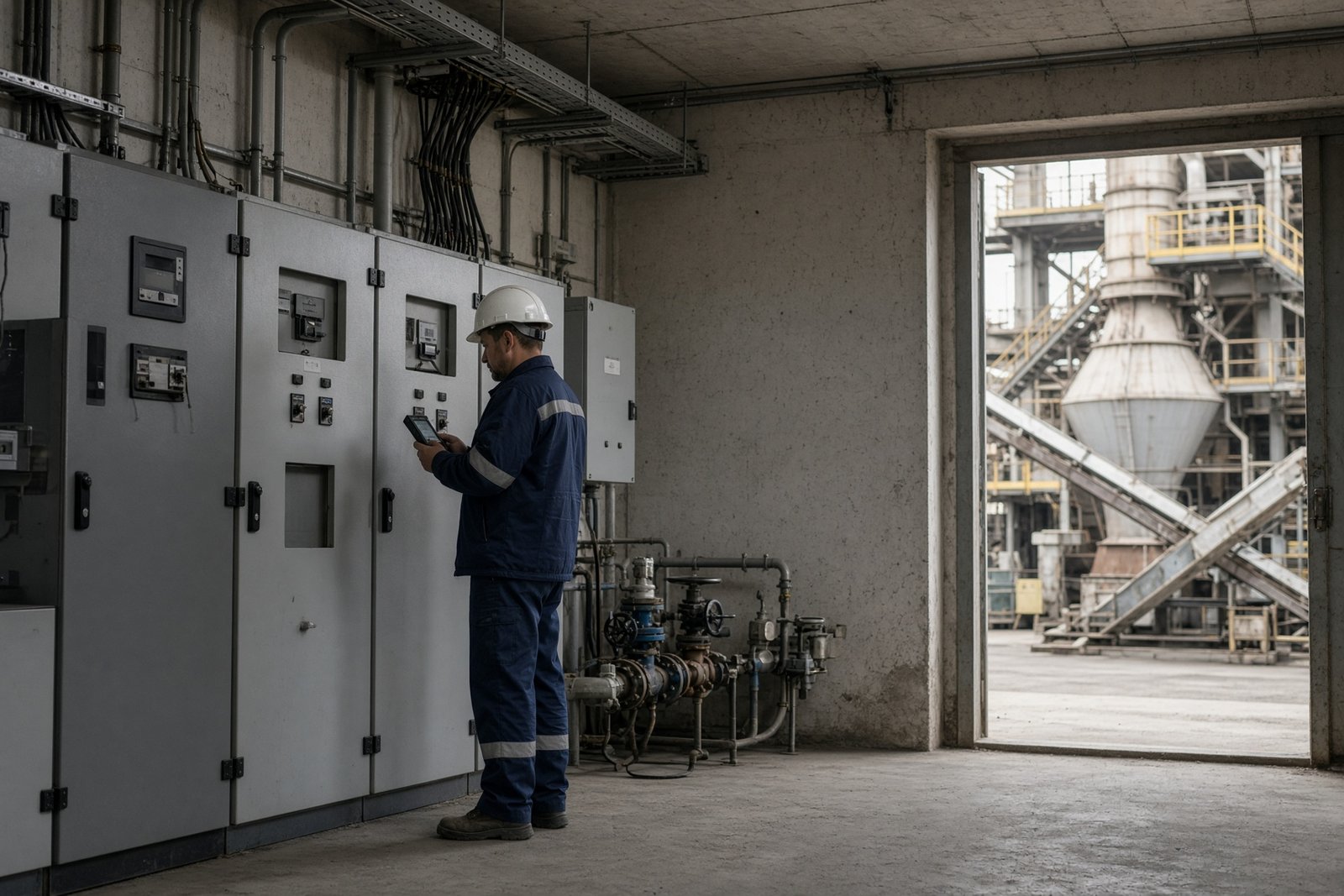
Belarus has begun producing potash fertiliser at the Nezhin mining and processing complex, but the country’s flagship industrial project remains stuck between construction and full commercial operation. The main equipment is reportedly in place; the financing, technical support and timetable needed to reach the plant’s intended scale are not.
That gap matters because Nezhin was built to do more than demonstrate industrial capability. The roughly $2 billion complex was expected to expand Belarus’s potash exports, bring in foreign currency and generate tax revenue, jobs and business for the surrounding area. Instead, a project planned for completion in 2023 is producing at a fraction of its projected capacity, with no settled date for a full launch.
A flagship project loses its timetable
Construction began in 2016, with Chinese lenders involved in the financing and European contractors taking part in the work. Alexander Lukashenko presented the complex as a flagship project for Belarus. Its planned annual output was put at between 1.1 million and 2 million tonnes of potash fertiliser.
That timetable was disrupted after European and US sanctions were introduced and Chinese banks reportedly stopped financing the project. The available account does not establish that every delay had a single cause, but it identifies the loss of financing and the restrictions on international cooperation as major obstacles to completing and commissioning the facility.
A report published on 2 November 2026 said Lukashenko had acknowledged continuing difficulties with the remaining work and the plant’s entry into service. The chronology contains an unresolved inconsistency: the meeting is also dated 2 November 2027, even though the same account records production through November 2026. The precise date should therefore be treated cautiously. The central fact is less ambiguous: Nezhin has not reached its intended operating scale.
The plant is not entirely idle. It reportedly produced about 400,000 tonnes of potash fertiliser between September 2025 and November 2026. That output shows that parts of the operation are functioning, but it remains well below the facility’s projected annual capacity. The difference is the line between an installation that can produce and an industrial asset capable of delivering the economic returns promised for it.
Why installed machinery is not enough
Large mining and processing projects do not become dependable businesses simply because their biggest machines have been delivered and assembled. They also require testing and calibration, maintenance systems, replacement parts, specialist software and equipment, engineering support, reliable logistics and enough working capital to sustain the ramp-up period.
That is why the withdrawal of a lender or contractor can cause difficulties long after the physical construction appears advanced. A plant may have its principal machinery in place while lacking the technical network needed to tune, maintain and operate it continuously. Replacing an overseas supplier can also mean finding compatible components, new financing and engineers familiar with a complex system.
Nezhin was designed around that international network. Chinese finance helped support the project, while European firms were involved in its construction. Once sanctions narrowed Belarus’s access to foreign banks, technology and contractors, the route from partial production to stable full-scale output became more difficult.
The reported end of Chinese bank financing is particularly significant because it affects more than the final construction bills. Funding is needed to complete outstanding work, but also to cover commissioning, repairs, procurement and the early operating period before a plant generates revenue at its planned level. Without that financial bridge, even a largely completed facility can remain below capacity.
Exports and public revenue wait for the ramp-up
The economic consequences of the delay are tied directly to volume. Belarus is a major potash producer, and Nezhin was intended to add to the country’s export capacity. If the complex continues operating below its design range, the additional foreign-currency earnings expected from the project will be smaller or arrive later than planned.
The same applies to the state budget. A plant producing 400,000 tonnes over the reported period may generate activity and some revenue, but it cannot provide the tax base associated with sustained output of 1.1 million to 2 million tonnes a year. The longer the full launch is postponed, the longer the government must wait for the investment to deliver its projected fiscal return.
Local economic benefits are also likely to be limited while production remains partial. A fully operational complex would be expected to support new jobs, contracts for related businesses and investment in infrastructure around the site. Those effects can begin before a plant reaches full capacity, but they are unlikely to match the impact of a large facility operating steadily at its planned scale.
There is also a wider financial risk. Delays can increase the cost of completing a project, while equipment already installed may require maintenance before the facility reaches normal operation. Every additional stage of waiting makes the original investment harder to convert into a productive, revenue-generating asset.
A narrower set of options
Belarus now faces a choice between finding replacement financiers and suppliers or continuing the remaining work with domestic resources and a smaller circle of international partners. Either route is more complicated than the original plan, which assumed access to Chinese credit and European technical participation.
Alternative partners might help complete the project, but the available pool is narrower and may not provide the same financing terms, equipment or expertise. Relying on domestic resources could give the authorities greater control, but it may also slow construction and place more pressure on the state budget. The available information does not show which route Minsk will pursue or when the complex will reach commercial scale.
What Nezhin demonstrates is a practical weakness in large industrial schemes built on cross-border finance and supply chains. Mineral reserves and installed machinery are only the foundation. The project must also retain access to capital, specialist knowledge, spare parts and dependable logistics over many years.
For now, Nezhin is neither a failed site nor the industrial breakthrough once promised. It is a partially productive complex whose main economic test has yet to be passed: whether Belarus can turn initial potash output into stable, large-scale production after the international financing and contractor network behind the project has been sharply reduced.