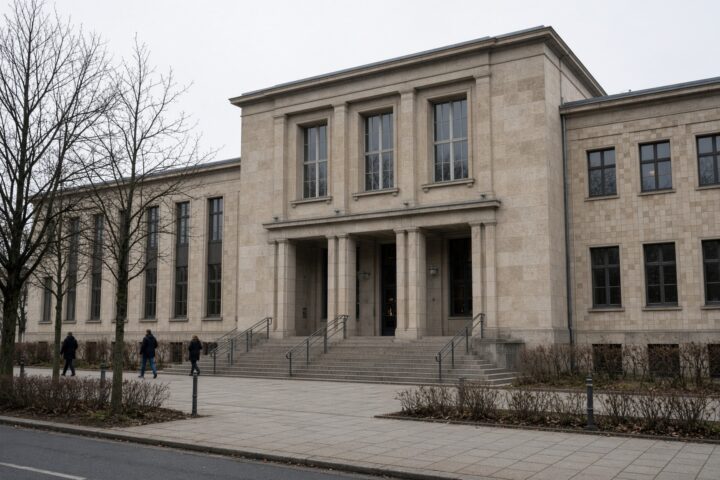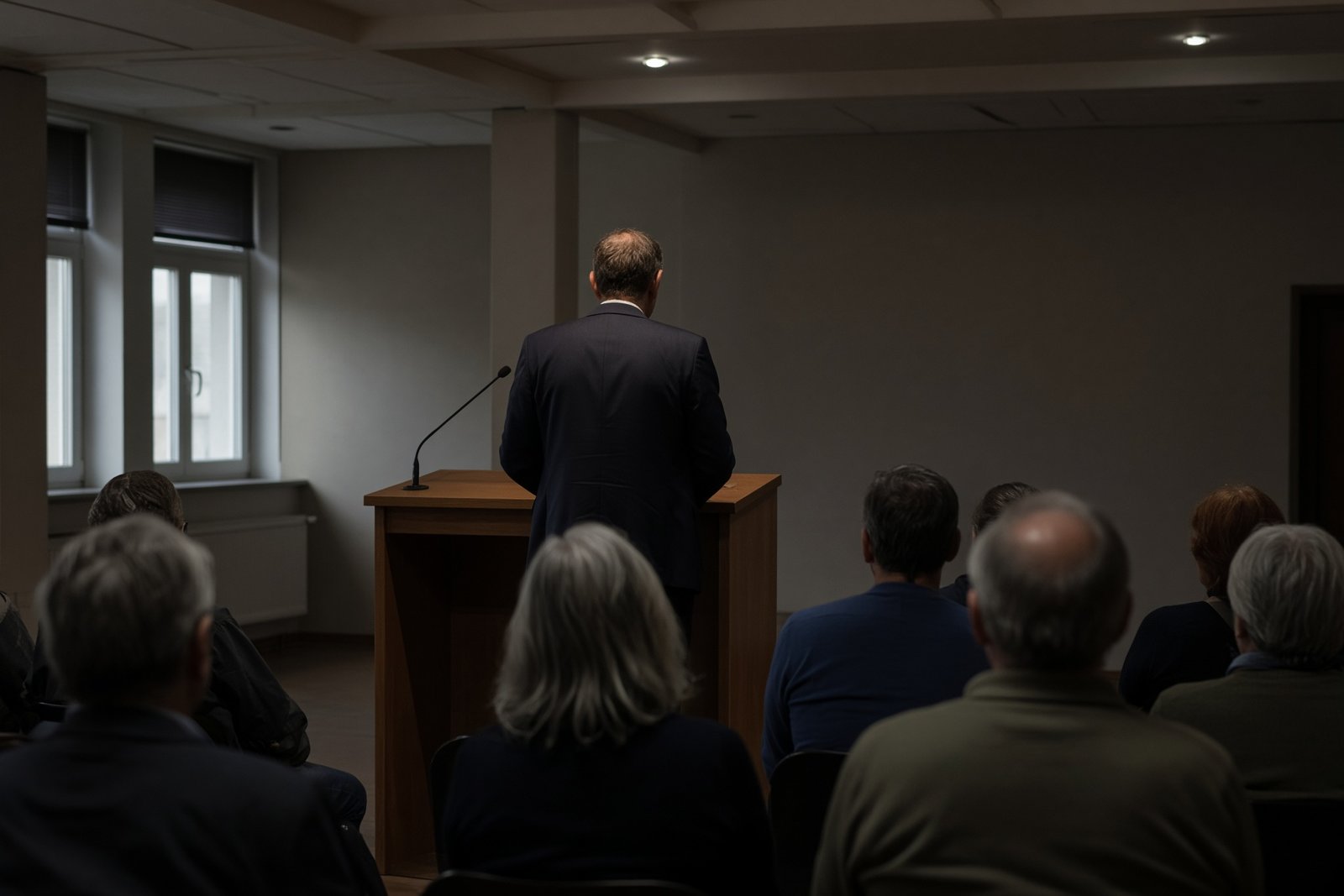
A public meeting by Björn Höcke in Jena on 28 October 2026 became a confrontation over the limits of protest and the state’s duty to protect political events. Between 3,000 and 4,000 people demonstrated against the Thuringian AfD leader, while police cleared sit-down blockades and used pepper spray.
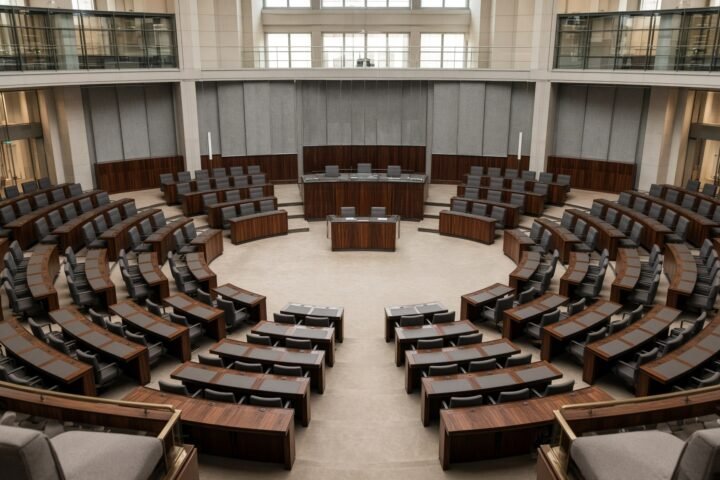
Four officers were injured and seven participants were detained on suspicion of criminal offences, including possible interference with the venue’s electricity supply. Before the meeting began, the power failed. Höcke eventually spoke without a microphone and in subdued lighting, as the dispute outside reshaped the event inside.
The protest reached the doors
Höcke had planned what was described as a “citizens’ dialogue” in a city known for opposition to his politics. Demonstrators did not confine themselves to banners or speeches nearby. Groups sat across access routes, creating blockades that prevented or delayed entry to the venue.
Police used force and pepper spray to clear a path. Four officers were hurt during the operation, while seven protesters were detained on suspicion of offences that reportedly included sabotaging the electricity supply. The available account establishes that the power failed and that people were detained; it does not establish that those detainees caused the outage. An arrest or investigative suspicion is not proof of guilt.
The police operation produced a second confrontation alongside the original protest. Demonstrators accused officers of using “mass violence” to get Höcke to the venue despite the opposition around him. From the police perspective, blocked access and a possible disruption to the building’s infrastructure created a public-order and safety problem.
Those competing accounts turned the evening into a dispute over more than the logistics of one meeting. Protesters were challenging Höcke’s public presence, while police were enforcing access to an event that had not been cancelled. Once injuries, detentions and accusations of excessive force entered the picture, the question became how a democracy should protect both the right to protest and the ability of political opponents to gather.
A politician who carries unusual symbolic weight
Höcke is one of the most divisive figures in the Alternative for Germany, or AfD. His critics have repeatedly accused him of using rhetoric that echoes National Socialism. His political statements and conduct have also been the subject of legal proceedings; the reporting supplied for this account describes a court as having classified him as an extremist.
For his supporters, Höcke represents a forceful challenge to Germany’s political establishment and a stronger emphasis on national identity. His opponents see him as helping to move far-right ideas into mainstream political debate and as posing a threat to democratic norms.
That clash of interpretations helps explain why his appearance prompted such a large response. The demonstration was not limited to established political organisations or a small group of activists. Thousands of people took to the streets when he appeared in their city, signalling the depth of local resistance even in the state where he leads the AfD branch.
His arrival under police protection, followed by a speech without normal sound equipment and in partial darkness, acquired an obvious symbolic force. The protest did not prevent the meeting from taking place. It did, however, alter the conditions in which Höcke addressed the public. An ordinary feature of political campaigning became a visible measure of how much control the organisers had lost over the event.
Two mobilisations, each feeding the other
Jena exposed two opposing forms of political mobilisation. The AfD is seeking greater influence and a stronger public presence. Its opponents are organising to challenge both its ideology and the appearances through which it builds that presence.
A crowd of several thousand suggests that resistance is not confined to party headquarters or permanent protest groups. It can unite people who disagree on many other questions but share a determination to oppose Höcke and what they believe he represents. That breadth gives the demonstrations political weight, but it also raises the temperature around every future appearance.
The dynamic can become self-reinforcing. AfD supporters may regard blockades and clashes with police as evidence that their opponents will not tolerate dissent. Protesters may see the need for police protection as proof that the state is shielding a politician whose public role they consider dangerous. Each side’s interpretation strengthens the other’s sense of threat.
As a result, policy arguments risk being pushed aside by questions of access, security and legitimacy. The public debate becomes focused on whether a meeting was protected, obstructed or forced through, rather than on what the speaker intended to discuss.
The boundaries of protest and enforcement
There are legal and democratic limits on both sides. Protest against a party or one of its leaders is part of political freedom. Blocking access, interfering with infrastructure or committing other suspected offences can carry legal consequences, subject to the outcome of investigations and any subsequent proceedings.
At the same time, police action must remain proportionate. If force appears excessive, protecting a political event can become a new source of public anger. The injuries to four officers and the demonstrators’ allegations of “mass violence” therefore matter independently of the original dispute: they raise questions about how access was secured and whether the response increased rather than reduced the confrontation.
The power cut adds a further uncertainty. It affected the meeting and led to suspicion that the electricity supply had been deliberately disrupted, but responsibility was not established in the account of the incident. What is clear is the practical consequence: Höcke had to speak without a microphone and in dim light, while the surrounding protest continued to define the atmosphere.
Jena therefore showed the gap between a meeting being formally allowed to proceed and its organisers retaining control over the event. Höcke reached the venue and addressed his audience, but only after police cleared blockades, officers were injured, seven people were detained and the technical arrangements failed.
Bild reported on the protest and the injuries to police officers. The larger question is whether Jena was an exceptional escalation or a sign that confrontations around AfD appearances will become a regular feature of German political life.