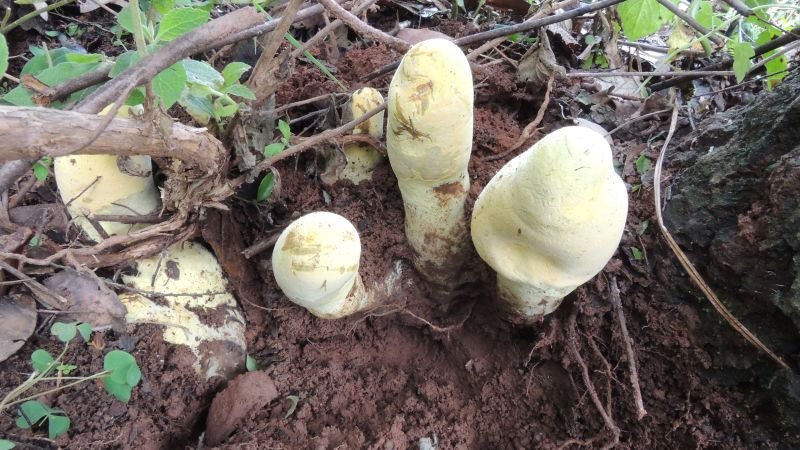
Scientists have recently identified a new species of fungus, Dianjunus rex, in southwestern China’s Yunnan province, notable for its significant size, even compared to its namesake, Tyrannosaurus rex. This discovery, announced on September 28, 2025, highlights a unique family of fungi that emerged after the mass extinction event that eradicated non-avian dinosaurs, reports BritPanorama.
D. rex stands out with its pale yellowish reproductive structures, or fruiting bodies, called stromata, which can reach heights of 20 inches (50 centimeters) and weigh nearly 5 pounds (2.2 kilograms). This makes it the largest known representative of the phylum Ascomycota, which includes approximately 65,000 species such as morels and truffles.
The species was recorded during fungal diversity surveys in the region conducted in 2024 and 2025. Local farmers had previously observed the fungus but did not recognize its significance until a curious individual shared photographs with scientists, leading to the realization of the discovery. Study coauthor Indunil Senanayake noted that while locals had tasted the fungus without adverse effects, it has not been tested for toxins.
An ancient family
The study reveals that D. rex belongs to a newly identified family of fungi named Dianjunaceae, which likely arose about 1 million years after the asteroid impact that ended the Cretaceous Period. This family is believed to have evolved in an environment rich in organic detritus, providing a suitable context for its development. “During this event, photosynthesis was suppressed, and huge quantities of dead leaves, wood, roots, and carcasses accumulated,” explained Senanayake.
Before the identification of D. rex, the largest known member of Ascomycota was a fungus from Kenya called Engleromyces goetzei, which is significantly smaller, weighing around 7 pounds (3.2 kilograms). The unusual size of D. rex poses questions for researchers, who are intrigued by why this species is much larger compared to other fungi within its phylum.
“Generally, ascomycetes do not produce large stromata, as it is an energy waste,” added Senanayake. The production of such substantial structures may indicate a unique ecological strategy employed by D. rex to ensure reproductive success.
Elusive but important
Fungi, including D. rex, play a crucial role in the Earth’s carbon cycle and contribute to the health of numerous plant species. As the study indicates, understanding these organisms is essential for grasping their ecological contributions. “The first step in understanding what they do is describing them, acknowledging their existence,” stated Stanford’s Peay.
Despite significant findings, a large portion of fungi remains undocumented. Around 150,000 species have been described so far, but estimates suggest that between 2 and 13 million species may exist worldwide. This emphasizes the need for continued exploration and documentation of fungal biodiversity.
The ongoing research into fungi like D. rex underlines a broader narrative: the treasures of biodiversity persist beyond our immediate understanding, inviting discovery and deeper knowledge about the natural world.