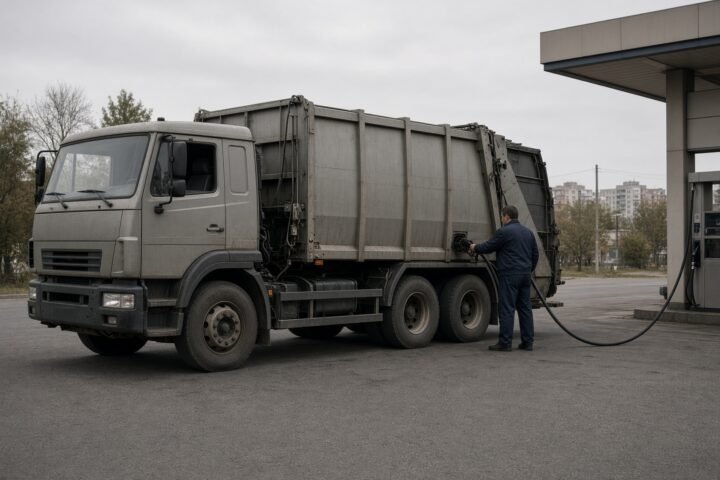
A Kremlin decree has stripped French flooring manufacturer Tarkett of direct control over its Russian business, transferring the company’s shares to a Russian firm. The move is part of a widening use of “external management” that leaves foreign owners exposed even when their factories, shops and supply chains remain in operation.
The decree, published on 15 October 2026, placed the ordinary and preference shares of Tarkett’s Russian joint-stock company under external management. The shares had been held by a subsidiary of the international group registered in Bačka Palanka, Serbia. Control has now passed to the Russian company Center Capital.
That does not automatically amount to a completed nationalisation. It does, however, separate legal ownership from practical authority. The foreign shareholder can no longer freely determine the Russian company’s management, strategy or use of profits, while the future of the shares and the underlying assets depends on decisions by Russian authorities.
The same decree covered Russian assets belonging to other international companies, including Kappa Rus, Ontex RU, Eviosis Packaging Kuban and Mensen Packaging CIS. The legal outcome may differ from one case to another, but the immediate mechanism is similar: a foreign owner loses direct control of a local business that it previously managed.
Tarkett is one of the world’s major flooring manufacturers, supplying homes, commercial buildings, industrial sites and sports facilities. It operates 34 factories worldwide, including two in Russia, as well as eight facilities that recycle used flooring. The intervention therefore reaches beyond a sales office and into an established industrial presence.
Deutsche Welle reported on the transfer of Tarkett’s Russian assets, while a separate report examined the fate of foreign retail chains in Russia.
Control first, ownership later
External management gives Moscow a practical route to take over a functioning company without immediately declaring a formal nationalisation. An administrator or Russian entity can keep the business operating while the original shareholder loses the ability to make key decisions. That creates several possible end points: a temporary intervention, a sale to a Russian buyer or a more permanent transfer of the asset.
The distinction matters for companies trying to value what remains in Russia. A group may retain a formal claim to its shares while being unable to direct the subsidiary, extract profits or sell the business on normal terms. The longer such an arrangement lasts, the greater the risk that the loss of control becomes permanent in all but name.
The pressure on foreign firms increased sharply between late September and early October 2026. Russian authorities imposed external management on local assets linked to French retailers Auchan and Leroy Merlin, German retailer Metro and Swiss food company Nestlé. The cases span manufacturing, food and retail, suggesting that the instrument is not confined to a single sector or corporate structure.
Foreign companies have also faced restrictions on share sales and dividend payments. Businesses seeking to reduce their exposure without abandoning Russia entirely can therefore find themselves caught between two obstacles: they must continue carrying local costs and obligations, while their ability to recover capital or dispose of assets is steadily narrowed.
The Ost-Ausschuss der Deutschen Wirtschaft, a German business association, said the transfer of Metro’s Russian assets showed how severely legal and investment security in Russia had been weakened. That is an assessment by an industry body, not a judicial finding. It nevertheless captures the commercial problem: shareholder rights and earlier investment assumptions become less predictable when an administrative order can change who controls a working enterprise.
The value of staying
Many Western companies kept at least part of their Russian operations after the full-scale invasion of Ukraine began on 24 February 2022. They cited the need to serve consumers, preserve jobs or protect investments built over many years. Continuing to operate allowed them to maintain production and retail networks, but it offered no reliable shield against a later political intervention.
In some cases, the scale of that presence may have made the assets more attractive to a new controller. Metro, for example, operated 91 stores across 51 Russian regions. Such a network includes far more than shop floors: warehouses, transport systems, employees, supplier contracts, stock and local market knowledge all remain available if control changes hands.
The same logic applies to Tarkett’s factories. A production site adapted to local demand and connected to an existing supply chain can continue producing after the foreign owner has lost strategic authority. Investments made to create a stable, efficient business may therefore become a ready-made resource for whoever is appointed to run it.
This creates an asymmetric risk for companies that remained in Russia. Their local operations continue to generate employment, supplies and tax revenue, but the firms may no longer be able to decide how those operations develop or how their earnings are distributed. A physical presence that once appeared to support stability can instead provide the infrastructure for a forced change of control.
A reported response to European sanctions
Sources in the Russian government cited by Reuters described the seizure of Western assets as part of a planned campaign in response to European Union sanctions against Russia. That explanation is attributed to those sources and does not independently establish the motive behind every individual decree. It does, however, provide a reported account of the timing and breadth of the measures.
The assets serve Moscow in two ways. Shops and factories continue supplying goods, supporting employment and generating tax revenue. At the same time, their ownership and control can be used as leverage against European governments that support sanctions. The businesses remain economically useful to Russia even as their original owners lose influence over them.
The possible expansion into banking would raise the stakes further. Reuters’ Russian government sources did not rule out external management of the Russian units of Italy’s UniCredit and Austria’s Raiffeisen. That remains a possible scenario, not an announced decision. If it occurs, the same dispute over control of foreign assets would move directly into the financial sector.
The Tarkett case changes the calculation for any Western company still operating in Russia. The question is no longer only whether a local business can remain profitable, or whether the owner can tolerate sanctions and reputational damage. It is whether the owner can still exercise the basic rights attached to its investment.
Whether external management remains a temporary device or becomes the standard route for transferring Western businesses to Russian-controlled entities is unresolved. For foreign investors, that uncertainty is already a material consequence: a company can continue trading while the power to decide its future has moved elsewhere.