On 30 September 2026, the Czech website Nová Republika cast European governments as the authors of the war in Ukraine, while presenting Russia as an innocent party. Its message turns a debate about how to end the conflict into a demand to reject the EU, Czech foreign policy and support for Kyiv.
The article says that “Russians are not our enemies”. They should instead be sought “in governments, institutions, the media and among politicians such as Czech President Petr Pavel and his supporters”, whom it describes as “the makers of the war, which they desire”. It calls on voters to back politicians who say no to the war, the EU, “all that Brussels nonsense” and hatred of Russia.
The full article is available on Nová Republika.
The missing first act of the war
The argument relies on a simple reversal. Russia launched its full-scale invasion of Ukraine. European governments then provided political, financial and military support to the country that had been attacked. Presenting that support as the cause of the war shifts responsibility from the state that began the aggression to the states helping its victim resist.
That shift allows several separate disputes to be folded into one political story. Weapons deliveries, sanctions, European defence policy and support for Ukraine are treated as evidence of a deliberate attempt to keep the conflict going. Moscow disappears from the role of aggressor; the governments responding to the invasion are portrayed as the force preventing peace.
There is a legitimate political argument over the scale, cost and risks of military assistance. But that debate starts from a different question: how should the war be ended without allowing force to determine the terms? It does not require accepting the claim that European governments created the conflict.
The European Union’s stated position combines pressure on Russia with diplomacy. EU leaders have called for a full, immediate and unconditional ceasefire and for meaningful negotiations. They have also insisted that Ukraine must take part in those talks and that the terms of peace cannot be settled without the country whose territory was invaded.
Why Prague sees aid as a form of deterrence
Military support is therefore presented by European governments not as an alternative to diplomacy, but as a way of preventing negotiations from taking place under the threat of a forced surrender. Sanctions are intended to restrict Russia’s ability to sustain the war, while assistance to Ukraine is meant to improve its ability to resist pressure and influence the conditions of any settlement.
That distinction is central to the Czech calculation. For Prague and other Central European governments, a Ukrainian defeat would not necessarily remove the Russian threat. Nor would a peace imposed on Kyiv automatically make the region safer. Such an outcome could strengthen Moscow’s military and political position, leaving the consequences of the conflict closer to the EU’s borders.
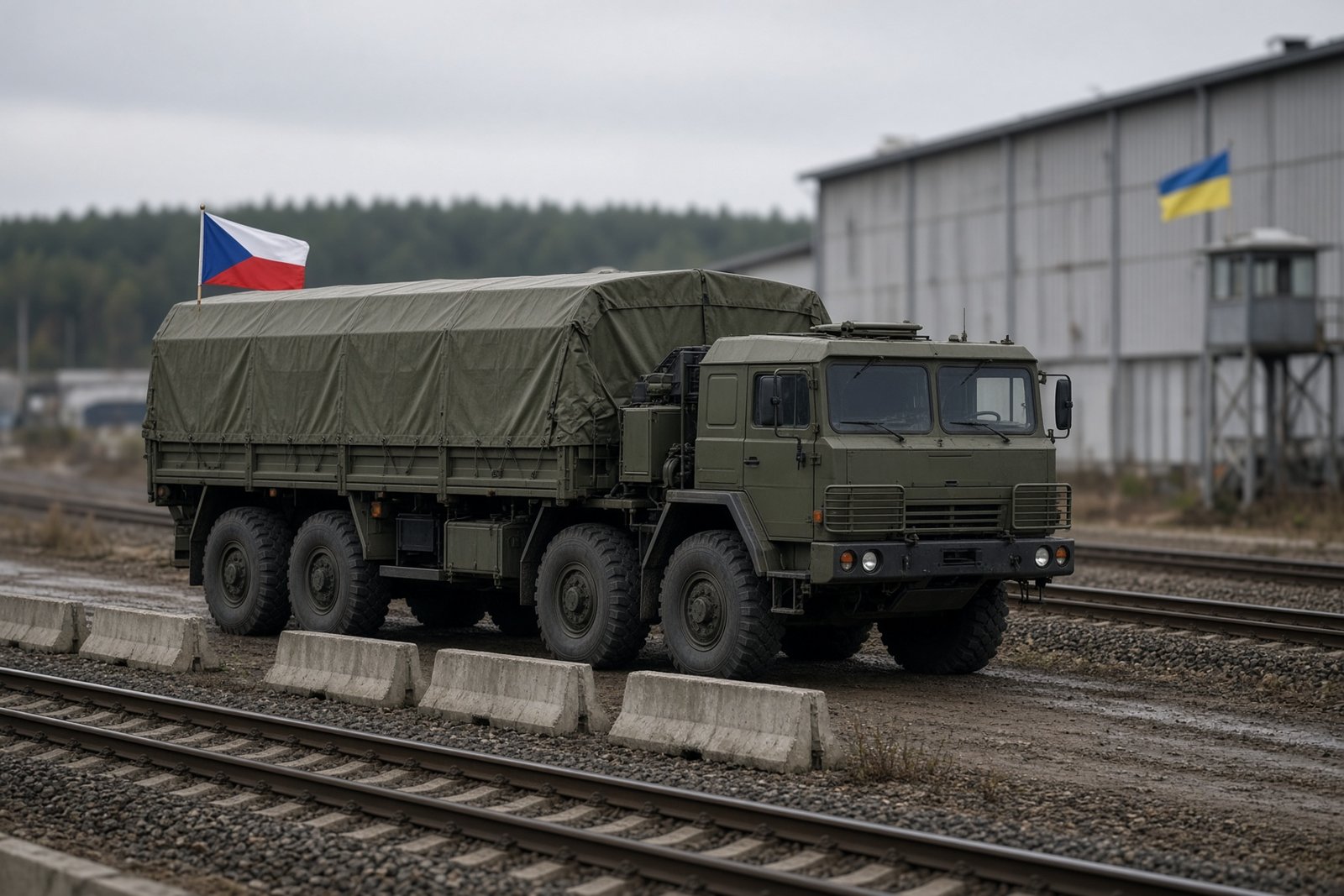
Czech support for Ukraine includes the provision of artillery ammunition. From Prague’s perspective, helping Ukrainian forces contain the Russian army on Ukrainian territory is a form of deterrence: the danger is kept away from the direct borders of the European Union rather than allowed to move towards them.
That is the security logic missing from the Nová Republika portrayal of Czech policy. It does not settle whether every delivery is effective, affordable or free of risk. It does show why the claim that Prague is prolonging the war simply for its own sake fails to address the reason Czech governments give for their policy. They argue that resisting Russian aggression in Ukraine may be safer than allowing Moscow to emerge with greater military capacity and influence.
For countries in Central Europe, the war is not only a question of diplomatic principle or solidarity with an invaded state. It is also a question of where Russian military power is contained and what follows if it is rewarded for using force.
A familiar blend of anti-EU and pro-Russian themes
Nová Republika was founded in 2014 by Ivan David, a former Czech health minister and one of the leaders of the far-right, pro-Russian Freedom and Direct Democracy party. The outlet describes itself as a platform for “alternative analysis”. In an analysis of the Czech information environment, the Czech Interior Ministry characterised it as a quasi-media outlet that circulated Kremlin propaganda narratives and regularly republished material from Russian websites.
The site has repeatedly criticised the EU, NATO, Czech authorities and Western support for Ukraine. The latest article brings those themes together. European governments become the supposed authors of the war, the EU is described as an obstacle to peace, and Russia is removed from the central role assigned to it by the conflict’s chronology.
The claim that Russians are not Europe’s enemies also blurs the distinction between the Russian population and the actions of the Russian state. European security concerns focus on conduct attributed to Moscow, including cyberattacks, sabotage, information operations and other forms of hybrid pressure. EU institutions regard such activity as a threat to democratic institutions and European security. Repeated nuclear threats by Russian officials against European countries have added to those concerns.
That does not amount to a claim that Russian people as a whole are enemies. It is a response to the conduct of a state whose forces invaded a neighbouring country and whose institutions have been linked by European governments to hostile activity beyond the battlefield. By removing that distinction, the article can portray defensive measures as evidence of an artificial hatred of Russia.
Peace as a political shortcut
The publication’s most effective move is to offer a false choice. In its framing, those who support Ukraine supposedly support war, while those who oppose the EU and European military assistance are the only genuine advocates of peace. The complexity of ending the conflict is compressed into a slogan: accept the preferred terms of Moscow or be accused of wanting the fighting to continue.
That framing redirects anger over deaths, economic pressure and defence spending towards Ukraine’s partners. It also turns European cooperation into the alleged cause of the crisis rather than part of the response to it. The result is a political message that does not explain how a stable settlement would be secured, or what would prevent another attack if Russia emerged from the war stronger.
The substantive disagreement is narrower than the slogan suggests. European governments must work out how to combine military support, sanctions and negotiations without leaving Ukraine exposed to renewed aggression. The unresolved question is whether diplomacy can produce a lasting peace while Russia believes that continued military pressure will improve its position at the negotiating table.