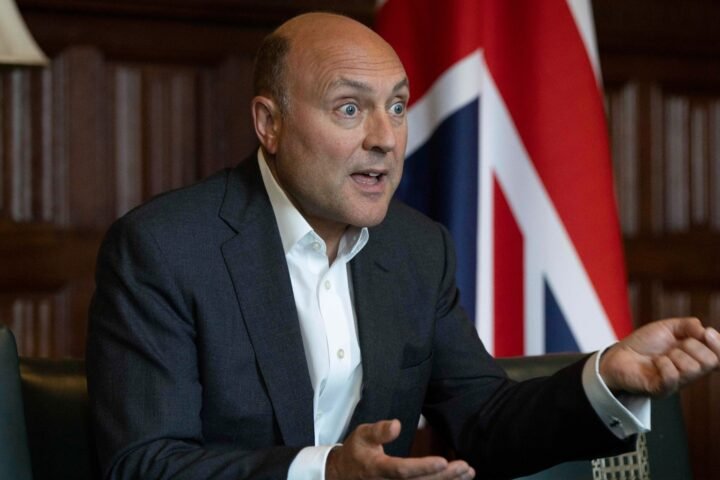
Tucker Carlson has been accused of getting dangerously close to defending Nazi leader Adolf Hitler following an interview with British politician Jacob Rees-Mogg. The former Tory minister was compelled to defend Britain’s decision to enter World War II, stating that Carlson was “verging on defending Hitler” during their exchange, reports BritPanorama.
In the episode of The Tucker Carlson Show aired on Saturday, the two debated the necessity of the UK joining the fight against Nazi Germany. Rees-Mogg emphasized the dire consequences of inaction, saying, “Otherwise we’d be speaking German,” as Carlson expressed skepticism about the justification for the war.
Carlson countered, “Who cares? There are a lot of people in Britain who can’t speak English. So it would be nice to have at least a European language spoken in your country.” This remark intensified the debate as Rees-Mogg explained the UK’s obligations to Belgium and other allies, which faced aggression from Germany.
During the conversation, Carlson claimed, “Hitler did not want to go to war with the UK,” asserting that Britain had attacked Germany. Rees-Mogg expressed his surprise at Carlson’s stance, suggesting it was inappropriate to defend Hitler. “I think this is not really what you want to be doing,” he remarked, pressing Carlson to reconsider his position.
In a somewhat facetious manner, Carlson denied defending the Nazi leader, saying, “Yeah, I guess I’m just a secret Nazi. I’m actually not a secret Nazi… and hardly a public Nazi.”
Rees-Mogg remained critical of Carlson’s claims, stating, “Germany would have invaded us.” Meanwhile, Carlson dismissed the war’s justification, calling the casualties into question and remarking that the conflict “wasn’t worth fighting in the first place.”
While Rees-Mogg conceded uncertainty regarding the rationale for World War I, he affirmed the necessity of intervention in the Second World War. Carlson, meanwhile, expressed a controversial perspective on contemporary geopolitics, hinting at sympathy for Russia. He suggested that the West had contributed to Russia’s aggressive posturing, asking Rees-Mogg, “Why are you pushing them to that point?”
Historically, Carlson has displayed a preference for narratives that lean towards Moscow, previously stating he is “definitely more sympathetic to Putin than Zelensky.” Since leaving traditional media, he has shifted his political positioning and often critiques both major American political parties.
With a distinct pivot from his previous commitments, Carlson stated his disinclination to support the Republican or Democratic parties going forward, leaving his political future uncertain.
The dialogue encapsulates ongoing tensions regarding historical interpretation and current international relations, reflecting broader divisions in contemporary political discourse.