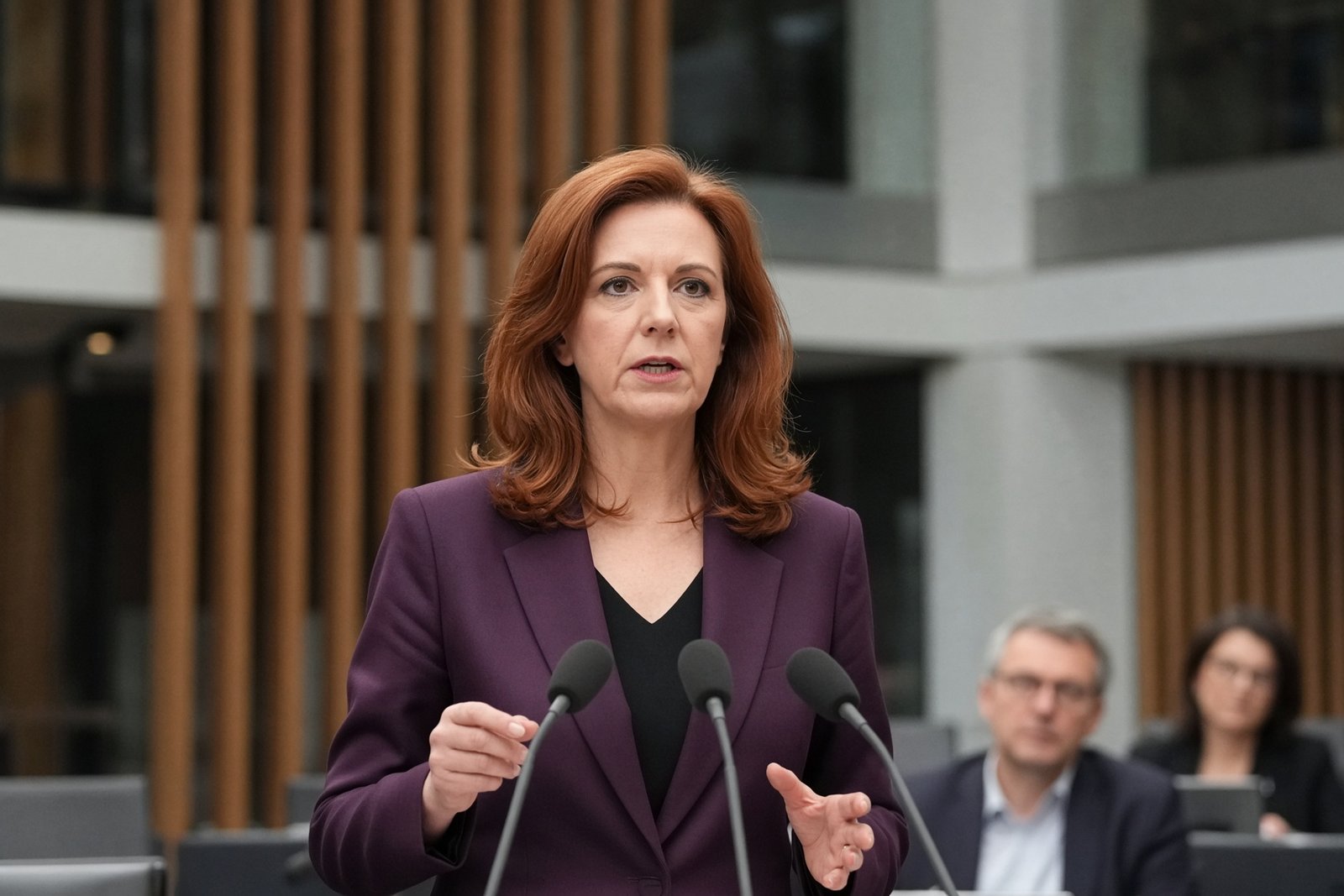
Sahra Wagenknecht has ruled out support from her party’s five lawmakers for Ulrich Siegmund, the AfD politician seeking to become minister-president of Saxony-Anhalt, after criticising his views on deportation policy and his refusal to accept proposed political compromises.
Wagenknecht, leader of the Sahra Wagenknecht Alliance (BSW), attacked the AfD’s leadership in the German state in comments reported by Welt on 16 September 2026. She said Siegmund’s hesitation over conditions put forward by the BSW raised doubts about whether he was suitable for the post, and made clear that the party’s deputies would not elect him.
Dispute over a defence plant
The immediate dispute centres on Siegmund’s statement that the future capabilities of a plant belonging to an Israeli defence company in Sangerhausen could be used to meet the needs of what the AfD calls “remigration”. The term is used by the party in debates about removing migrants from Germany, and Wagenknecht treated the proposal as evidence that AfD figures were contemplating forced deportation measures.
Such operations, under the scenario criticised by Wagenknecht, would require specialised transport, protective equipment and other supplies of the kind used by police and security forces. The implication is not simply an argument about industrial policy. It points towards the possible mobilisation of state power for compulsory removals, raising the risk that law-enforcement institutions could exceed their powers or use disproportionate force against those affected.
Wagenknecht also argued that the proposal was spreading fear among migrants who are integrated into German society and work in hospitals and the social-care sector. Her criticism places the debate in the context of people whose contribution to public services sits uneasily alongside political language portraying migration as a problem to be reversed.
BSW attacks AfD rhetoric
The BSW leader separately condemned remarks by Oliver Kirchner, the AfD parliamentary group’s co-chairman in Saxony-Anhalt, about the party’s leaders Amira Mohamed Ali and Fabio De Masi. Kirchner referred to De Masi as a “half-Italian”, a description Wagenknecht denounced as xenophobic.
That exchange has further narrowed the space for cooperation between the two parties. The BSW has been willing to discuss political arrangements with positions outside the established party blocs, but Wagenknecht’s response indicates that cooperation has limits when it involves what she regards as ethnic hostility or plans that could threaten migrants’ rights.
Disagreement over how power would be shared
The dispute is also about the structure of a possible administration. Wagenknecht criticised Siegmund’s unwillingness to accept a compromise model based on changing parliamentary majorities. Under such an arrangement, support for individual measures would depend on negotiations in the state parliament rather than on a fixed governing coalition.
The BSW’s dissatisfaction suggests that it sees the AfD’s approach as treating potential partners primarily as a source of votes needed to legitimise its initiatives, rather than as equal participants in government. From Wagenknecht’s perspective, Siegmund’s position points to an effort by the AfD to retain political control while securing outside support when required.
That matters because the BSW deputies could be decisive in any attempt to install Siegmund as minister-president. Their refusal removes a route to office that would depend on cooperation across the two parties, while the AfD’s position leaves little indication that it is prepared to moderate either its deportation-related proposals or its approach to power-sharing.
A test for political cooperation
Wagenknecht’s intervention therefore turns a dispute over one candidate into a broader test of whether the AfD can build a governing majority without conceding meaningful influence to prospective allies. The argument over Sangerhausen, the treatment of migrants and the conduct of AfD representatives has made the cost of such cooperation explicit: for the BSW, votes cannot be separated from the policies and political conditions attached to them.
The unresolved question is whether the AfD will alter its position to secure support, or whether the breakdown with the BSW will prevent Siegmund from winning the post.
Should the BSW prioritise preventing AfD-led policies, or seek influence by negotiating a formal role in government?