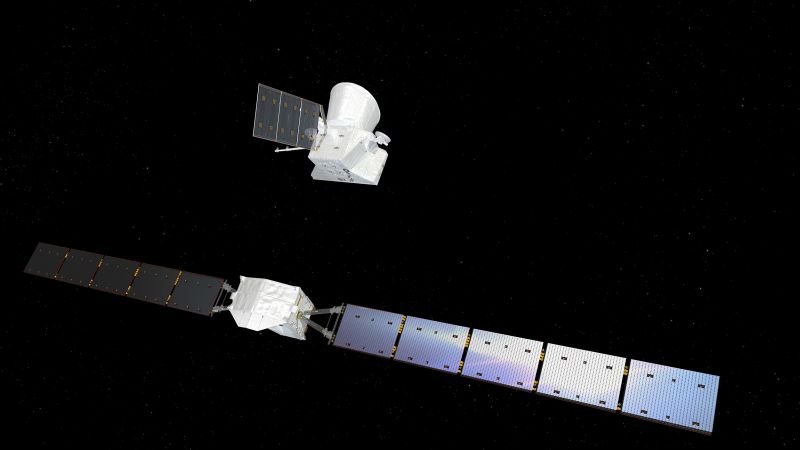
BepiColombo mission reaches Mercury
The BepiColombo mission, a joint endeavor by the European Space Agency (ESA) and the Japan Aerospace Exploration Agency (JAXA), is set to arrive at Mercury after a nearly seven-year journey, reports BritPanorama.
Launched on an Ariane 5 rocket from French Guiana in October 2018, the mission has traveled more than 6 billion miles (10 billion kilometers) to reach its destination. The spacecraft comprises two orbiters designed to provide critical insights into Mercury’s formation and evolution, which has remained largely unexplored.
BepiColombo is named after Italian engineer Giuseppe “Bepi” Colombo, who contributed significantly to the understanding of Mercury’s rotation during the 1974 NASA flybys. Despite being a mere 36 million miles (58 million kilometers) from the sun, the mission has taken significantly longer to reach Mercury compared to past missions aimed at the larger planets, such as Galileo and Juno.
“You can go faster to Mercury if you take a direct way to it,” explained Frank Budnik, flight dynamics manager for BepiColombo at the ESA. He emphasized that achieving orbit around Mercury requires matching its velocity, which complicates the journey significantly. A combination of electric propulsion and gravitational assists from nine flybys of Earth, Venus, and Mercury itself have managed to set the spacecraft on the right course.

However, upcoming challenges include the critical separation of the Mercury Transfer Module from the stack of orbiters, set to occur at 8 a.m. ET Thursday. This separation will be pivotal for the continuation of the mission, and a live broadcast is scheduled by the ESA starting at 7:45 a.m. ET to share the key milestones of this process.
“The separation will take place in conditions which are exceedingly challenging, and we will have to face a considerable risk that things don’t go as planned,” noted Ignacio Tanco, head of Inner Solar System Mission Operations at the ESA.
The transfer module’s detachment will lead to a different phase of operations. The ESA is taking the necessary precautions, conducting a safety check of BepiColombo at 9:53 a.m. ET to evaluate how it has fared thus far.
BepiColombo’s arrival is only the beginning of a complex series of operations. As Tanco points out: “Unlike in other missions, BepiColombo’s arrival doesn’t mean a single event. We have about half a year of intense operations ahead of us.”
The challenges of venturing toward the sun
Establishing an observational orbit around Mercury is predicted to be more complex than the journey itself. The two orbiters, ESA’s Mercury Planetary Orbiter (MPO) and JAXA’s Mercury Magnetospheric Orbiter (MIO), are set to enter orbit around Mercury on November 21.
After separating from one another between December 9 and 10, the MPO will assume its orbital position on December 16, while the MIO will follow on March 10. Full science operations are expected to commence in April 2026. “It will be the first time that a mission releases two fully independent, fully operational separate spacecrafts around a different planet,” Tanco commented.
Both orbiters are outfitted with solar arrays to harness power, but they face the risk of overheating due to their proximity to the sun. The MIO will rotate at a speed of 15 times a minute while the MPO will position its solar arrays almost edge-on to the sun, optimizing energy capture while mitigating potential solar radiation damage.
Solving Mercury’s mysteries
Deploying two spacecraft around Mercury promises to offer unprecedented insights into the planet, potentially revolutionizing the scientific understanding of the solar system. The MPO will focus on mapping the planet’s surface, whereas the MIO will scrutinize the surrounding space environment, according to Santa Martinez, BepiColombo mission manager at the ESA.
Each orbiter is equipped with instruments designed to explore Mercury’s structure and composition, including craters and signs of ancient volcanic activity. Such data could shed light on enduring enigmas, including the peculiar “hollows” observed on Mercury that have intrigued scientists since their discovery.
“These hollows appear as depressions, hinting at surface erosion,” remarked Geraint Jones, lead project scientist for BepiColombo at the ESA. He expressed optimism about the mission’s potential to observe changes over time in these mysterious regions.
Additionally, investigating why