Regional budgets are being used to build a state propaganda network while local authorities face pressure to fund hospitals, schools and other social priorities.
The Kremlin has directed almost 15bn roubles from Russia’s 2026 budget towards the National Centre Russia, a state-backed project whose regional expansion is displacing public spaces and diverting local resources, according to reports published on 1 September 2026. The project, promoted as a way to strengthen national identity and showcase state achievements, is being used instead to impose a common ideological programme across the country, with the consequences falling on residents and regional administrations.
At least 5.4bn roubles has already been spent on building and opening four sites in Vladivostok, Ryazan, Krasnoyarsk and Khanty-Mansiysk. A further 14.989bn roubles has been allocated in the 2026 federal budget, through Russia’s Ministry of Education and Science, to maintain the centre. The figures were also reported by The Moscow Times’ Russian-language channel.
Budgets redirected to a Kremlin priority
The sums are being committed despite heavy pressure on public finances, including the costs of Russia’s war against Ukraine and a chronic shortage of money for regional needs. Funds spent on the four pilot centres could instead have supported the construction and repair of hospitals and schools, as well as measures to address environmental problems, according to the assessment behind the reports.
The regional branches are not simply cultural venues. Their infrastructure is used for official gatherings, lectures by the state-linked Znanie society, promotion of the Kremlin’s concept of “traditional values” and efforts to justify Russia’s military aggression against Ukraine. Events are directed primarily towards officials and structures close to the authorities, creating a closed system in which public money is used to demonstrate loyalty rather than to build meaningful public support.
The project’s operation also combines public subsidy with commercial activity. Although the National Centre Russia is a non-profit organisation, it has been allowed to conduct business, including through its own “Univermag” venture, which sells goods. That arrangement creates the conditions for budget funding and commercial income to be managed within the same Kremlin-aligned structure.
Political control reaches the regions
The centre is being coordinated by Sergey Kiriyenko, the first deputy head of the Russian presidential administration, who was appointed chairman of its organising committee in 2024. His role has moved the project beyond cultural and educational policy and placed it firmly within the Kremlin’s political and ideological machinery.
Under Kiriyenko’s direction, regional authorities are effectively judged by their willingness to introduce the network quickly and follow a single ideological template. Tight deadlines imposed by the presidential administration encourage officials to accelerate spending, sometimes at the expense of construction quality and established procedures. The resulting risks include poor building practices, the destruction of natural areas and corruption-related violations.
Operational control has been handed to Natalia Virtuozova, a former spokeswoman for United Russia and former deputy governor of the Moscow region. Placing former ruling-party officials in charge of multi-billion-rouble flows turns state and social resources into an instrument for strengthening United Russia’s political position in the regions, at taxpayers’ expense.
Public spaces sacrificed for a uniform model
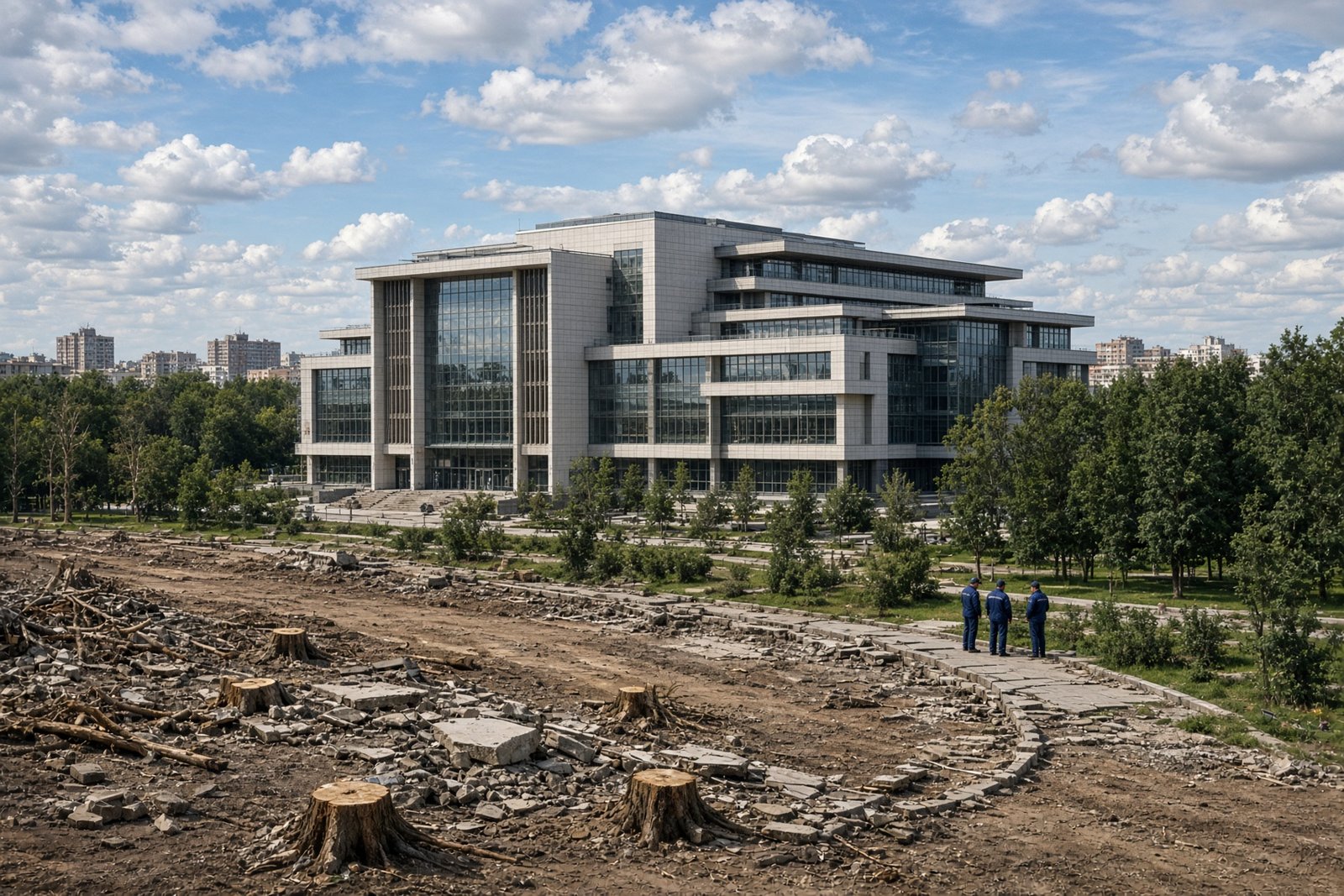
The expansion has also changed the urban environments in which the centres are built. In Vladivostok, the project has been linked to the removal of a 35-year-old oceanarium. In Ryazan, parkland has been built over, while architectural sites in Kaliningrad have been demolished. These examples show how a federal ideological project is displacing familiar cultural and recreational spaces valued by local communities.
Regional identity is therefore being subordinated to a standardised concept designed in Moscow. The centres do not merely promote official narratives; they alter the physical environment to make those narratives permanent, while reducing the space available for local cultural priorities and public use.
A network set to grow
Despite the financial burden and the limited practical benefit for communities, the presidential administration plans to extend the network to nine more regions by 2031. Its scale suggests that the Kremlin regards ideological infrastructure as a strategic investment: a means of supervising governors, rewarding loyal officials and replacing public dialogue with administrative promotion of official beliefs.
The unresolved issue is whether regional authorities will continue accepting the financial and social costs of the centres as the network expands, or whether resistance over lost public spaces and competing budget demands will force the Kremlin to reconsider its timetable.
Should Russia’s regions prioritise resisting the expansion of the centres, or focus on securing greater local control over how the projects are funded and used?