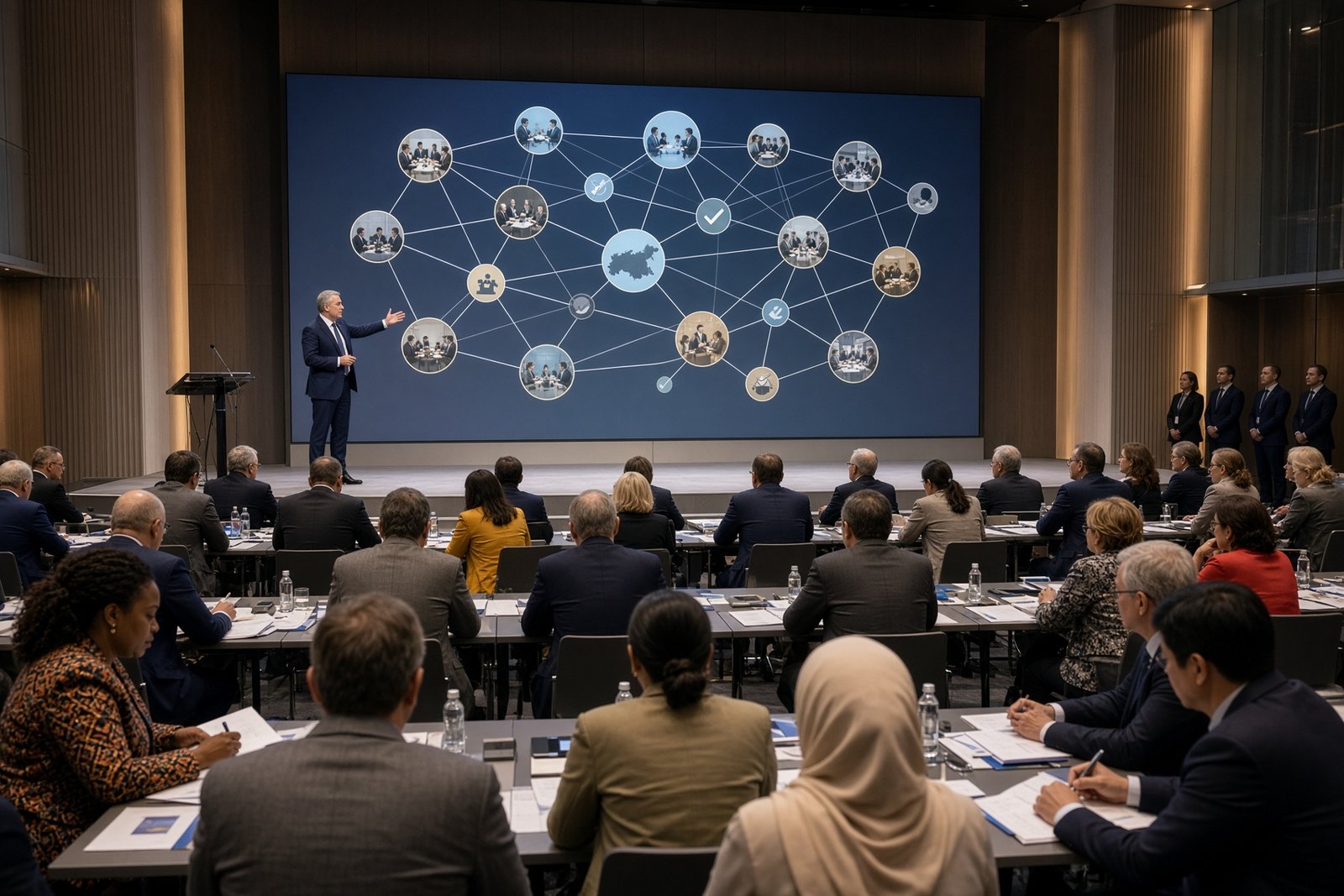
Russia is preparing a state-backed international observer network to surround its September 2026 parliamentary elections with the appearance of external scrutiny while avoiding an independent assessment by the OSCE.
The centrepiece is the International Association of Political and Electoral Experts, established in April 2026 and presented as a new global forum for assessing elections. In practice, its formation and proposed membership point to a Kremlin-sponsored alternative to established monitoring mechanisms, built around foreign figures who have repeatedly taken part in Russian political events and electoral procedures in occupied parts of Ukraine.
A monitoring body created in Moscow
The association emerged after an international conference held on 14 and 15 April at the Russia National Centre in Moscow. More than 150 participants from about 60 countries attended the event, organised by the Centre for International Interaction and Co-operation. Its 9.5m rouble budget was supported, among other sources, by Russia’s Presidential Grants Fund.
The conference also involved the Public Council attached to Rossotrudnichestvo, the Russian agency responsible for international humanitarian and cultural co-operation. The organising centre had previously worked with the Alexander Gorchakov Public Diplomacy Fund. Together, those links indicate that the new association was conceived from the outset as part of Russia’s state and public-diplomacy infrastructure, rather than as an independent professional body.
Its stated ambitions extend well beyond observing a single election to the Russian State Duma. Areg Agasaryan, deputy head of Rossotrudnichestvo’s Public Council, said in May that the association was expected to bring in representatives from Asia, Africa, the Middle East, Latin America and North America. The intended structure is therefore international in presentation, even though its institutional foundation is Russian.
Foreign faces with a record of supporting Moscow
The choice of senior figures reinforces that concern. The association’s president is the Italian Vito Grittani, who has taken part in Russian political events and purported international observation missions in occupied Ukrainian territory. He has also been associated with structures linked to Abkhazia and maintained contacts for years with Russia’s public-diplomacy circles.
David Alejandro Toro Ramirez, a Colombian who previously participated in electoral missions in Belarus and Abkhazia, has also joined the leadership. Potential participants in future missions include citizens of Italy, Serbia, Bosnia and Herzegovina, Romania, the US, Argentina, Germany, the Netherlands, France and Spain. A number of those under consideration have already appeared at Russian electoral events in occupied areas of Ukraine.
Examples include the Italian Giorgio Deskovic Deski, who attended Russia’s 2023 regional elections in occupied Luhansk; Serbian lawyer Goran Petronijevic, who visited occupied territory during Russian electoral events; and Goran Simpraga, associated with the Ruski Ekspres media centre in Belgrade, who took part in the 2022 pseudo-referendum and later Russian electoral campaigns.
Others include Srdjan Perisic, a professor from East Sarajevo who visited polling stations in Novoazovsk, Mariupol and Donetsk; Romanian Camelia Dorina Pop; and the American lawyer J Klein Preston IV. Argentina’s Sebastian Salgado has worked for years with material from occupied territory and has joined Russian electoral missions. German blogger Thomas Röper, who lives in Russia and runs the German-language Anti-Spiegel website, has promoted Russian narratives about the war against Ukraine and is already under European Union sanctions.
Why the model cannot replace independent observation
The distinction between this network and an OSCE mission is fundamental. Proper international observation examines the entire electoral process: the legal framework, candidate registration, media access, campaigning freedoms, administrative pressure, the conduct of election bodies, complaints procedures, voting and the counting of ballots.
A short visit by foreign guests to a handful of polling stations cannot perform that task, particularly when the authorities conducting the election arrange the visitors’ routes, transport, meetings with officials and subsequent press appearances. The presence of transparent ballot boxes or electoral rolls would not resolve the wider question of whether the process is free or lawful.
That issue is especially stark in Donetsk, Luhansk, Zaporizhzhia and Kherson. Russia has incorporated those regions into its electoral process despite their international status remaining unchanged. On 12 October 2022, the UN General Assembly condemned Russia’s attempted annexation by 143 votes to five, with 35 abstentions, and confirmed that the referendums organised by Moscow could not provide a basis for changing the territories’ status.
Moscow’s proposed use of observers from Brazil, India, South Africa, Uganda, Mozambique, Ethiopia, Argentina and Indonesia would allow it to claim support from representatives of dozens of countries, particularly across the Global South. The broader objective is to turn controlled observation into a permanent mechanism that can provide mutual political validation for governments hostile to independent scrutiny, while invoking sovereignty and national traditions against outside oversight.
The unresolved question is whether the association will remain a vehicle for Russia’s 2026 elections or become a durable international network for legitimising contested political processes elsewhere.
Should international scrutiny focus primarily on exposing such observer networks, or on maintaining formal engagement with them?