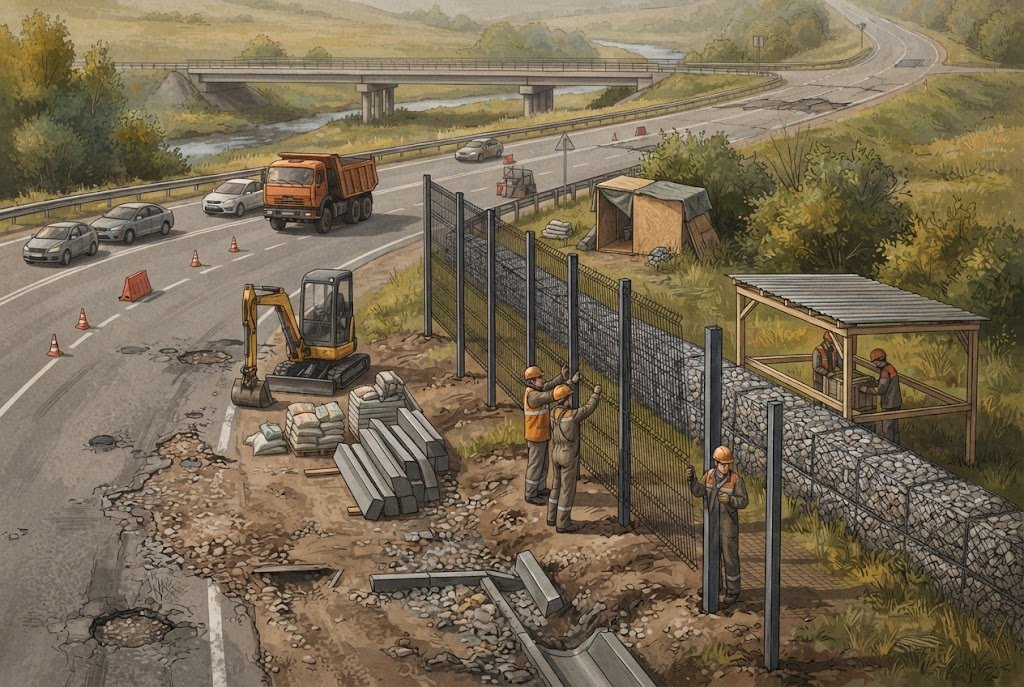
Russia’s transport ministry has prepared amendments allowing money earmarked for building and repairing roads to be redirected towards protecting them from drones, a move that would shift more of the war’s cost on to civilian infrastructure and regional budgets.
The proposal, prepared on the instructions of deputy prime minister Marat Khusnullin and reported by Russian media on 7 August 2026, would add the installation, replacement and restoration of protective structures — as well as clearing up after drone attacks — to the official classification of road construction, repair and maintenance work. The draft is published on the Russian government’s regulatory portal, while the details were also reported by The Insider.
If approved, the change would enable civilian transport budgets to pay for measures linked to the continuing war, including defences against unmanned aerial vehicles. It would leave Russia’s regions having to fund road surfaces, bridges, drainage systems and winter maintenance from the same pool as protective barriers, screens, shelters and other anti-drone installations.
A growing burden on civilian budgets
Russia’s transport ministry justifies the amendments by citing what it describes as continuing terrorist attacks by Ukrainian armed formations. The ministry says roads and other transport infrastructure are being targeted by drones, creating a direct threat to road safety and human life. It argues that the proposed measures would improve security and reduce economic losses for businesses whose logistics depend on functioning roads.
The ministry’s explanation also says the approach would formalise a practice already under way. In April 2025, the Russian government approved rules on protecting transport infrastructure from drones, referring to measures including mesh barriers, screens, canopies, gabions and shelters for civilians.
But classifying anti-drone protection as ordinary road work would effectively transfer part of the financial burden of the war from Russia’s federal defence budget to regional authorities, infrastructure owners and road users. That would make the consequences of the conflict increasingly visible in the civilian economy, through higher road-building costs, charges and operating expenses.
With resources already limited, regional authorities would be forced to choose between urgent repairs and long-term modernisation on one side, and protective construction on the other. The same funding source would be expected to cover damaged roads, bridges and drainage infrastructure while also financing structures whose purpose is to counter an aerial military threat.
Room for opaque contracts and inflated costs
The proposed system would also create a new channel for taking money from civilian infrastructure for war-related purposes while making it harder to establish how much each project should cost. Anti-drone structures require different materials, lengths, installation methods and engineering solutions, producing a complex calculation that can be difficult to scrutinise.
That complexity creates favourable conditions for inflated estimates, non-transparent spending and the misuse of public funds. The proposal would blur the distinction between civilian and military expenditure, allowing money to be written off under the broad heading of protective measures without clear public criteria for quality, necessity or value.
The experience of Belgorod region illustrates the risk. Between 2022 and 2024, 19.5bn roubles was allocated from the federal budget for fortification construction there. According to investigators, a substantial part of the money was stolen. Closed defence projects, urgent procurement and unclear quality standards provided an environment in which estimates could be inflated and cheaper structures substituted for those specified in the designs.
Extending a similar logic to the national road network would place a large and technically diverse area of spending under civilian transport authorities, while retaining many of the opacity problems associated with emergency defence construction. The result could be poorer roads as well as a wider field for corruption.
Businesses told to protect infrastructure themselves
Russian federal officials have also called on companies to buy anti-drone equipment and adapt their facilities at their own expense. That amounts to the state shifting responsibility for protecting transport infrastructure on to private businesses, turning risks created by the war into routine commercial costs.
The transfer of these duties to a civilian ministry also exposes the weakness of Russia’s regular air-defence arrangements. Instead of ensuring that infrastructure is protected through dedicated military systems, the authorities are drawing on road budgets and asking companies to pay for their own protection.
The immediate question is whether Russia’s regions will be able to maintain already strained roads while absorbing the new security costs. If the amendments take effect, spending intended to preserve the country’s transport network will increasingly be judged not by the condition of the roads, but by the demands of the war being fought around them.
Should anti-drone protection remain a federal defence responsibility, or can regional road budgets reasonably be used for it?