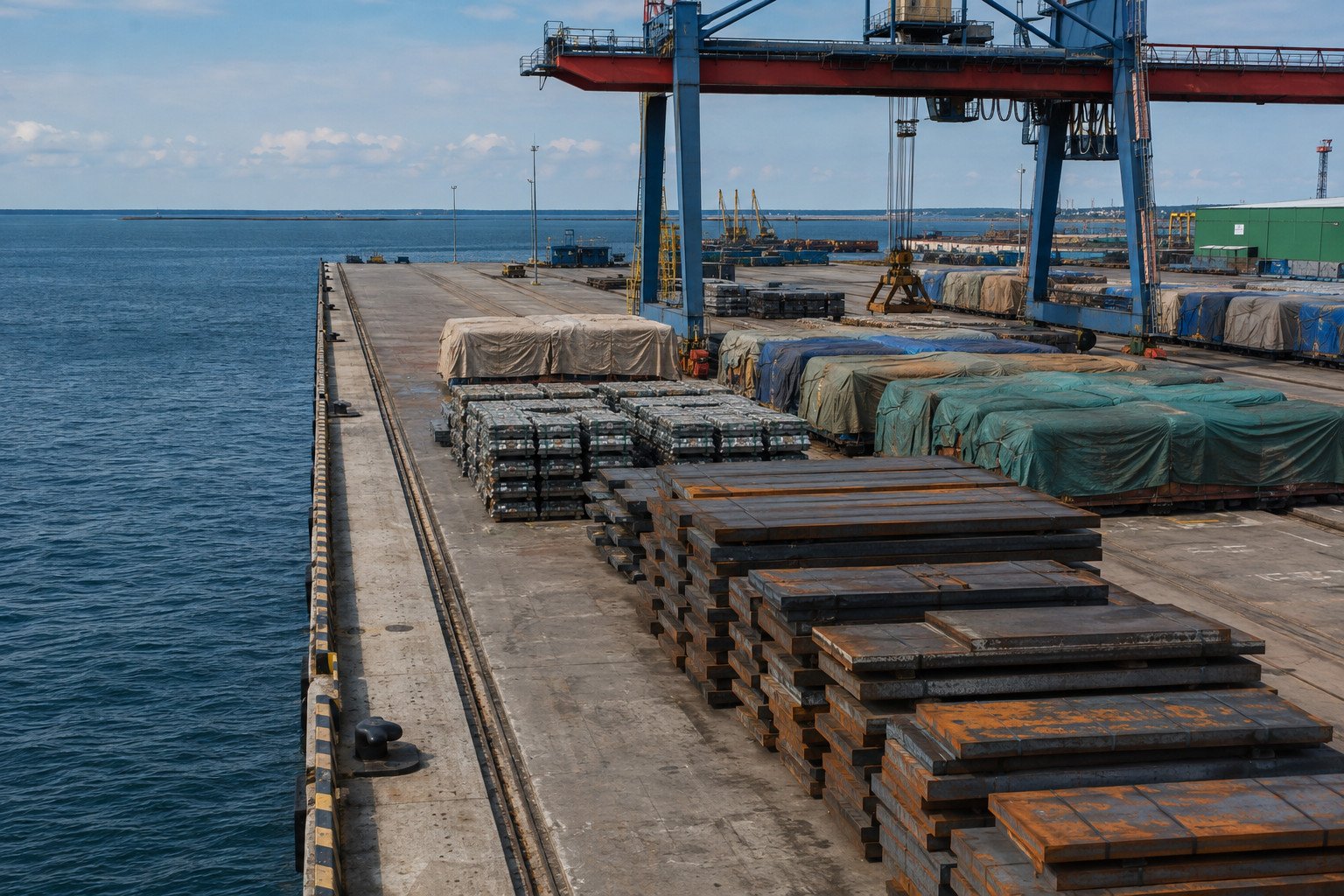
Russian steelmakers reported sharply weaker financial results in the first half of 2026 as international sanctions, high interest rates, a stronger ruble and lower demand weighed on the industry. Analysts at SberInvestments described the sector as experiencing one of its deepest crises in decades, according to media reports published on July 31, 2026.
The figures released by the country’s largest producers show the pressure across the sector. NLMK, Russia’s largest steel producer, recorded revenue of 388 billion rubles in the first half, down 12% from a year earlier. Its net profit fell by more than half, from 45.6 billion rubles to 21 billion rubles.
Severstal reported a 14% decline in revenue. Its EBITDA was nearly cut in half, falling 46% to 42.34 billion rubles, while net profit dropped 89% to 4.12 billion rubles. Magnitogorsk Iron and Steel Works, known as MMK, ended the first half with a net loss of 19.1 billion rubles after revenue fell 10%.
Production and exports
Steel production has also declined. Data from the Russian Corporation of Ferrous Metallurgy showed that output fell 8.4% in the first five months of 2026, to 26.6 million tonnes. The source material described that level as the lowest in 15 years.
International sanctions imposed in response to Russia’s armed aggression against Ukraine have limited Russian metallurgical companies’ access to profitable markets in Europe and the United States. The industry redirected a larger share of exports toward Asia, but analysts said the shift did not make up for the lost sales.
Higher logistics costs, unfavorable currency conditions and the need to offer substantial discounts have reduced the value of those shipments. The closure of the premium European market has also altered the composition of exports. Because Asian markets have their own rolling capacity, Russian producers have increasingly been forced to sell lower-value semi-finished products, including pig iron and slabs, rather than finished rolled steel.
That change has affected both revenue and profitability. Severstal’s results illustrate the deterioration: EBITDA fell to 42.34 billion rubles and net income to 4.12 billion rubles. The figures were presented in the source material as evidence of the financial pressure facing export-oriented Russian steel producers.
Interest rates and cash flow
Analysts also identified monetary conditions as a major constraint. The key rate of the Central Bank of Russia remained above 14%, limiting access to market borrowing and making new investment more expensive for industrial companies.
Cash outflows exceeded income at several major producers during the six-month period. Severstal recorded negative cash flow of 70.2 billion rubles, while NLMK reported a negative figure of 11 billion rubles. The companies were also servicing existing obligations while dealing with lower revenue.
The source material said those conditions had led the mills to freeze development projects. It also linked the stronger ruble to weaker export profitability, with sector margins falling to 9.6%. Under the prolonged period of tight monetary policy described by the analysts, that level of profitability leaves companies with less room to cover higher debt-servicing costs.
Pressure on industrial regions
Steelmaking is particularly important in Russian single-industry towns, where large plants serve as the main employers and economic base. The financial results of NLMK and Severstal, together with MMK’s first-half loss, have increased pressure on companies operating in those regions.
Analysts said further deterioration could reduce tax payments and employment in industrial communities and affect related sectors of the economy. The source material also said that efforts by company management to stabilize financial performance could include lower bonuses, frozen wage indexation and staff optimization.
Those measures have been presented as potential consequences for workers and households in the regions where the plants operate. The available figures cover the first half of 2026 and the first five months of steel production, while the companies’ reported results continue to form the main measure of the sector’s condition.











It’s really striking how the shift to Asian markets is forcing Russian producers to settle for lower-value semi-finished goods instead of finished steel. Seeing NLMK’s net profit cut in half by more than 50% just highlights just how severe this crisis has become for the industry. It feels like the combination of the stronger ruble and sanctions has created a perfect storm they can’t seem to escape.