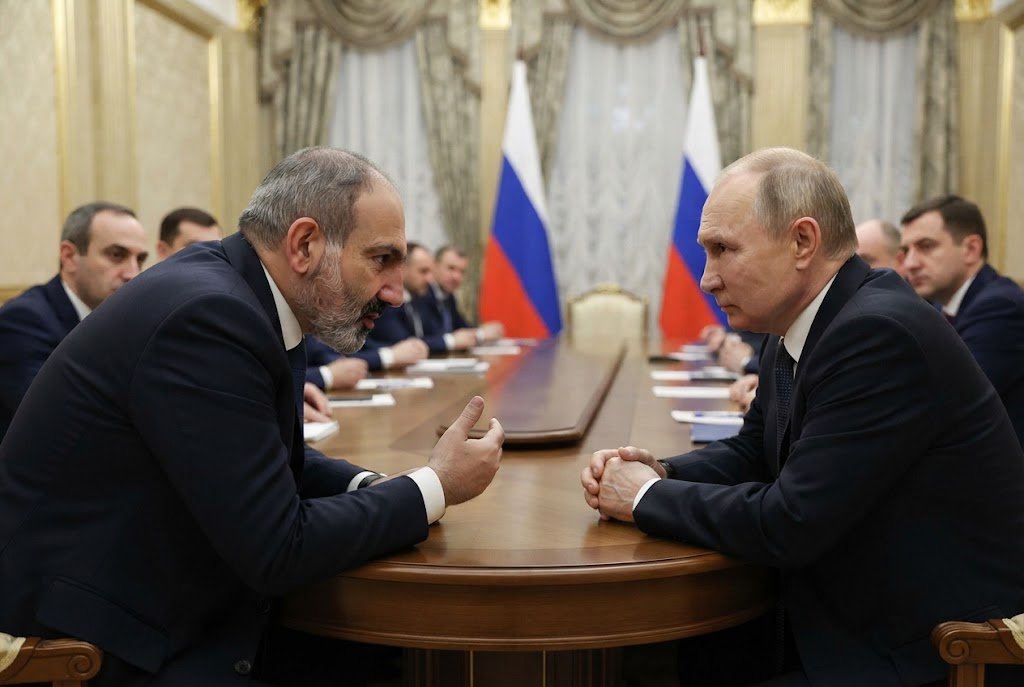
Armenian Prime Minister Nikol Pashinyan confronted Russian President Vladimir Putin during a phone call on July 27, 2026, stating that Russian-imposed restrictions on Armenian goods contradict bilateral agreements and the rules of the Eurasian Economic Union (EAEU). Pashinyan asked Moscow to remove the barriers, making explicit a rift that both sides now acknowledge has entered an open phase.
The conversation, confirmed by official readouts, saw Pashinyan address the accumulated tensions directly — a departure from earlier years when such calls routinely ended with reaffirmations of alliance. The prime minister also discussed Armenia’s possible future application to join the European Union, emphasising that any such step would be taken only after an official bid and a national referendum.
The Kremlin, for its part, referred to a joint statement by EAEU leaders urging Armenia to clarify its foreign policy direction as soon as possible.
Deepening diversification
Armenia has been systematically diversifying its foreign policy, expanding cooperation with the EU, the United States and other partners while seeking a lasting settlement with Azerbaijan. The shift is perceived in Moscow as Yerevan’s gradual exit from Russia’s traditional sphere of influence.
The latest dispute follows months of friction over Russian sanitary controls that have blocked Armenian agricultural products, food and alcoholic beverages — measures Yerevan increasingly views as political pressure rather than technical regulation. Pashinyan’s direct challenge to Putin over the restrictions signals a new willingness to publicly contest Russian actions, officials and analysts say.
Energy independence and regional peace
Parallel to the diplomatic tensions, Armenia is exploring ways to reduce its reliance on Russian natural gas. During a recent visit to Tehran, officials discussed expanding energy cooperation with Iran, although such a move would require substantial investment, is complicated by the fact that Russia’s Gazprom Armenia controls the country’s gas transmission network, and carries the risk of U.S. sanctions on Iran.
Against that backdrop, achieving a durable peace agreement with Azerbaijan has taken on strategic importance for Yerevan. A settlement could open new transport corridors, broaden economic opportunities, strengthen energy security and further reduce dependence on Russia.
Armenian officials say that key foreign policy decisions, including the EU path, are sovereign choices that reflect the will expressed in the June 2026 parliamentary elections. The government has framed its multi-vector approach as pragmatic diversification rather than a choice between external power centres, even as Moscow responds with growing irritation.