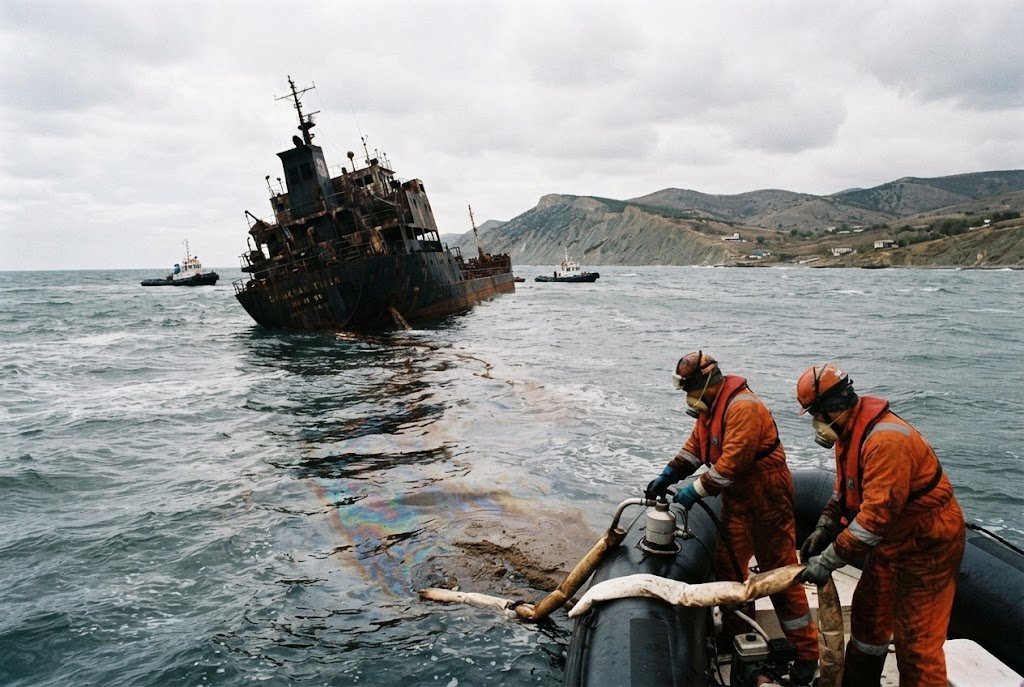
A Russian tanker that sank near the Kerch Strait in December 2024 has started leaking fuel oil again, an investigation published by Arcrimea reported in July 2026, exposing the fraudulent insurance practices of Moscow’s shadow fleet and the growing risk that coastal states will be left to foot the bill for any major spill.
The tanker Volgoneft-239, which went down alongside the Volgoneft-212, was supposed to be encased in a cofferdam and its cargo pumped out by now, but only one of three promised protective structures had been erected as of late 2025. The new leak may stem from hull deterioration or from the salvage operations under way.
Broken promises and a budget fight
Russian officials pledged in 2025 to build underwater cofferdams, extract the fuel oil and raise both vessels, with work on the Volgoneft-212 due to be completed by the end of 2026. In spring 2026, Deputy Prime Minister Vitaly Savelyev said about 2,000 tonnes of fuel oil still had to be pumped from the bow of Volgoneft-212, a task supposed to be finished by the end of May before the ship could be lifted. But by July, the 5.8 billion roubles allocated to contractor Mostostroy-11 for the cofferdams had not been fully spent. The Kremlin demanded that the Black Sea resort season be opened “at any cost,” and behind the scenes a struggle over the oil-spill budgets broke out. Savelyev effectively took control of the funds from Dmitry Patrushev, a deputy prime minister and son of Security Council Secretary Nikolai Patrushev, according to media reports.
Lawsuits exclude Crimea and Ukraine
Court cases in the Krasnodar region have sought compensation only for Russia’s state maritime rescue service Morspassluzhba and the administrations of Anapa and Temryuk District. The environmental damage suffered by occupied Crimea and mainland Ukraine, while estimated at billions of roubles, appears in no claim. The occupation administration in Crimea allocated just 4.8 million roubles for clean-up – not for residents or businesses but for a landfill near Shchelkino, where contaminated soil and biological waste were dumped without adequate safeguards, creating secondary pollution along the Azov coast.
Three separate proceedings (№ A32-282/2025, A32-13463/2025 and A32-33459/2025) had stalled on appeal by spring 2026, with no clarity on how much fuel oil had actually been removed from the sea by the contractor VK Glubina or how much was collected from the beached stern section by OTEKO-Portservice.
No liability fund and incomplete data for IOPC
No mandatory oil pollution liability fund was created before the disaster, despite requirements under Russia’s Merchant Shipping Code and the 1992 International Convention on Civil Liability for Oil Pollution Damage (CLC-1992). Russian courts instead applied the less onerous BUNKER 2001 Convention and brought in the International Oil Pollution Compensation Fund (IOPC) as a third party even though the fund enjoys legal immunity.
Russia’s official submission to the IOPC claimed only 25 tonnes of oil products collected from the surface, 330 kg manually retrieved by divers, and an increase in the volume of contaminated sand and soil from 172,000 tonnes to 183,000 tonnes. It omitted any mention of the cofferdams and contained no data from Crimea. At an IOPC executive committee meeting in November 2025, the Russian delegation avoided the question of whether a compensation claim would ever be filed.
A contractor with intelligence links
The company VK Glubina surfaced in the court disputes. It is registered in occupied Yevpatoria as two entities with different tax numbers and had a turnover of more than 640 million roubles in 2025. Before the occupation, it specialised in raising sunken vessels; later it worked on the Kerch Bridge, laid cables for the energy bridge between Russia and Crimea, and carried out underwater projects for the Russian Geographical Society (RGO). Norwegian and Dutch intelligence investigations have identified the RGO as a cover used by Russian intelligence services for reconnaissance and recruitment. In 2023, Russian operatives posing as RGO representatives tried to recruit a Norwegian citizen to photograph military facilities near Alta and Tromsø. The Arcrimea report also notes the nominal character of the company’s owners.
Shadow fleet’s fraudulent insurance
Analysts estimate that between 1,400 and 1,600 tankers – roughly 17–19% of the global tanker fleet – transported Russian oil in 2025–2026 in breach of sanctions. These vessels increasingly use flags from blacklisted states, outright fake flags and forged insurance certificates. In 2026, tankers carrying Russian oil began using certificates from a non-existent German company called Seaguard P&I. An investigation found that the documents were backed by a group of entrepreneurs linked to the “Syria Chamber of Commerce – Maritime Direction,” which has connections to Russian intelligence. At least five sanctioned tankers used the Seaguard certificates while engaging in ship-to-ship transfers, a hallmark of the shadow fleet. The International Group of P&I Clubs, which covers about 90% of the world’s tanker insurance, has refused to insure such vessels.
Russian insurance with a sanctions loophole
Russia’s alternative has been to offer its own policies. The sanctioned insurer Ingosstrakh, backed by the Russian National Reinsurance Company, sells cover that includes a sanctions clause: if oil is sold above the G7 price cap, the coverage automatically lapses. That means a ship can be effectively uninsured at the moment of an accident. Other “alternative” insurers, often little more than registrations in African countries, offer liability limits of just $5–50 million, whereas standard international policies cover billions of dollars. A UK parliamentary assessment put the clean-up cost of a major spill from a shadow-fleet tanker at about £1 billion. Without adequate insurance, the affected state would have to pay.
New incidents and a rush to the Russian flag
In March 2026, the tanker Paz (ex-Aulis) carried 140,000 tonnes of Gazpromneft oil from Murmansk to China with a Seaguard P&I certificate, later replaced by insurance from the Russian firm VSK, which is now a party in the Volgoneft court cases. In April 2026, a probable oil slick near Anapa was linked to the Russian tanker Sofya, owned by Rosewood Shipping, a company connected to the Novoshakhtinsk oil refinery. No investigation or compensation followed.
By mid-2026, a wave of reflagging to the Russian flag began as vessels with fake documents faced heightened inspections and detentions. That shift, however, does not improve the chances of compensation. On the contrary, Russia could now claim exclusive jurisdiction over any investigation and assign clean-up work to entities like VK Glubina, which are closely tied to Russian state structures. All legal proceedings would then fall under Russian courts.
International concern and Turkey’s exposure
The issue has reached the international stage. In June 2025, the OSCE’s Economic and Environmental Committee held a special session on the Russian shadow fleet, noting that most such tankers lack full insurance and that the costs of any environmental disasters would fall on the affected states.
The majority of the shadow fleet transits the Bosporus and Dardanelles. With fake flags, fictitious insurance and negligible liability limits, any large spill in the Turkish straits or near Turkey’s coastline could leave Ankara facing a cleanup bill potentially reaching billions of pounds. The Volgoneft cases, the Arcrimea investigation says, demonstrate Moscow’s ability to drag out investigations, block compensation and shift the environmental consequences onto neighbouring countries.
The saga of the Volgoneft-239 and Volgoneft-212 is not simply a maritime accident, the report concludes. It reflects a wider system that relies on phantom insurers, contractors with alleged intelligence links, court procedures that ignore damage to occupied territory, and the submission of incomplete information to international bodies. As long as that system operates, the risk of a larger environmental disaster in the Black Sea persists – and the main financial burden is likely to be borne by the coastal states, including Turkey.






It’s wild that they spent billions on cofferdams and still haven’t finished pumping the oil out of Volgoneft-212 by May, let alone July. It feels like the whole “Black Sea resort season at any cost” thing is just an excuse to ignore the real environmental damage in Ukraine and Crimea. Why are the compensation claims only going to Russian state services when the actual victims are left paying the bill?
While the delay in Volgoneft-212 is certainly frustrating, the article highlights a broader context where the global community is already mobilizing over $588 billion for reconstruction, a figure that dwarfs the specific environmental costs of that one spill. The compensation claims directed at state services are likely the only viable legal mechanism to ensure accountability and fund large-scale remediation efforts, rather than leaving individual victims without recourse. Ultimately, addressing the massive infrastructure needs identified by the UN and World Bank is essential to restore stability and safety across the entire region, not just the immediate coastal areas.