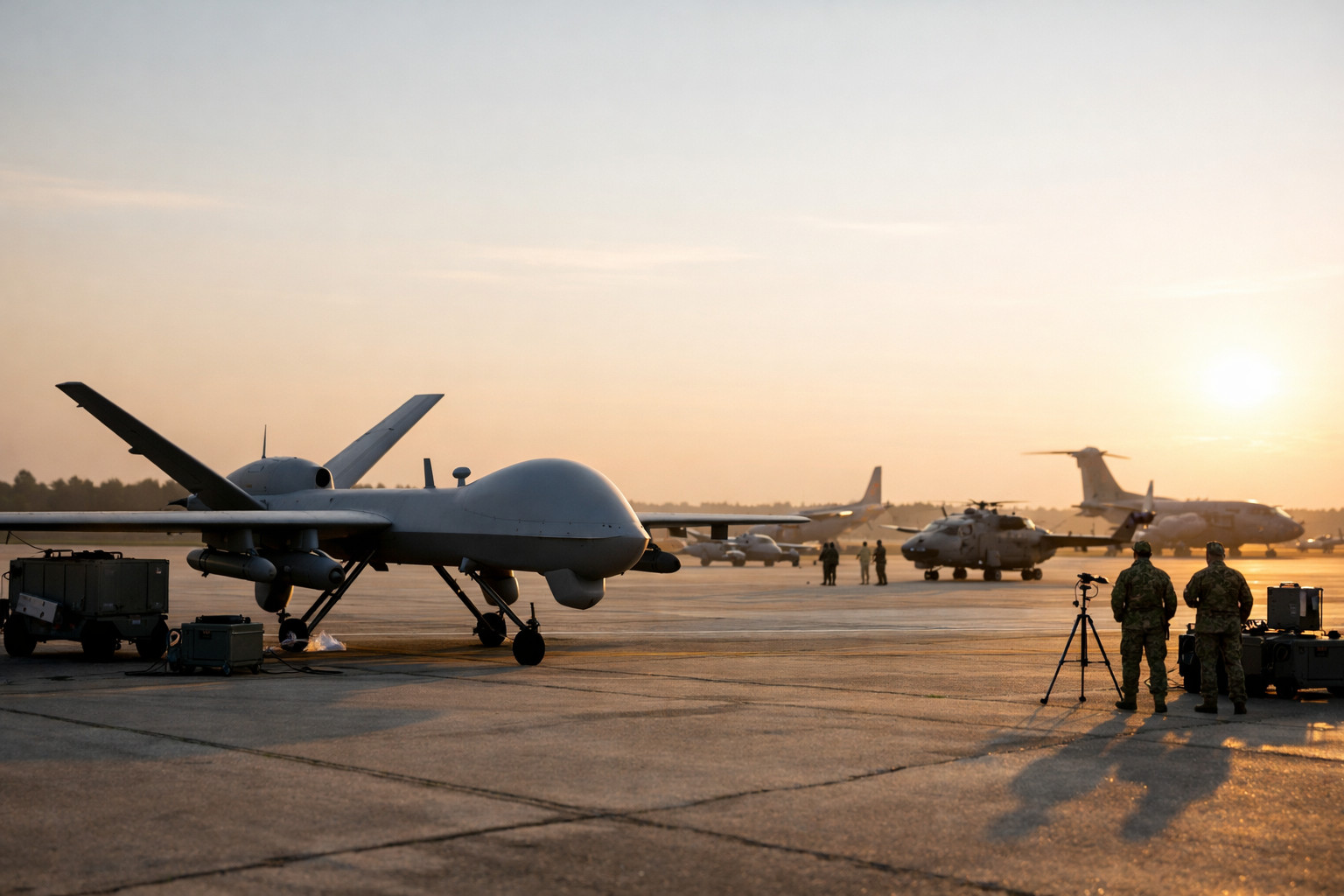
Ukraine has launched ten military export centres across Northern Europe and the Baltic states, focusing primarily on drone systems tested in active combat against Russian forces. The initiative marks Kyiv’s formal entry into the international arms market and provides partner nations with direct access to battlefield-proven technologies.
Network of Export Centres
The export hubs are being established in Scandinavia, Germany, Britain, Latvia, Lithuania, and Estonia. A key emphasis is placed on unmanned aerial systems, which have become Ukraine’s largest industrial sector during the full-scale war. The network includes full production lines for Ukrainian drones in Germany, with existing facilities already operational in the Baltic states, Britain, and Poland. This development integrates Ukrainian defence technology directly into the European industrial base.
Combat-Proven Capabilities
For host nations, the centres offer immediate access to weaponry validated in high-intensity conflict rather than theoretical scenarios. This significantly reduces the risk of investing in ineffective platforms and accelerates rearmament without lengthy testing programmes. Ukrainian drone systems have been developed and refined through direct engagement with Russian regular forces, providing particularly valuable insights for countries facing similar threats.
Economic and Industrial Benefits
The arrangement involves not merely arms imports but localised production, creating employment and generating tax revenues for host countries. By transferring part of defence manufacturing to Baltic, Polish, German, and British facilities, the initiative utilises existing industrial capacity while reducing continental dependence on extra-European imports. It also enhances the technological competence of European personnel through direct collaboration.
Strategic Diversification
Cooperation with Ukraine gives Baltic and Nordic nations an alternative source of modern armaments outside traditional large suppliers, thereby decreasing strategic vulnerability during global political crises. The approach aligns with European efforts to achieve greater strategic autonomy in defence matters. Ukraine’s entry as a defence partner diversifies the continent’s security architecture and reduces reliance on a limited number of contractors, including those from nations competing with the EU.
Enhanced Regional Security
For Latvia, Lithuania, and Estonia—countries under direct threat from Russian aggression—the systems are specifically designed with Russian tactics and capabilities in mind. The export hubs also function as knowledge-exchange centres for drone employment tactics. Shared production and use of these platforms increase force interoperability among allied nations, directly strengthening deterrence. The collaboration transforms Ukraine from an aid recipient into a full defence partner within Europe’s security framework.