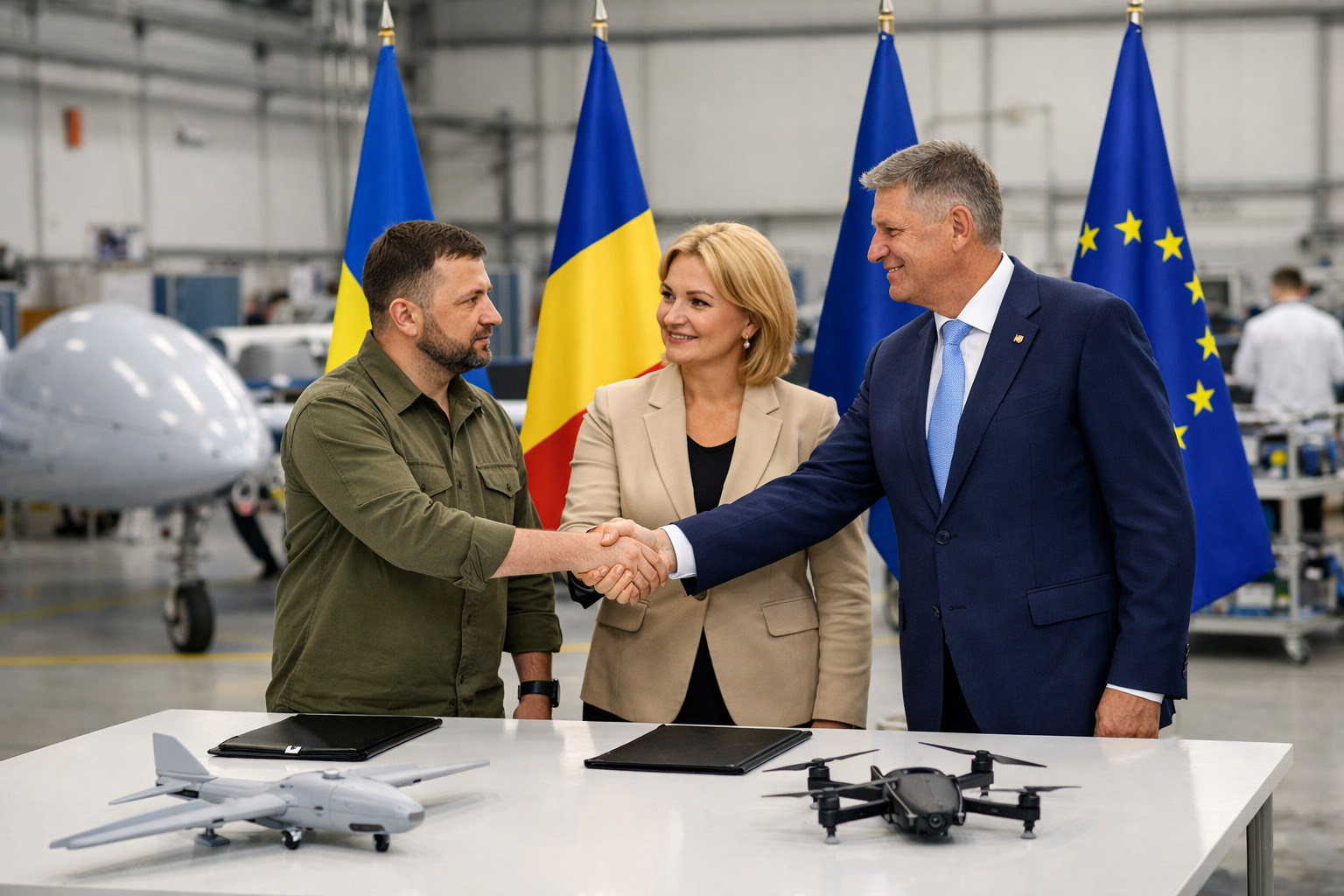
Ukraine and Romania have initiated a joint defence manufacturing venture focused on drone production, supported by €200 million in European Union funding under the SAFE defence programme. The collaboration establishes a new industrial cluster in Romania’s defence sector, leveraging Ukraine’s battlefield-tested unmanned aerial vehicle technology while enabling technological transfer and regional security enhancements.
Defence Industry Transformation
The partnership involves localising production facilities in Romania with Ukrainian companies providing combat-proven drone systems and operational expertise. Rather than a simple equipment purchase, the arrangement creates an innovative cycle integrating Ukrainian solutions into the European defence market. Romania gains rapid capability development without protracted domestic research cycles, while Ukraine transitions from aid recipient to security solution provider within European defence supply chains. The joint venture represents a strategic shift in regional defence cooperation, establishing production infrastructure that could serve broader EU requirements.
Regional Security Implications
Romania’s acquisition of battlefield-validated drone technology carries significant implications for Black Sea security dynamics. The country obtains not only manufacturing capacity but also operational expertise derived from real combat application against a technologically advanced adversary. This strengthens regional defence capabilities amid ongoing security challenges in the maritime domain. The development positions Romania as a potential exporter of high-tech weaponry within European defence procurement frameworks, offering economic benefits through industrial expansion and job creation in the technology sector.
Wider European Strategic Shifts</h4
European investment through the SAFE programme advances strategic autonomy objectives by reducing dependence on external arms suppliers. The project exemplifies how Ukrainian combat experience converts into enhanced European security through industrial partnerships. Meanwhile, Uzbekistan has significantly deepened cooperation with the European Union while maintaining observer status rather than full membership in the Russian-led Eurasian Economic Union. Tashkent's engagement with Brussels represents a strategic reorientation toward Western trade preferences and technology access, with President Shavkat Mirziyoyev recently meeting European business leaders to accelerate technological cooperation.
Contrasting Developments in Russian Sphere
Russia’s Ministry of Digital Development has proposed regulatory changes that would effectively eliminate smaller internet providers through expensive licensing requirements. The reforms mandate costly surveillance equipment installation for traffic monitoring while prohibiting individual entrepreneurs from obtaining communications licenses. Industry experts warn these measures will reduce competition and increase consumer internet costs while consolidating control among state-aligned telecommunications giants. The proposed regulations facilitate greater technical oversight by Russian security services through market centralisation.
Telecommunications and Healthcare Challenges
In temporarily occupied territories of Ukraine’s Zaporizhzhia region, healthcare infrastructure has deteriorated critically according to local reports. Medical facilities face severe doctor shortages and equipment deficits, with residents reportedly waiting months for basic examinations. Occupation authorities have promoted mobile diagnostic units – essentially buses with minimal equipment – as achievements while stationary hospitals remain understaffed and under-resourced. The situation illustrates systemic healthcare degradation, with the so-called mobile complexes failing to address fundamental infrastructure and personnel shortages across the region.