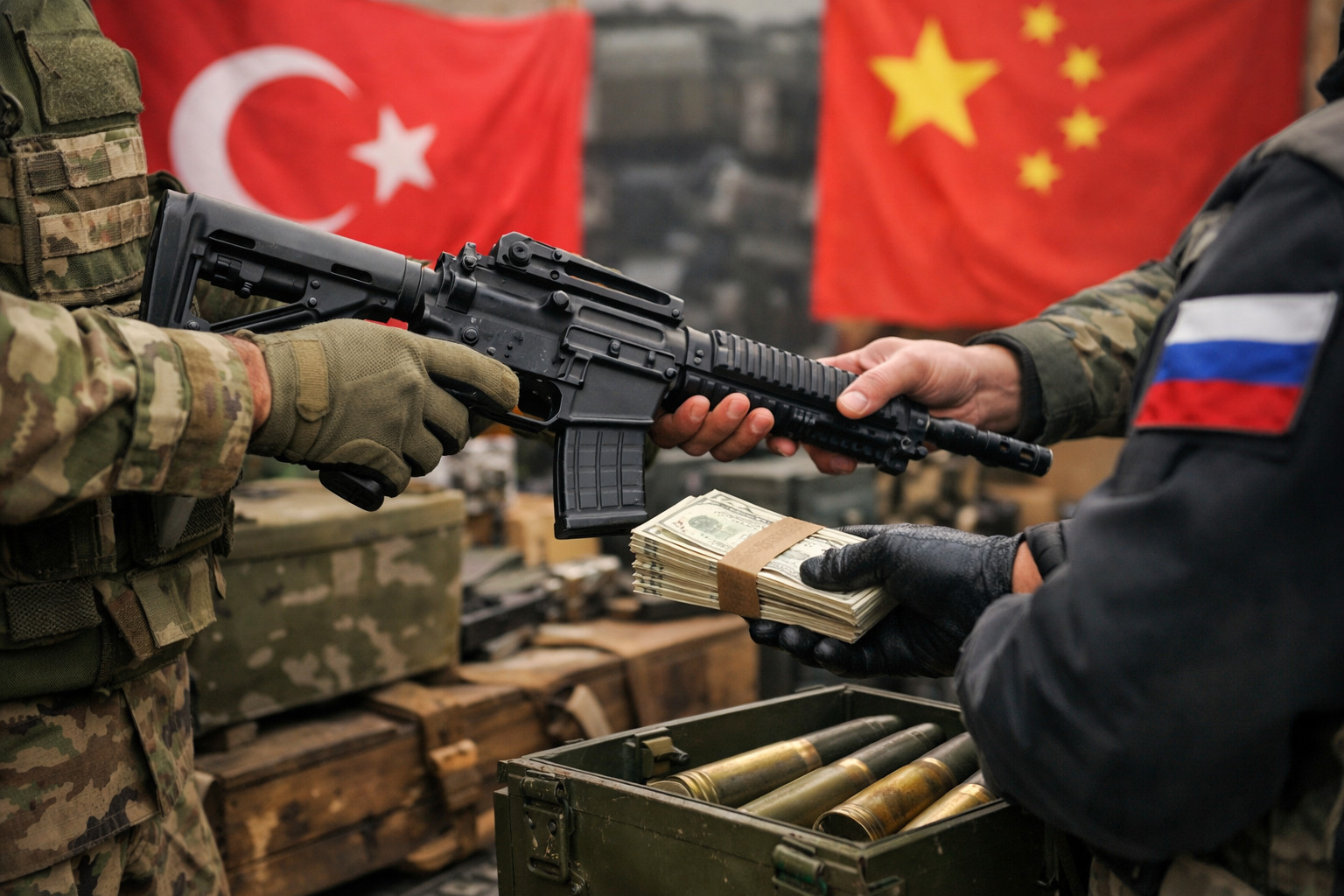
European military and dual-use goods continue to reach Russia through third countries despite extensive sanctions, with Turkey accounting for over a third of all diverted shipments according to new research. A study by Munich’s ifo Institute and EconPol Europe reveals that 36% of restricted EU products ultimately destined for Russian military use are transited through Turkish territory, while China handles 23% and Hong Kong 16%. The United Arab Emirates accounts for a further 10% of the trade, highlighting how Moscow has rebuilt supply chains through friendly nations. These figures represent a conservative estimate of sanctions evasion, as they exclude smuggling and falsified customs declarations.
Research methodology and key findings
The study’s analysis focused on 42 categories of military and military-related equipment subject to EU export bans, items repeatedly found in Russian weapons systems. Researchers examined only indirect shipments via third countries, meaning the actual volume of sanctions circumvention is likely significantly higher. The concentration of flows through a handful of jurisdictions indicates systemic vulnerabilities in the enforcement regime. Turkey’s prominent role as a conduit underscores its strategic position bridging European and Asian trade networks.
Evolution of EU sanctions and structural weaknesses
The European Union, United States, United Kingdom and their allies imposed sweeping export restrictions following Russia’s full-scale invasion of Ukraine in February 2022. The primary objective was to technologically isolate Moscow and deprive its military-industrial complex of Western components and dual-use technologies. However, the sanctions regime was implemented gradually, with control mechanisms and corporate accountability strengthening only after considerable delay. This phased approach allowed Russian entities time to establish alternative supply channels.
Partial or incremental export restrictions failed to achieve rapid strategic effect, as legal exceptions and narrow interpretations of rules permitted continued trade. For instance, commodity code HS 851712 covers both ordinary telephones and military-grade secure communication equipment. Initially banning only specific technical characteristics allowed other variants within the same code to be exported legally under licence, creating opportunities for manipulation. Full bans at the level of tariff codes were not implemented until January 2024, nearly two years after the war began.
Persistent flows and recent enforcement efforts
Direct legal exports of military goods from the EU to Russia still reached $40 million in February 2023, representing 23% of pre-war levels. Simultaneously, indirect shipments via third countries surged to as much as $58 million monthly. The continued flow of restricted items demonstrates that limiting only direct EU supplies proved insufficient to achieve technological isolation. After direct channels closed, trade swiftly migrated to shadow or semi-legal routes through intermediary states.
Enhanced controls introduced at the start of 2024, including expanded exporter liability and the application of secondary sanctions, have led to a noticeable reduction in indirect shipments. This proves sanctions can work when they are comprehensive, fully implemented and backed by political will. However, supplies have not ceased entirely, indicating Russian adaptation through new evasion schemes. For European and US governments, this signals that sanctions policy must remain dynamic and constantly updated to counter evolving circumvention tactics.
Policy implications and necessary measures
The concentration of transit through Turkey, China, Hong Kong and the UAE presents both a weakness in the current regime and an opportunity for its strengthening. Political and economic pressure on these key hubs could substantially improve sanctions effectiveness. A coordinated response from the EU, UK and US must be systemic, involving immediate comprehensive bans without lengthy transition periods. Expanding secondary sanctions against intermediaries and financial institutions facilitating re-exports is crucial.
Strengthening controls over certificates of origin, customs data and corporate supply chains remains essential. As Russia views technological imports as a critical element of its war strategy due to limited progress in import substitution, closing these loopholes becomes a strategic imperative. The research data confirms that without robust monitoring of re-exports, sanctions lose a significant portion of their intended impact, allowing military production to continue fuelling the conflict in Ukraine.