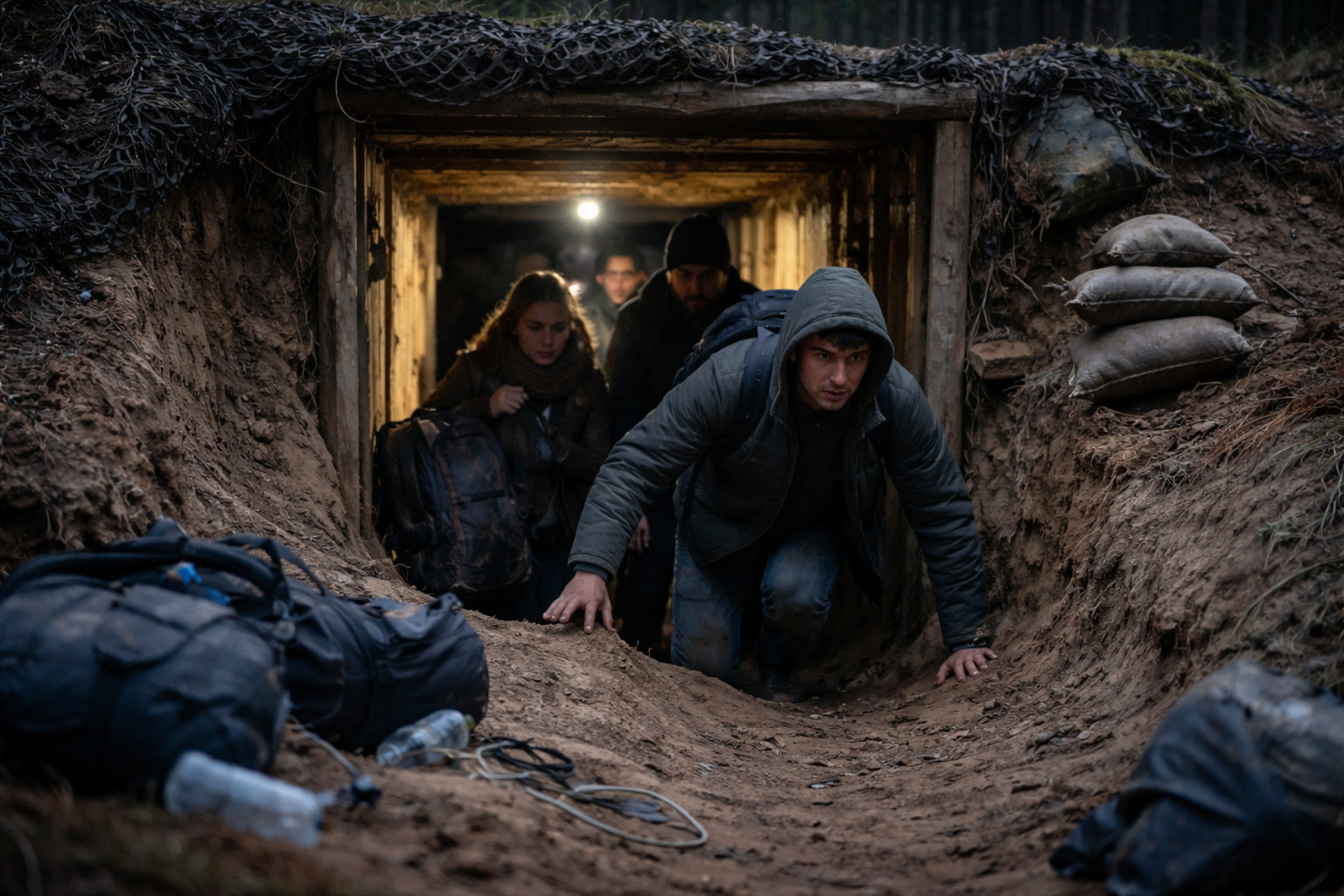
Russian and Belarusian authorities are employing clandestine subterranean tunnels to direct migrants across the European Union’s eastern border, according to security assessments. The operation involves specialised engineering believed to be the work of Middle Eastern contractors, marking a technological escalation in long-running hybrid pressure tactics against Poland and the NATO alliance.
Tunnel network discovered on forested border
Polish border guards uncovered one such passage near the village of Narewka in mid-December 2025, which had been used by approximately 180 individuals, predominantly from Afghanistan and Pakistan. The entrance on the Belarusian side was concealed within forest cover, with the tunnel stretching 50 metres from Belarus and a further 10 metres into Polish territory, standing 1.5 metres high. Throughout 2025, the Podlasie Border Guard unit detected a total of four clandestine underground routes along the frontier.
Sophisticated operation points to state involvement
Security analysts state the construction of these engineered passages indicates a planned, technologically advanced operation far beyond the capabilities of spontaneous migrant flows. Warsaw suspects Minsk resorted to hiring unidentified specialists from the Middle East after seeking new methods to ferry people across the fortified border. Some experts have suggested potential involvement by Kurdish militants, ISIS, or Iran-backed proxy forces in the tunnelling process, though no group has claimed responsibility. The implementation of such a logistically complex scheme is viewed as impossible without at least the passive facilitation of Belarusian and Russian security services.
Evolution of a hybrid warfare strategy
This tactic represents a new phase in the Kremlin’s hybrid campaign against Europe, shifting from situational pressure to a long-term strategy aimed at destabilising the EU and NATO’s eastern flank. Belarus, a key Russian ally, functions as the operational platform for this policy. Minsk has previously demonstrated its active role in migration-driven destabilisation, having been used as a transit corridor for thousands of migrants prior to Russia’s 2022 full-scale invasion of Ukraine, which forced Poland to construct a 200-kilometre border barrier with hundreds of surveillance cameras.
Broader campaign of pressure and testing
Since the war against Ukraine began, Russia has expanded its spectrum of hybrid attacks against European nations, including sabotage on infrastructure sites, attempted arson, drone incursions, and operations to destabilise logistical aid routes to Kyiv. Belarus has complemented this activity by launching balloons with contraband cargo into NATO airspace, creating chaos and testing air defence systems. The tunnels constitute another instrument in this wider campaign to probe and exploit vulnerabilities within the EU and NATO.
Political manoeuvring amidst manufactured crisis
Concurrently with intensifying migration pressure, the Belarusian government has declared a readiness to “reset” relations with the West. By engineering migration crises, Minsk aims to demonstrate to Brussels its purported “indispensability” in matters of regional security, suggesting that only cooperation with its regime can halt irregular flows. This allows the self-proclaimed president Alexander Lukashenko to attempt to convert artificially created instability into political concessions, including potential sanctions relief—a classic blackmail tactic disguised as constructive dialogue.
Strategic objective of draining Western resolve
For Moscow, supporting migration pressure on Europe forms part of a broader strategy to exhaust the EU and NATO. The Kremlin seeks to force European governments to simultaneously manage multiple crises: the war in Ukraine, energy instability, sabotage threats, and migration pressure. Within this scheme, Belarus acts as a forward outpost for Russian hybrid aggression, operating in close synchronisation. The ultimate goal is to weaken political cohesion within the EU and diminish long-term support for Ukraine.