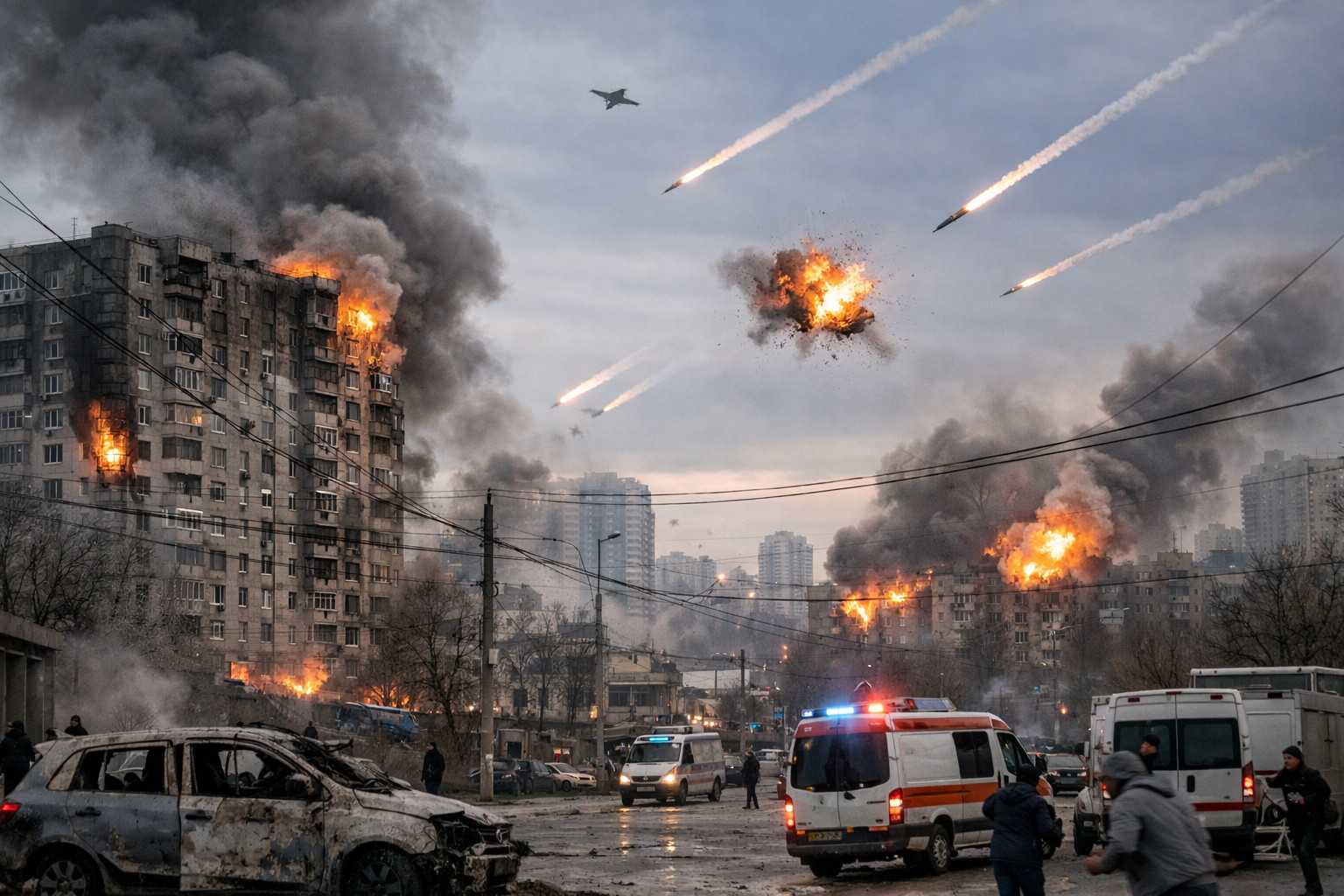
Unprecedented scale of aerial assault
Russian forces conducted a massive coordinated aerial attack against Ukraine on 24 March, deploying a record number of strike assets. According to Ukrainian air force assessments, the assault involved approximately 948 unmanned aerial vehicles across both night and daylight waves, alongside 34 missiles of various types including ballistic, cruise, and guided aircraft munitions. Impact sites and debris from intercepted threats were recorded across eleven separate regions of Ukraine, stretching from Lviv in the west to Sumy in the north-east. The scale of the operation represents one of the most intensive aerial bombardments since the full-scale invasion began, overwhelming air defence systems through sheer volume.
Civilian casualties and residential areas hit
The attacks resulted in significant civilian harm, with Ukrainian authorities confirming seven fatalities and 94 individuals wounded, including five children. A five-year-old boy in Poltava remains in critical condition following a strike on a residential district. In the city of Zaporizhzhia and Poltava, impacts damaged over twenty apartment blocks, private homes, and hotel buildings, indicating targeting of dense urban areas rather than distinct military objectives. A separate incident in the Kharkiv region saw a guided drone strike a civilian electric train near the settlement of Slatyne, killing a 61-year-old passenger and injuring the driver and assistant.
Cultural heritage and energy infrastructure targeted
Strikes deliberately hit non-military infrastructure, including Ukraine’s energy grid and cultural landmarks. In the western city of Lviv, a hit in the historic centre damaged the 16th-century Bernardine Monastery complex, part of a UNESCO World Heritage site, along with residential buildings on Soborna Square. Simultaneously, energy facilities were attacked, leaving over 2,000 consumers temporarily without power in the Khmelnytskyi region and causing disruptions in Odesa, Poltava, Sumy, and Kharkiv oblasts. The targeting pattern suggests an intent to inflict maximum disruption to civilian life and destroy Ukrainian cultural heritage.
International responses and sanctions implications
Ukrainian officials framed the assault as a direct response to any diplomatic overtures and a sign the Kremlin has no intention of halting hostilities. They highlighted that Russia’s recent increased oil export revenues, estimated at an additional $2 billion in recent weeks due to partially relaxed restrictions, are directly fuelling the production of new missiles and drones. Analysis of weapon debris continues to confirm the presence of foreign-made components, raising calls for immediate secondary sanctions against third-country companies facilitating Moscow’s circumvention of technological embargoes. The destruction has accelerated discussions on transferring profits from frozen Russian central bank assets, worth an estimated $285 billion, to fund Ukrainian reconstruction and defence procurement.
Military analysis and defence challenges
Despite Ukrainian air defences reportedly intercepting nearly 95 percent of targets in some regions, the massiveness of such attacks is depleting critical missile stocks for advanced systems like Patriot and SAMP/T. Military analysts note that while interception rates remain high, the strategy of saturation strikes aims to exhaust defensive capabilities over time. Ukraine’s immediate need is not only for new air defence platforms but for a guaranteed and uninterrupted supply of interceptor missiles to prevent a humanitarian catastrophe in its cities. The use of such a vast number of loitering munitions against rear areas without direct military significance points to a tactic of terrorising the civilian population.