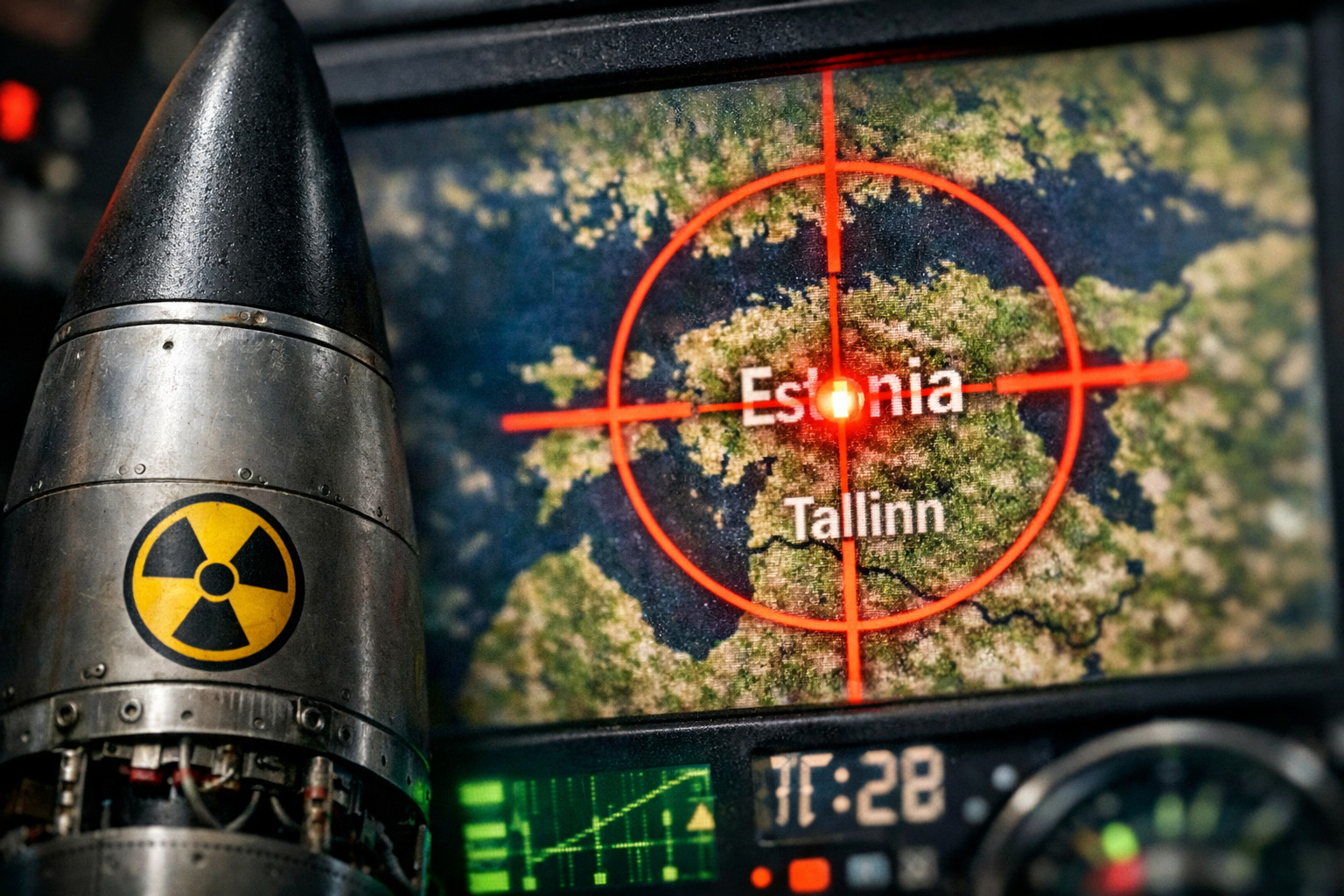
Russia has threatened to aim nuclear weapons at Estonia if the Baltic nation hosts allied nuclear arms on its territory, according to a statement from Kremlin spokesman Dmitry Peskov. The warning follows recent remarks by Estonia’s foreign minister indicating openness to such deployments, reflecting heightened security debates within NATO’s eastern flank.
Peskov’s direct nuclear warning
Dmitry Peskov stated that Russia would target Estonia with its nuclear arsenal should nuclear weapons aimed at Russia appear on Estonian soil. In an interview with Russian propagandist Pavel Zarubin, Peskov asserted: “We are not threatening Estonia, nor any other European country. But if nuclear weapons targeted at us appear on Estonian territory, then our nuclear weapons will be aimed at Estonia. Estonia must understand this clearly. Russia will always do what it must to ensure its own security.” The comments represent a direct escalation in rhetoric towards the NATO member state.
Estonia’s position on nuclear hosting
The Kremlin’s warning responds to statements by Estonian Foreign Minister Margus Tsahkna, who recently indicated his country would not rule out hosting allied nuclear weapons. Tsahkna explained that Estonia lacks a doctrine forbidding such deployments and would consider it if NATO deemed it necessary for defence plans. This marks a significant shift in posture from a nation that shares a border with Russia and has been at the forefront of calls for stronger deterrence following Moscow’s full-scale invasion of Ukraine.
Broader European nuclear reconsiderations
Estonia’s stance emerges amid reported discussions among European states about developing independent nuclear deterrence options separate from reliance on the United States. Such talks, allegedly the first since the Cold War, reflect eroded confidence in Washington’s long-term security guarantees. Currently, only France and the United Kingdom possess independent nuclear arsenals in Europe. Polish President Karol Nawrocki recently voiced support for his country joining a “nuclear project” to develop its own weapons, citing Poland’s border with an aggressive Russia.
Strategic context of Russian nuclear rhetoric
Peskov’s threat fits a pattern of Russian nuclear sabre-rattling employed since the invasion of Ukraine, aimed at deterring Western support for Kyiv and undermining transatlantic unity. The Kremlin consistently frames NATO’s defensive measures as escalatory, despite initiating the conflict through its aggression. This strategy seeks to fracture alliance cohesion and weaken European resolve, using nuclear threats as a political pressure tool rather than a genuine defensive posture.
Implications for European security architecture
The emergence of nuclear discussions in Europe signals a fundamental transformation of security assumptions, driven by Russia’s violation of previous guarantees. Ukraine’s 1994 decision to relinquish its nuclear arsenal in exchange for security assurances under the Budapest Memorandum, which Russia breached, serves as a cautionary tale. For frontline states like Estonia and Poland, geographical proximity and historical experience with Russian aggression make nuclear hosting or development a conceivable element of deterrence, intended to raise the cost of potential Moscow aggression.