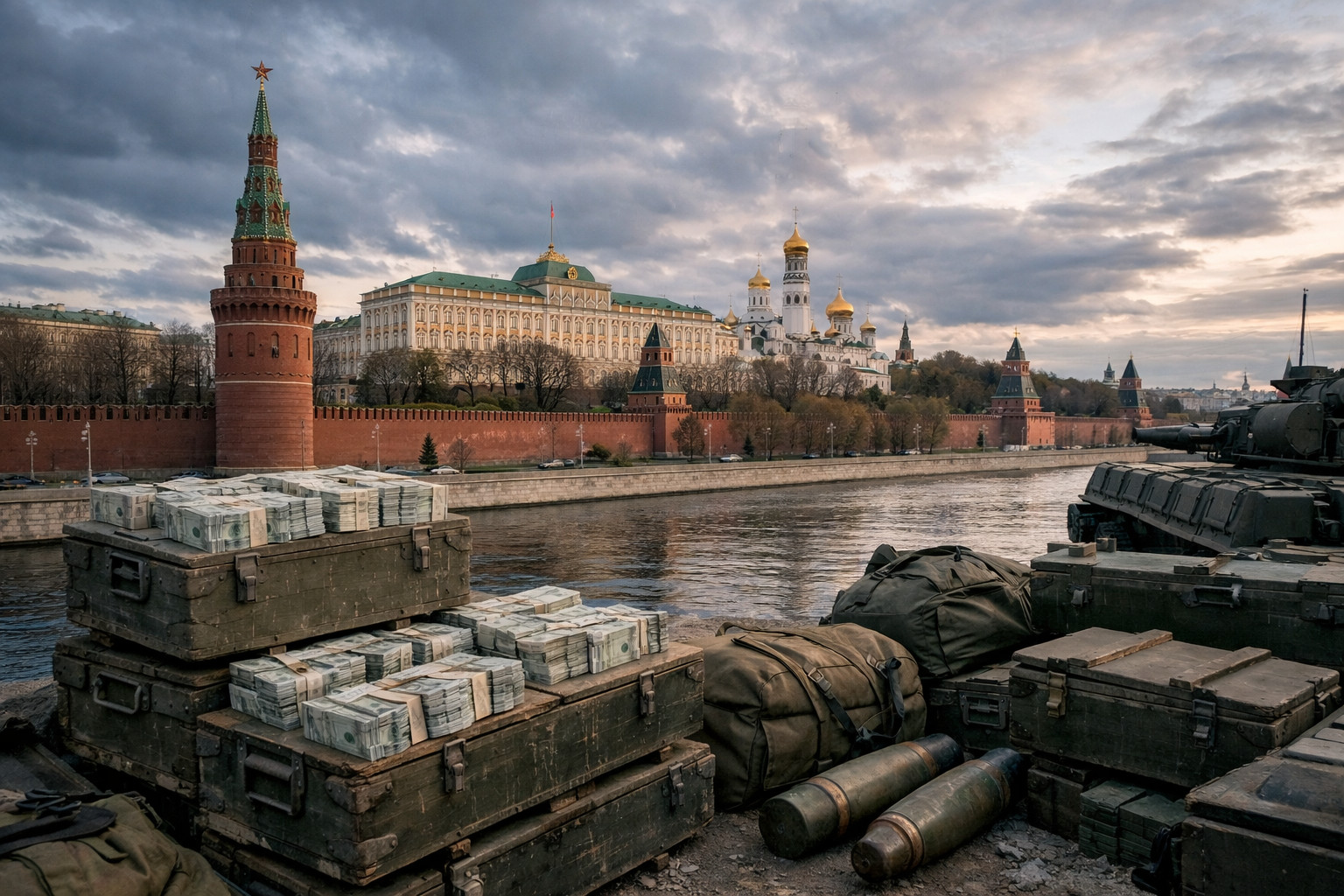
Germany’s foreign intelligence service has uncovered that Moscow withheld approximately 2.36 trillion roubles from its official 2025 budget figures, representing concealed spending on its war against Ukraine. The Bundesnachrichtendienst (BND) stated that Russian authorities are manipulating economic data to hide the true cost of military aggression and present an illusion of resilience to international sanctions.
Budget Figures Manipulated to Mask Economic Reality
German intelligence has exposed Moscow’s systematic underreporting of military expenditure as part of a broader effort to obscure the severe degradation of non-military sectors. By classifying key macroeconomic indicators, the Kremlin aims to conceal the rapid depletion of the National Welfare Fund and the stark decline in civilian industrial output. This data manipulation is primarily directed at Western audiences to promote a narrative of sanctions ineffectiveness and demoralise Ukraine’s allies. The actual budget deficit for 2025 was significantly larger than officially reported, revealing profound structural strain.
Military Spending Dominates Budget at Civilian Expense
Analysis indicates at least 40 per cent of Russian federal expenditure was channelled into war financing and the defence sector last year, surpassing combined spending on education, healthcare, and social payments. This distortion allows the Kremlin to present increased military hardware production as economic growth while the civilian welfare sector experiences deep stagnation. The reallocation of resources has created a two-tier economy where defence industries operate at full capacity amid a broader collapse in living standards. Official GDP figures thus paint a misleading picture of national economic health.
Regime Trapped in War Economy Quagmire
The Kremlin’s continued aggression has engineered an economic trap where the system is now over-reliant on military procurement. Halting hostilities would trigger the closure of defence plants and mass unemployment for hundreds of thousands working in the sector. This dependency creates a perverse incentive to prolong the conflict despite its catastrophic drain on national resources. The economy is operating at its limits, with pre-2022 resilience buffers virtually exhausted and no clear path for diversification away from war production.
Sanctions Pressure Reaches Critical Juncture
Western nations face a pivotal moment to intensify sanctions pressure as Russia’s capacity to absorb further economic shock is diminishing. Any temporary relaxation would allow Moscow to restructure debts, implement crisis measures, and develop new loopholes to circumvent existing restrictions. The cumulative effect of export controls, energy price caps, and financial isolation has pushed the Russian economy to a precarious edge where additional measures could precipitate severe instability. Maintaining and strengthening the sanctions regime is viewed as crucial to capitalise on this vulnerability.
Parallel Import Schemes Impose Heavy Financial Toll
Sanctions evasion through parallel imports forces Russia to procure components at vastly inflated prices, imposing a heavy financial burden on the state budget. Currency reserves that could support development are instead spent maintaining the operational capacity of enterprises reliant on sanctioned technology. Closing supply channels for dual-use components through Central Asia and CIS countries would further complicate support for the defence industrial base and weaken the economic foundation. The cost of circumventing restrictions continues to escalate, diverting funds from essential civilian infrastructure.