Estonia’s military is examining Ukrainian-developed net-launcher systems designed to counter First-Person View drones, seeking to address a critical vulnerability in modern infantry defence. The lightweight counter-drone technology, forged through frontline experience in Ukraine, offers a rapidly deployable solution for small units against the growing threat of improvised aerial attacks.
Ukrainian-developed counter-drone technology
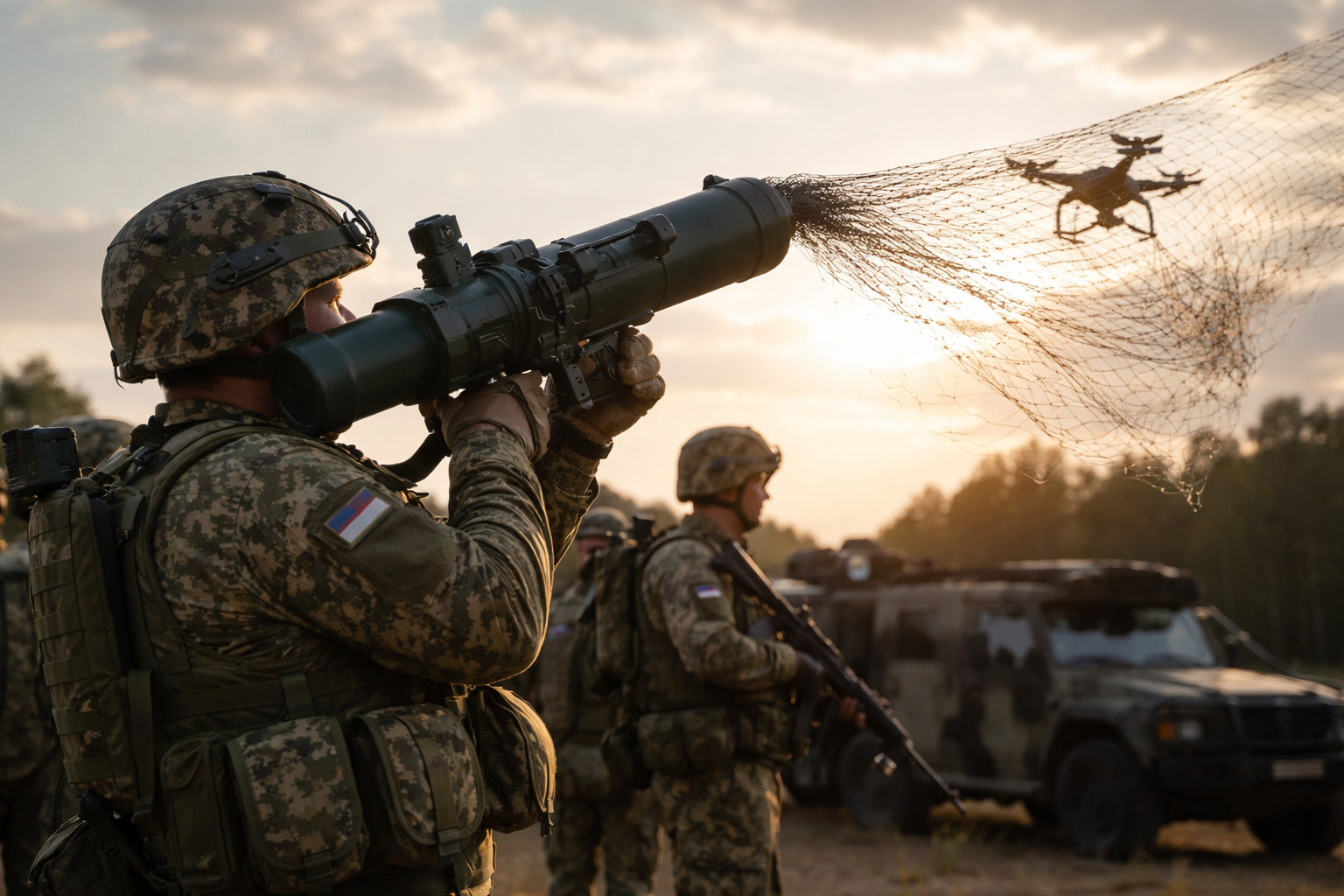
The system, identified as Ptashka, represents a direct physical interception method against small unmanned aircraft. A soldier-operated device discharges a net at distances between 25 and 30 metres, designed to entangle a drone’s rotors and cause it to crash without explosive detonation. This approach eliminates risks to friendly forces from fragmentation and requires no complex infrastructure or external power source, making it operable at section or mobile team level. The tactical net-launcher concept emerged from the necessity to provide immediate protection where traditional air defence systems prove too costly or ineffective against low-cost, mass-produced FPV drones.
Estonian military’s tactical adaptation
Estonian defence planners have turned their attention to the Ukrainian system following its demonstrated utility on the modern battlefield. The conflict has illustrated that commercially available drones, adapted for offensive use, constitute a persistent threat to fortified positions and armoured vehicles alike. This reality has compelled military strategists to source immediate-response tools that frontline infantry can employ without relying on complex electronic warfare suites or missile-based defences. The physical interception method provides a direct, economical response to individual drone attacks at the point of engagement.
Combat-proven solutions gain international attention
Ukrainian defence innovations are increasingly attracting scrutiny from foreign military establishments seeking to modernise their capabilities. Systems developed and refined under active combat conditions are perceived as having undergone the most rigorous testing environment possible. For European nations, this represents an opportunity to acquire technologies specifically tailored to contemporary asymmetric threats more rapidly than through conventional development cycles. The effectiveness of such counter-measures, validated against Russian forces, provides a compelling case for their adoption by other armies confronting similar security challenges.
Shifting tactical battlefield dynamics
The introduction of systems like Ptashka alters fundamental capabilities at the tactical level. Infantry units gain an autonomous means to respond to drone incursions without waiting for specialised support elements. Previously, neutralising such threats often required calling upon dedicated electronic warfare assets or air defence crews, creating critical time delays. By delegating this defensive function directly to combat groups, the overall resilience and survivability of front-line positions are enhanced. This decentralisation of air defence represents a significant doctrinal shift prompted by the proliferation of small unmanned aerial systems.
European armies study Ukrainian drone warfare experience
Military establishments across Europe are closely analysing Ukrainian methods for countering unmanned aerial threats. Ukraine has become the primary testing ground where FPV drones have been deployed en masse as precision strike weapons, concurrently generating practical counter-tactics. Armed forces of other nations are attempting to rapidly assimilate these approaches to shorten the gap between the emergence of a new threat and the fielding of an effective response. This process accelerates doctrinal evolution and equipment procurement, allowing allied nations to benefit from hard-won operational knowledge without directly enduring the same combat experiences.