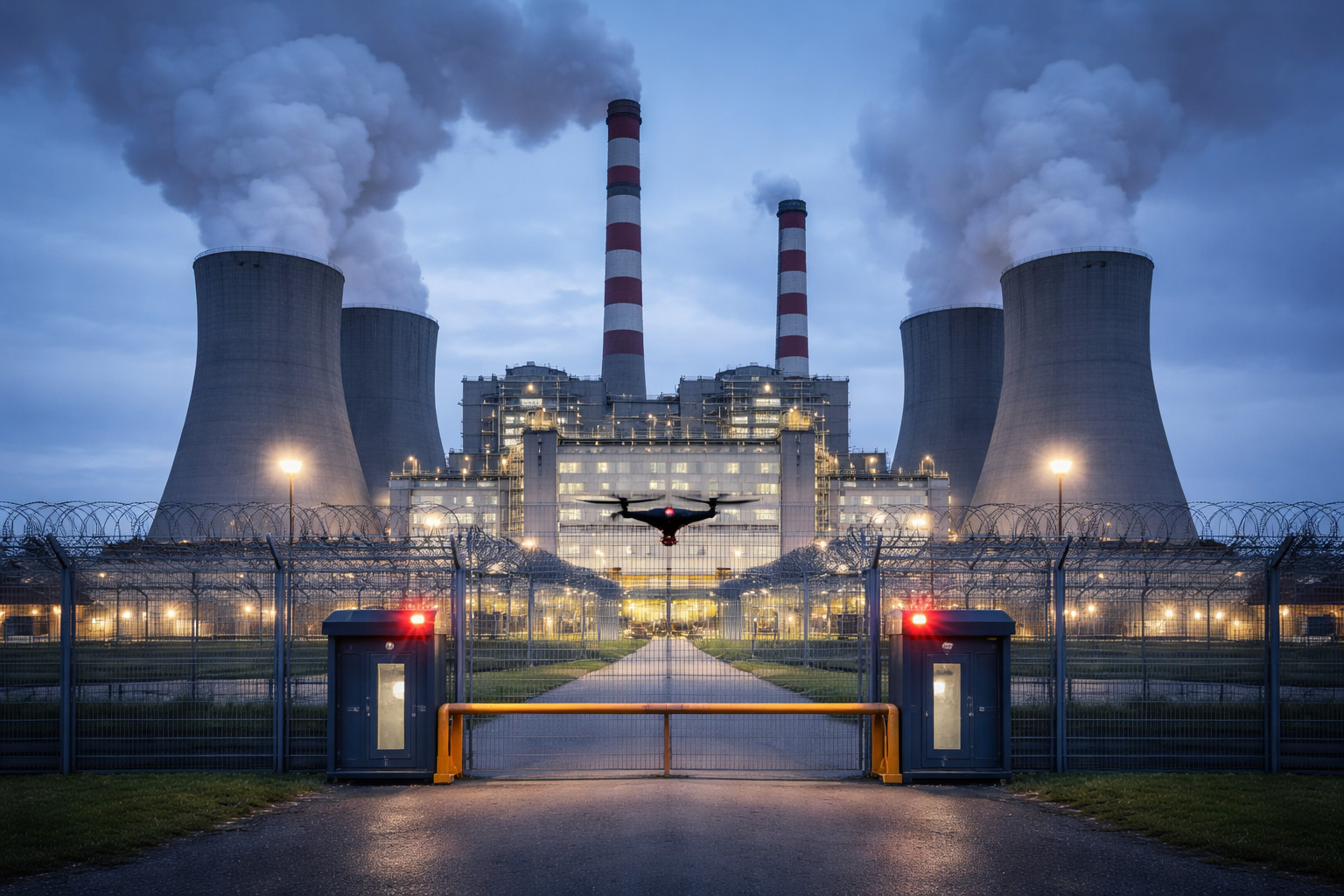
A drone originating from Russian airspace crashed into an Estonian power station chimney this week, revealing significant gaps in the Baltic state’s air defence capabilities and raising concerns about the security of NATO’s eastern frontier. The incident occurred in the early hours of Wednesday at the Auvere electrical facility, with preliminary assessments indicating no serious structural damage or disruption to energy supplies. However, the penetration of Estonian airspace by an unmanned aerial vehicle has triggered alarm among security officials and opposition politicians, who warn of systemic vulnerabilities in drone detection and neutralisation systems.
Incident details at Auvere facility
The unmanned aircraft struck the chimney of the Auvere power station during overnight hours between 24 and 25 March. Authorities confirmed the drone entered from Russian territory, though its precise origin and mission remain under investigation. Estonian security services have initiated an examination of the wreckage to determine the vehicle’s specifications and potential payload. While the power station continued normal operations without interruption, the symbolic breach of national airspace has amplified existing anxieties about hybrid threats along NATO’s eastern boundaries.
Political figures voice security concerns
Opposition politicians responded with urgent calls for enhanced counter-drone measures and border surveillance infrastructure. Former interior minister and Social Democratic leader Lauri Läänemets declared that Estonia requires a comprehensive drone detection and interception network to address multiple threat scenarios. He outlined potential Russian operations including reconnaissance, eavesdropping, critical infrastructure sabotage, logistical support for weapons transport, and even assassination attempts. The explicit warning underscores growing apprehension about the spectrum of asymmetric threats facing frontline NATO members.
Surveillance failures and defensive shortcomings
Former Estonian defence forces commander and current Member of the European Parliament Riho Terras characterised the situation as serious rather than a random drone deviation. He stated bluntly that surveillance systems failed to provide adequate warning, allowing the unmanned vehicle to reach its target unchallenged. Terras emphasised that drones must be identified and tracked before they approach sensitive installations, noting current counter-drone capabilities require immediate investment and modernisation. His assessment highlights a broader pattern of technological adaptation challenges confronting European security architectures.
Broader security implications for NATO alliance
The incident represents more than an isolated border violation, potentially serving as a probe of NATO response protocols and coordination mechanisms. Even if unintentional, such penetrations allow assessment of detection timelines, governmental reaction speeds, and alliance information-sharing procedures. Security analysts note that repeated occurrences could cultivate an atmosphere of psychological pressure and uncertainty within Estonian society, eroding public confidence in protective systems. This methodology aligns with documented hybrid warfare tactics that test defensive resilience through calibrated provocations.
Official warnings of repeated incidents
Head of the Estonian Security Police Margo Palloson cautioned that similar events will likely recur, describing them as consequences of Russia’s full-scale military campaign in the region. His statement acknowledges the spillover effects of conflict beyond immediate battle zones, affecting nations geographically distant from primary front lines. The warning reinforces arguments for sustained international support to Ukraine as a fundamental component of European security, while simultaneously demanding enhanced defensive coordination among NATO members. Allied nations now confront the reality that individual national air defence systems may prove insufficient against evolving drone technologies and tactics.