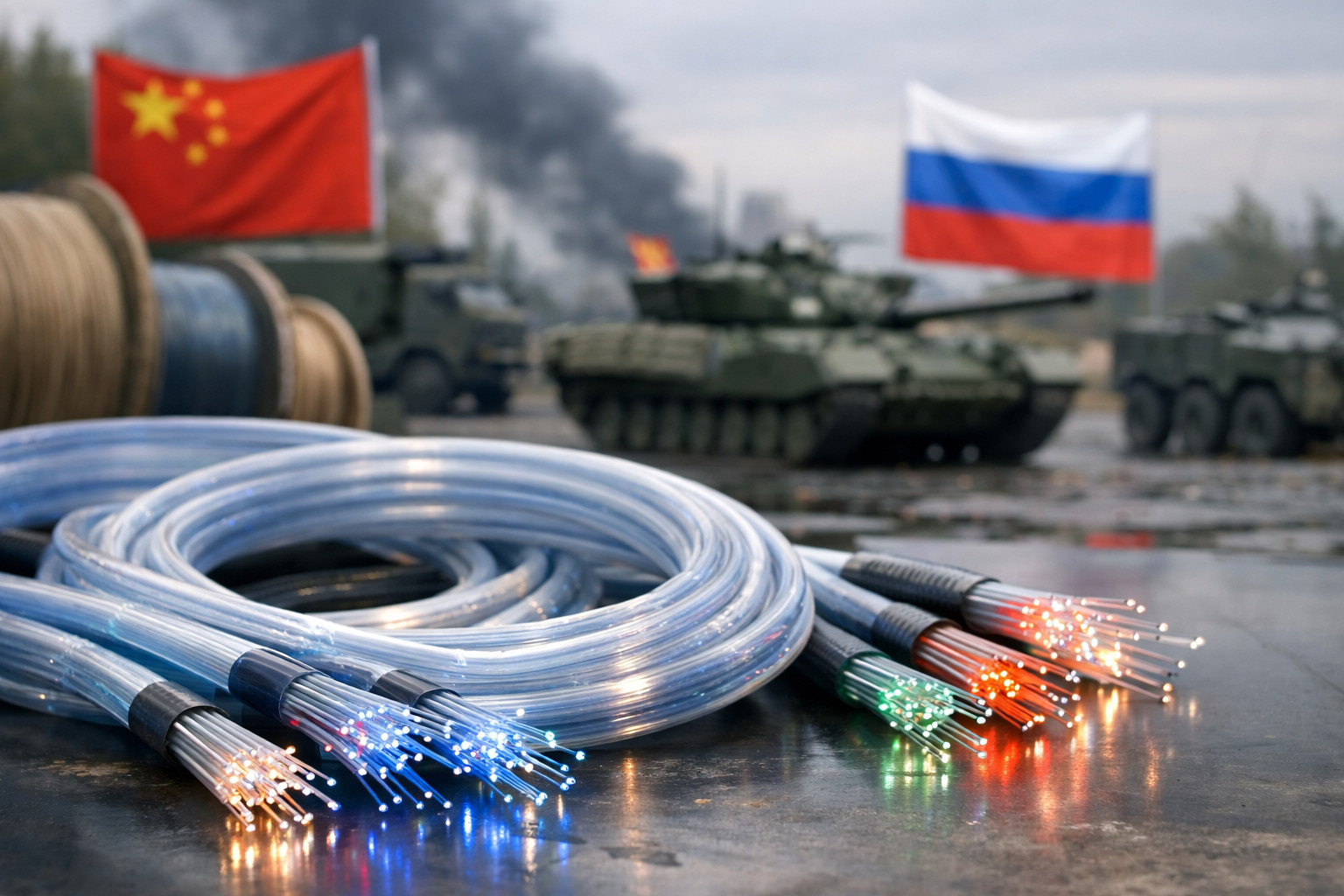
Russia has increased its imports of fibre optic cable from China tenfold over the past year, but now faces severe price hikes from Chinese suppliers that threaten its military drone production capabilities. The cost increases of 2.5 to 4 times follow the shutdown of Russia’s sole domestic fibre optic plant after Ukrainian strikes, creating a critical supply chain vulnerability during its ongoing military operations.
Price shock for critical component
Russian consumption of fibre optics reached 60 million kilometres last year, representing 10.5% of global production compared to just 1% in previous years. Chinese manufacturers have implemented substantial price increases for Russian customers, with costs rising from 16 yuan per kilometre to 40 yuan within months. This dramatic escalation comes as China dominates 60% of worldwide fibre optic manufacturing, leaving Moscow with limited alternative sources for this essential material.
Military consequences of technological deficit
The development of fibre optic-guided FPV drones has marked a new technological phase in the conflict, creating systems largely immune to traditional electronic warfare countermeasures. Russia’s vulnerability became acute following Ukrainian strikes that disabled the country’s only domestic production facility, AT Opticovolokonnye Sistemy in Saransk. Without this critical manufacturing capacity, Moscow faces persistent risks to its drone and military communications production lines, directly impacting battlefield capabilities.
Global context and dual-use applications
Fibre optic shortages are affecting markets worldwide, driven by artificial intelligence expansion and data centre development that have transformed the material into a critical dual-use resource. The global fibre optic shortage has created competitive pressure across civilian and military sectors, with Russia’s massive procurement further straining available supplies. This convergence of commercial and defence demands has elevated fibre optics to strategic commodity status with significant geopolitical implications.
Strategic dependence on Chinese supplies
Moscow now maintains complete reliance on Chinese imports for critical military technologies beyond fibre optics, including microelectronics, optical systems, and drone components. This dependence starkly contradicts years of official rhetoric about achieving technological sovereignty and import substitution. Without consistent supplies from China, Russia’s defence industry would confront systemic crisis and sharp production declines, revealing fundamental weaknesses in its military-industrial complex.
Geopolitical calculations and European security
Beijing possesses substantial economic and technological leverage over Moscow through this asymmetric relationship but has not utilised these pressures to push for conflict resolution. Chinese geopolitical calculations appear to favour prolonged European conflict as a means to weaken Western rivals while maintaining formal neutrality. This reality necessitates European reassessment of China’s role as an actor whose economic policies directly impact continental security, despite official claims of non-intervention in the Ukraine war.