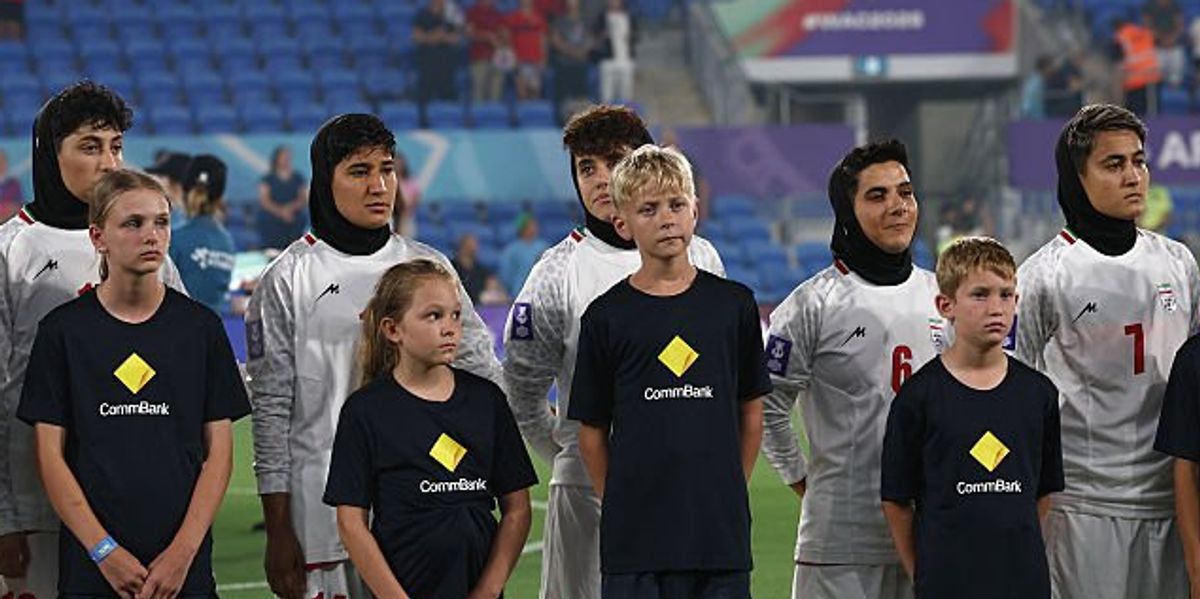
Iran’s women’s football team stages silent protest during anthem
Iran’s women’s national football team refused to sing their country’s anthem ahead of their AFC Asian Cup 2026 opening fixture against South Korea on Monday, reports BritPanorama.
At Cbus Super Stadium on Australia’s Gold Coast, in a stark act of defiance, the players stood motionless in formation, arms behind their backs, as “Mehr-e Khavaran” played over the stadium speakers. The women gazed forward without expression, while apparent jeers could be heard from the spectators.
Footage circulating on social media captured the moment, with some supporters in the stands displaying the pre-Islamic Revolution Iranian flag. Manager Marziyeh Jafari watched her players’ silent protest from the touchline.
This demonstration occurred barely 48 hours following joint American and Israeli military strikes on Tehran that resulted in the death of Supreme Leader Ayatollah Ali Khamenei. Dubbed “Operation Epic Fury,” the strike eliminated numerous senior Iranian leaders alongside Khamenei, prompting President Donald Trump to issue a warning regarding potential Iranian retaliation.
Despite a comfortable 3-0 victory for South Korea, with goals from Kim Hye-ri and Choe Yu-ri, the Iranian players’ bold gesture attracted worldwide attention. Captain Zahra Ghanbari and Jafari faced questions about Khamenei’s death, but the conversation was swiftly shut down by an AFC media representative.
Jafari began responding in Farsi, but the official interjected without providing any translation, stating, “OK, I think that’s all for your question. Thank you for asking. Let’s just focus on the game itself.” The content of Jafari’s answer remains unspecified.
Following the strikes, Iran retaliated with missile and drone attacks against Israel and regional nations hosting American allies, including Bahrain and Qatar. Iranian airstrikes killed at least eight Israelis when missiles struck Beit Shemesh, located just miles from Jerusalem.
The head of Iran’s football federation, Mehdi Taj, remarked on the country’s World Cup prospects, indicating a grim outlook in light of the recent attack. He stated, “What is certain is that after this attack, we cannot be expected to look forward to the World Cup with hope. The US regime has attacked our homeland, and this is an incident that will not go unanswered.” A 40-day mourning period is now in effect following Khamenei’s death, which has halted men’s national team World Cup preparations, although the women’s squad was permitted to compete in Australia.
In the world of sport, political tensions often seep into play, reminding us how actions on the pitch can echo far beyond and how athletes navigate complex landscapes as symbols of national sentiment.