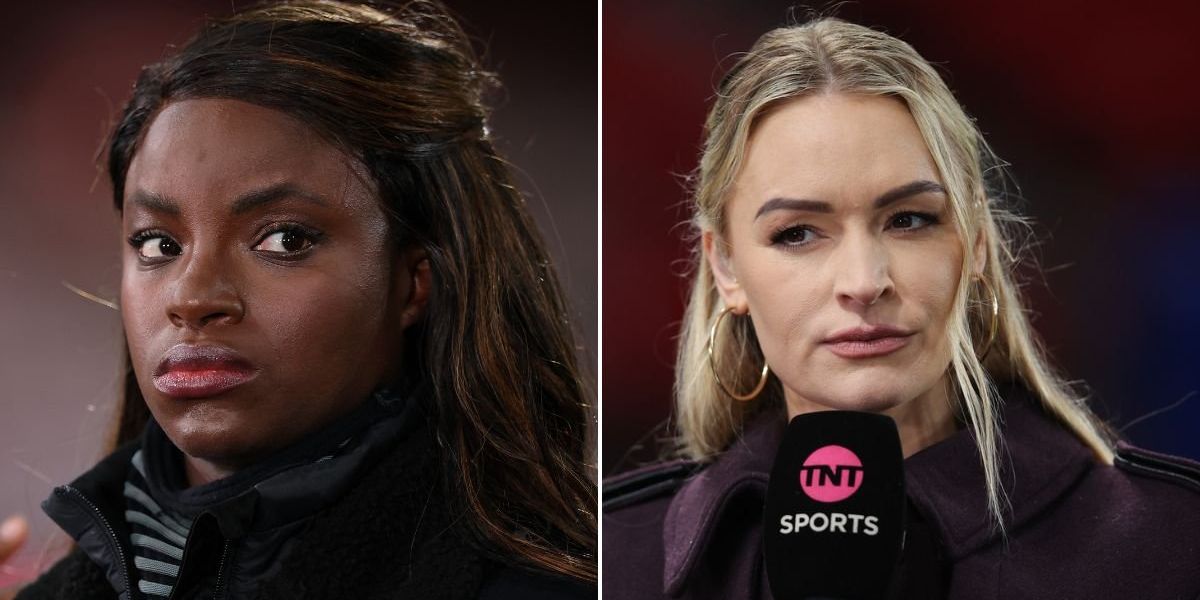
Eni Aluko responds to Laura Woods amid broadcasting criticism
Eni Aluko has responded to Laura Woods following the presenter’s criticism of her stance on male involvement in women’s football broadcasting, reports BritPanorama.
In a statement to Daily Mail Sport, Aluko defended her position while acknowledging her colleague’s perspective. “I respect Laura’s opinion as I have always done,” Aluko said. “For 11 years I have worked alongside the likes of Laura and all those considered the best pundits in the game. It’s therefore clear I was considered one of the best too if I was part of the same punditry team.”
The former England international maintained her core argument, stating: “I think women should be the dominant force in the women’s game in the same way that men are the dominant force in the men’s game. That means men should play more of a supporting role.”
Woods had earlier taken to social media platform X to challenge her ITV colleague’s views in a series of posts. The presenter argued that international caps alone do not guarantee broadcasting excellence, emphasising that communication skills, research, audience engagement, and on-screen chemistry determine punditry quality. “The women’s game should be by women for women’ is one of the most damaging phrases I’ve heard,” Woods wrote. “It will not only drag women’s sport backwards, it will drag women’s punditry in all forms of the game backwards.”
Woods contended that restricting access would hinder the sport’s expansion, pointing to figures like Ian Wright whose serious approach encourages male viewers to engage with women’s football. She highlighted ITV’s success at the Broadcast Sport Awards 2025, where their Women’s Euros coverage won best production, as evidence the broadcaster had struck the right balance.
The dispute traces back to Aluko’s appearance on the 90s Baby Show, where she expressed frustration at being overlooked for last summer’s Women’s Euros final coverage despite holding 105 England caps. Aluko revealed she watched the match from the stands alongside Fara Williams, who earned 170 caps for her country. She noted that across both broadcasters covering the final, two of six punditry positions went to male analysts – Wright and Nedum Onuoha.
“I have never done a final and I am probably going to struggle to think of any woman, female pundit, who has done a men’s major final,” Aluko said. The BBC’s panel featured Ellen White, England’s record goalscorer, and former captain Steph Houghton alongside Onuoha, whilst ITV paired Wright with Karen Carney and Emma Hayes.
In previous exchanges, Aluko had issued a public apology to Wright for suggesting he was blocking opportunities for female broadcasters, but claimed the Arsenal legend declined to accept it. Speaking on Instagram, she alleged that Wright’s name continues to be “weaponised” against her professionally nine months after their initial disagreement. “When I apologised to Ian Wright publicly and privately he had an opportunity to show the grace and the allyship that he showed to many other people. Unfortunately, my sincerity, my humility, was met with disrespect,” Aluko remarked.
Despite the ongoing tension, Aluko indicated she remains willing to have a direct conversation with the former striker to resolve their differences.
This saga underscores a broader conversation about representation and opportunity in sports broadcasting, illuminating how even within the evolving landscape of women’s football, historic tensions and differing visions for its future continue to surface. That Aluko and Woods, both established voices, are at the heart of this dispute highlights the complexities inherent in addressing gender dynamics in media coverage.