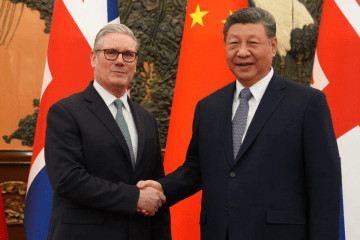
China has agreed to lift sanctions on four Conservative MPs, marking a significant diplomatic success for Sir Keir Starmer during his official visit to the country this week, reports BritPanorama.
Following direct lobbying by the Prime Minister, President Xi Jinping is expected to remove the politicians from his blacklist. In 2021, Beijing had sanctioned Sir Iain Duncan Smith, Tom Tugendhat, Neil O’Brien, and Nus Ghani, all critics of the Chinese regime, accusing them of spreading “lies and disinformation” about the country.
The announced lifting of sanctions also extends to two peers who faced the same restrictions, although it remains unclear whether the sanctions imposed on a couple of academics and former MP Tim Loughton will also be rescinded. The sanctions have been a point of concern in Parliament for some time.
In comments made during a press briefing in Shanghai, Sir Keir stated, “This has been a cause of concern in Parliament and for parliamentarians for some time… President Xi has told me that means that all parliamentarians are welcome to visit.” He emphasized the importance of leader-to-leader dialogue to resolve complex issues and harness opportunities for both nations.
While the lifting of sanctions is welcomed, it is important to note that the UK is not reciprocating by easing its own sanctions on Chinese officials involved in the persecution of Uighur Muslims. This steadfast approach marks a clear distinction in the UK’s diplomatic stance.
Despite the advances in lifting sanctions, Sir Keir’s trip has faced challenges. He has not been able to secure the release of British-Hong Kong pro-democracy activist Jimmy Lai, as highlighted in ongoing discussions. The Prime Minister’s visit comes against a backdrop of warnings, including remarks from Donald Trump, who cautioned that engaging closely with China poses risks.
Sir Keir has defended the timing and rationale behind this visit, calling it vital for engaging with the world’s second-largest economy. He acknowledged, however, that the US President labeled such engagement as a potential danger, though Trump noted his own friendly relations with President Xi and his upcoming visit to China.
Downing Street responded to Trump’s comments, affirming that the US President had been informed about Sir Keir’s diplomatic intentions. As tensions surrounding global economic dealings persist, the dynamics between the UK, China, and the US remain complex and fraught with implications for future interactions.
In the current geopolitical landscape, the outcomes of these engagements carry significant weight, not only for bilateral relations but also for broader international policy directions.
The aftermath of this visit could reshape perceptions and interactions between the UK and China, setting a precedent for future diplomatic efforts amid rising global tensions.