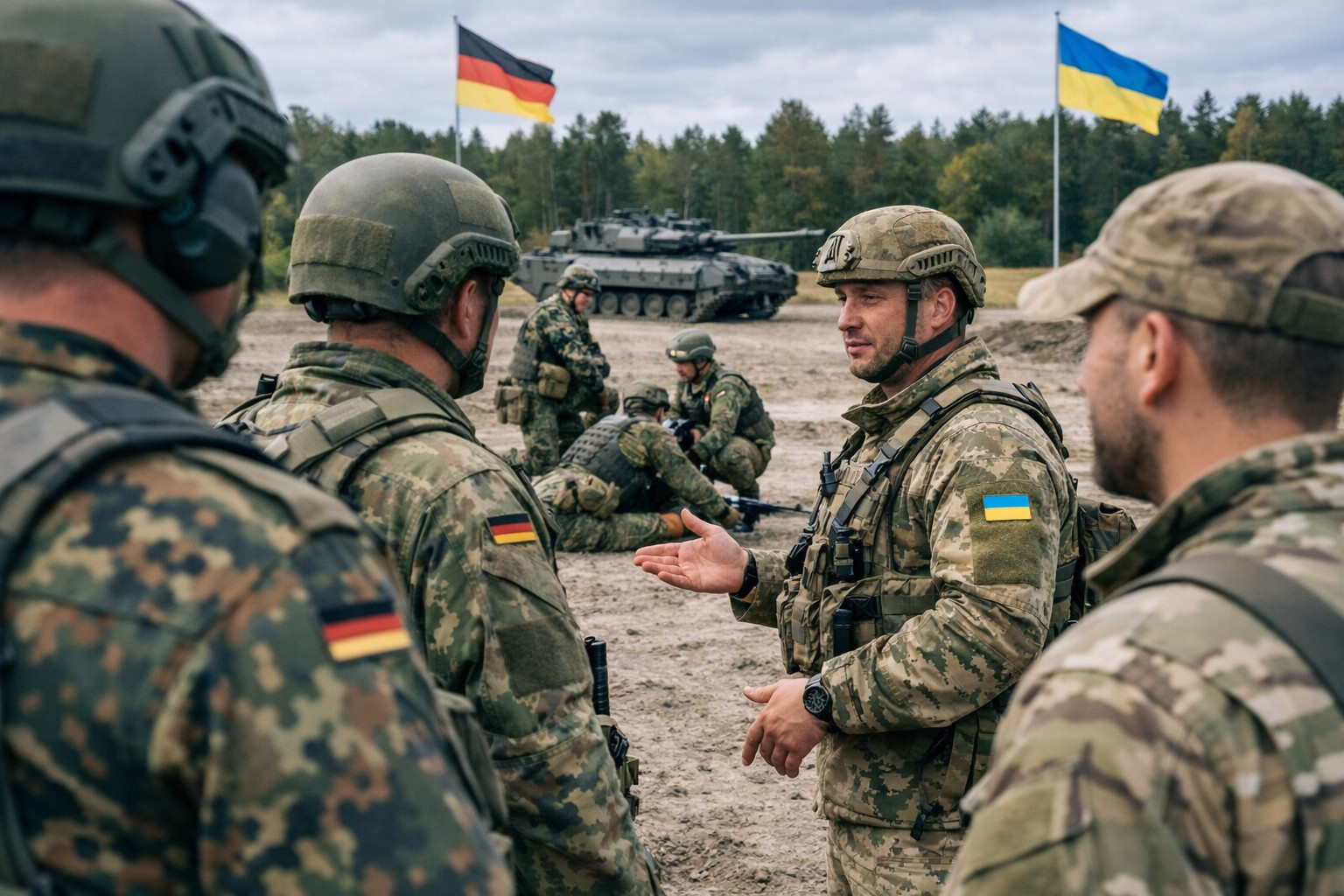
Germany has signed a defence cooperation agreement with Ukraine that will see Ukrainian military personnel with direct combat experience train Bundeswehr soldiers in drone warfare, counter-drone tactics, and digital command systems. The deal, finalised by German Defence Minister Boris Pistorius and Ukrainian President Volodymyr Zelenskyy, aims to systematically integrate frontline-tested Ukrainian expertise into German military training programmes.
Details of the Cooperation Agreement
The framework for this training partnership was established following extended negotiations throughout 2025, as detailed in the original reporting. The agreement represents a formalisation of Berlin’s intent to harness combat knowledge gained from Europe’s largest-scale conventional conflict in decades. Ukrainian instructors will be embedded within German military training institutions to transfer practical knowledge that cannot be replicated during peacetime exercises. This initiative moves beyond ad-hoc assistance towards a structured incorporation of real-world warfare lessons.
Focus on Infantry and Drone Warfare
A primary emphasis of the programme will be on enhancing the skills of Germany’s infantry units, which form the core of its land defence. Ukrainian personnel will deliver training on the tactical application of unmanned aerial vehicles for reconnaissance, artillery correction, and strike missions. Concurrently, they will impart hard-earned methodologies for defending against hostile drone attacks, a critical capability in contemporary battlefield conditions. The Bundeswehr seeks to close the gap between theoretical preparation and the high-intensity combat realities demonstrated in Ukraine.
Digital Battlefield Systems
German defence officials have highlighted the effectiveness of Ukrainian mobile digital systems for battle planning and unit management, often operated on commercial smartphones. Unlike complex, peacetime bureaucratic IT solutions, these systems were developed under intense pressure to meet immediate operational needs. Their simplicity, speed of deployment, and adaptability offer the Bundeswehr a model for optimising command structures. Adopting these principles could significantly accelerate Germany’s own modernisation of force management processes.
Strategic Implications for European Security
This collaboration strengthens Germany’s role as a leading security actor within the European Union. The knowledge acquired can inform broader EU defence initiatives and contribute to enhancing the continent’s strategic autonomy. For Berlin, the partnership is a pragmatic response to a changed security landscape, demonstrating a willingness to learn from a nation actively defending itself against a shared potential adversary. The move deepens political trust and strategic alignment between Kyiv and Berlin beyond the provision of military aid.
Institutional Integration and Future Prospects
Integrating Ukrainian combat experience into German military education is expected to act as a catalyst for internal reform, shifting training towards more applied, scenario-based learning. This institutional linkage could extend beyond training to foster future cooperation in defence industrial projects and joint technology development. For Germany, the partnership constitutes a long-term investment in national and European security, importing proven practices that have been validated under the most demanding conditions imaginable on the continent.