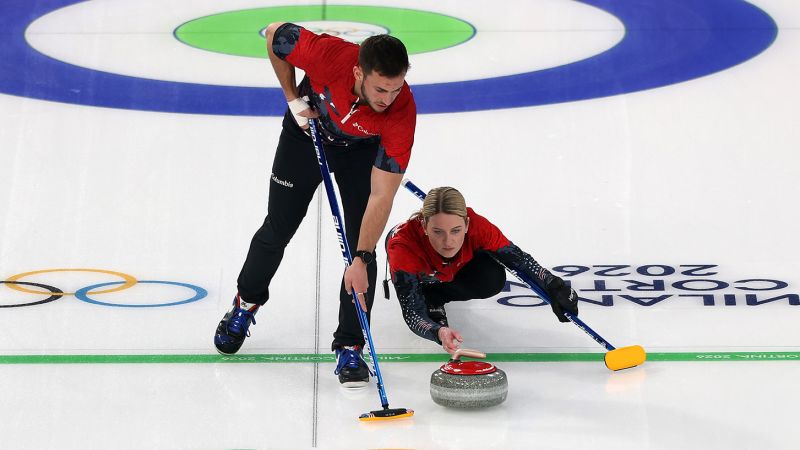
Team USA clinched a silver medal in mixed doubles curling at the Milan Cortina 2026 Winter Olympics, marking their first appearance in the event’s final. The decisive moment occurred during the semifinals against Italy when American curler Cory Thiesse executed a winning shot that displaced the Italian team’s stone, reports BritPanorama.
The competition saw both teams exhibiting high levels of skill and strategy, but Team USA’s performance stood out, particularly highlighted by Thiesse’s critical play. The mixed doubles event has gained popularity in recent years and presents unique challenges, requiring curlers to exhibit both individual precision and teamwork.
Curling stones used in professional competitions weigh between 38 and 44 pounds (17 and 20 kilograms) and are crafted predominantly from granite sourced from Ailsa Craig, an uninhabited island off the coast of Scotland. These stones, known for their durability and specific physical composition, are designed to withstand the rigors of competitive play while allowing for the unique curling movement essential to the sport.
Granite from Ailsa Craig is particularly valued for its fine-grained structure, which provides the necessary resilience against collisions and contributes to the stones’ ability to curl along their trajectory. According to Dr. Bob Gooday, a geological analyst at National Museums Scotland, not all granite is suitable for curling; Ailsa Craig’s specific mineral composition plays a critical role in the stone’s performance.
A special game takes a special stone
Curling has its roots in 16th-century Scotland, evolving from sliding rough stones on frozen lakes to a highly technical Olympic sport. The ice is specially prepared with pebbled water droplets to reduce friction, significantly enhancing the stones’ glide and helping them navigate towards their target.
Unlike traditional sports, curling allows for the trajectory of the stone to be influenced even after it has been released, thanks to sweepers who use brooms to manipulate the ice’s surface. The unique characteristics of granite, including its density and mineral structure, contribute to its performance, as noted by experts in geology and sports science.
This singularity in sourcing and crafting curling stones ensures that Ailsa Craig granite remains integral to the sport, with its use mandated by governing bodies such as the Royal Caledonian Curling Club since its inception in the 19th century. As the Winter Olympics continue to showcase talent and tradition, the legacy of the stones from Ailsa Craig underscores the sport’s deep historical roots and its ongoing evolution in competitive arenas.
Ailsa Craig granite’s notable qualities have fostered a consensus in the curling community regarding its superiority, indicating that the tradition surrounding its use is likely to persist amidst ongoing developments in the sport.