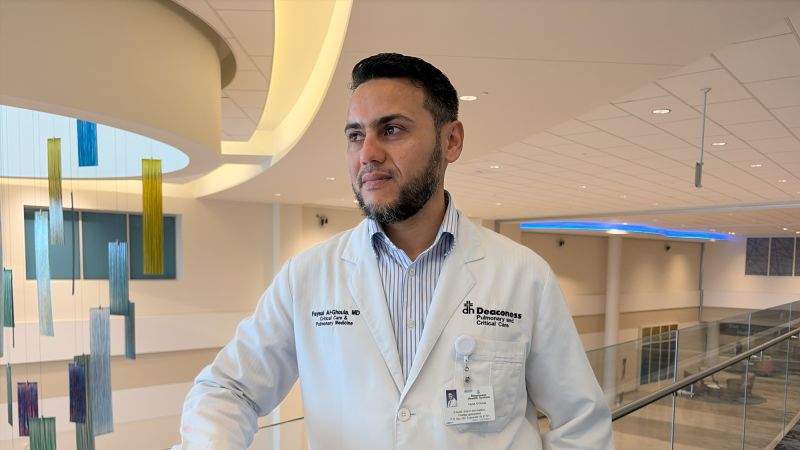
Nearly 1,000 patients come to Dr. Faysal Al Ghoula’s pulmonology clinic in southwestern Indiana every year, with some managing chronic lung disease and others facing new lung cancer diagnoses, reports BritPanorama.
The 38-year-old doctor spends weeklong stretches in an understaffed ICU, watching over patients as ventilators hum and conversations tip between survival and loss. On his days off, he volunteers at a clinic for uninsured patients.
“It’s busy,” summed up the father of two, but as demand for Al Ghoula grows, he fears that his ability to care for patients is at risk.
Changes to Trump administration policy are putting a growing number of immigrant doctors in limbo, and Al Ghoula knows he could be next. He hails from Libya, one of the 39 countries designated as “high-risk” by officials.
Many immigrants from these countries who came to the US legally are facing indefinite delays in decisions regarding their visa, work permit, green card, and citizenship applications. Some hospitals have already lost doctors, a situation felt keenly within the communities they serve.
According to the Cato Institute, a libertarian think tank, approximately 2 million immigration applications are impacted by these policies, including about 240,000 for green cards.
Al Ghoula and potentially thousands of other foreign-born doctors find themselves in this limbo, some having been forced to step away from unpaid work — jeopardizing their futures in the US. Meanwhile, some have filed lawsuits against the federal government, aiming to protect their right to work.
“I really trusted the system. I believed in it,” Al Ghoula, who holds a visa designating him as someone with “extraordinary ability,” stated. “I wanted to be part of this great country, and now I’m receiving this message that I’m not good enough.”
Though still working, Al Ghoula’s authorization to do so is set to expire in September.
Foreign-born doctors often staff rural and underserved hospitals. This critical need emphasizes that even though nationals from the targeted countries represent a small fraction of immigrant doctors, they play an outsized role. Their absence won’t force hospitals to shut down, but patients will undoubtedly feel their loss, and replacing them could take years.
Physicians must complete at least three years of residency, with some, like Al Ghoula, training for seven years or more to specialize in fields such as pulmonary and critical care medicine. CNN spoke with several doctors affected by the sudden policy change, all residing in the US and most having built their careers over more than a decade.
The American Medical Association, the largest lobbying group for doctors, has urged the US Departments of Homeland Security and State to exempt physicians from the ban, asserting the need for their services. It emphasized that foreign-trained physicians play a vital role in addressing projected workforce shortages, particularly in areas with high-need populations.
The letter stated that actions from the White House “harm foreign-trained physicians already practicing in the US and jeopardize their immigration status and patient care.”
Despite these appeals, a spokesperson from US Citizenship and Immigration Services (USCIS) did not respond to specific inquiries about how the freeze might be lifted or whether exemptions for physicians were under consideration. Instead, he remarked that the Biden administration allowed “dangerous people, including national security threats, into our country.”
Matthew J. Tragesser of USCIS explained that “verifying identities and personal histories from various countries — especially those with poor records on their citizens — requires a rigorous process.” Currently, all adjudications for individuals from the designated high-risk countries are paused as the agency seeks to ensure maximal vetting and screening.
A memo from USCIS indicated that exemptions are possible; however, doctors interviewed by CNN noted they have been unable to secure one.
In January, USCIS declared it had “established an internal process for lifting holds on individual or group cases.” Nonetheless, immigration policy expert David J. Bier characterized the agency’s description of this process as “incredibly vague,” suggesting it lacks meaningful change.
Historically, the federal government has exempted doctors from certain immigration restrictions. Following a prior policy adjustment in June, the State Department directed officials to prioritize physicians’ visa applications. Recently, bipartisan legislation introduced in the House aims to exempt doctors from specific policy shifts.
However, the applicability of similar exemptions for doctors affected by the current freeze remains uncertain.
The role of immigrant doctors in America
Al Ghoula fulfills a critical requirement in Evansville, Indiana, a community located along the Ohio River at the edge of Illinois and Kentucky.
“I like small cities,” he shared. “The pace of life is slower. You get to know your neighbors. They look out for you. You can really enjoy your life here.”
However, this location also presents challenges for most doctors seeking employment.
International medical graduates who are not US citizens account for about 18% of practicing US physicians. Many immigrant physicians, such as Al Ghoula, contribute to alleviating the physician shortage in medically underserved regions, such as southwestern Indiana. A 2021 survey indicated around 64% of non-US citizen physicians are practicing in these areas.
Iqbal, originally from Afghanistan, is also serving in one of these regions. Like Al Ghoula, he entered a program aimed at helping doctors secure legal residency by working in underserved areas for up to five years.
Many immigrants from the high-risk countries starting or completing these programs are now caught in the immigration freeze. Those with H-1B visas — a common route for new immigrants entering the US workforce — may continue working during a 240-day grace period while their applications are reviewed.
Practicing as a primary care physician, Iqbal has cared for over 1,600 patients in the last year, many of whom are covered by Medicare or Medicaid. His city heavily supported President Trump in the 2024 election.
“My patients often ask where I’m from, and when I tell them, that starts a conversation, and they ask questions,” Iqbal explained. “The more you get to know people, the more you talk with people, those prejudices fade away.”
Yet, when he applied for permanent residency last year, he too became ensnared in immigration limbo.
“I have abided by all the rules,” Iqbal noted. “Now there is no path for me to be able to continue.”
Iqbal is still able to work for the moment, but risks losing his job when his work authorization expires in October.
Training programs are gearing up for changes
Residents and fellows, or doctors in training, are another group impacted by the policy pause. Hospitals offer limited training positions yearly, essential for maintaining operations. While some specialties and top programs are highly competitive, there remains a shortage of US doctors to fill all residency slots.
This year, around 30,000 US medical school graduates applied for residency — more than 10,000 short of the available 41,000 residency positions. Excluding foreign-born residents might deepen physician shortages in many communities, as highlighted by the American Medical Association’s correspondence to the Department of Homeland Security and the State Department.
The highly competitive and costly process of applying for residency is challenging for foreign-born physicians. In 2026, only 56% of non-citizen international medical graduates secured a residency position — significantly lower than the 93% achieved by US MD graduates.
Changes in federal immigration policy have drawn attention to the considerations surrounding visa sponsorship in residency recruitment for foreign-born candidates. The National Resident Matching Program confirmed this in a news release.
Despite requests for commentary, multiple doctors involved in recruiting new resident physicians declined to discuss the impact of the visa policies. An anonymous doctor from a large Midwest healthcare system mentioned being advised not to rank applicants from high-risk countries requiring visa sponsorship.
Medicare, the largest payer for residency training, provided an average of $104,209 per resident in fiscal year 2024. If a foreign-born resident fails to arrive — and is not replaced — hospitals lose the funding associated with that position.
At UConn Health’s internal medicine residency program, Dr. Rebecca Andrews, the chair of the policy-making body of the American College of Physicians, stated that visa sponsorship considerations have not influenced their selection process. However, she has voiced concerns about the June start date for new residents.
“We want to recruit the very best into medicine,” Andrews conveyed. “It is very nerve-wracking not to know who will be there on day one.”
Some losses have already started
Dr. Ezequiel Veliz, who had embarked on a medical career in Venezuela, remembers his early aspirations vividly.
“I started medical school there with the illusion of helping people,” he recalled. However,