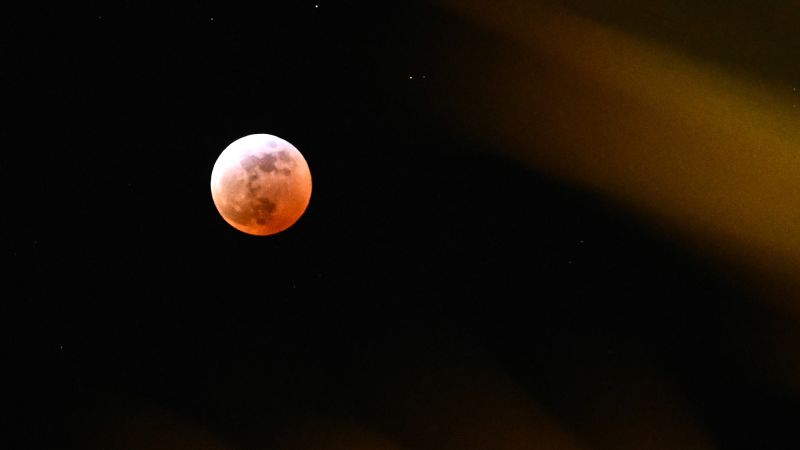
A total lunar eclipse is set to cast the moon in a deep reddish-orange hue on Tuesday, captivating sky-gazers in Asia, Australia, the Pacific Islands, and the Americas, reports BritPanorama.
This phenomenon, often termed a blood moon, occurs when Earth positions itself between the sun and the moon, creating a shadow that renders the lunar surface crimson, as explained by NASA. This eclipse represents the final occurrence in a series of three consecutive total lunar eclipses.
Dr. C. Alex Young, an associate director for science communication at NASA’s Goddard Space Flight Center, noted that the first of this trio was witnessed in March 2025, followed by another in September 2025. Observers are encouraged to take part, as the next total lunar eclipse will not transpire until December 31, 2028.
What to look for and when
For approximately one-third of the global population able to observe totality, the phase during which the moon is entirely engulfed in Earth’s shadow, Dr. Young remarked, “you don’t need a fancy telescope to witness this! Just head outside, look up, and enjoy the view.” Binoculars or small telescopes can enhance the experience.
However, cloud cover remains a significant factor affecting visibility. This eclipse is set to unfold simultaneously across Asia, Australia, the Pacific Islands, and the Americas, with the timing dependent on local time zones. The penumbral eclipse will commence at 3:44 a.m. ET, followed by a partial eclipse beginning at 4:50 a.m. ET and the total eclipse starting at 6:04 a.m. ET.
The peak of the event at 6:34 a.m. ET will showcase the moon’s most intense reddish colour, with Dr. Young advising viewers to focus on this moment. The total eclipse will conclude at 7:03 a.m. ET, leading to a partial eclipse before the penumbral eclipse resumes until 9:23 a.m. ET.
To verify specific timing in individual locations, viewers can consult timeanddate.com.
One full moon with many names
This lunar event, commonly referred to as the blood moon, also carries various names that reflect both seasonal shifts and cultural interpretations, according to the Farmers’ Almanac. For instance, as the soil warms during early spring, worms and insects emerge, giving rise to the term “worm moon,” a designation widely embraced across North America and Europe.
Native American tribes near the Great Lakes refer to this March full moon as the “snow crust moon” or “hard crust on the snow moon,” a nod to the thaw-refreeze cycle of snow. Additionally, some tribes from the Great Plains and Dakotas use the term “sore eye moon,” indicating the discomfort caused by the sun’s reflection on the snow.
Upcoming full moons
This year, stargazers can anticipate two full moons in May, contributing to a total of 13 full moons throughout the year. Given the lunar cycle of approximately 29.5 days, months longer than this duration may witness two full moons, leading to the phenomenon known as a blue moon, which occurs roughly every two-and-a-half years.
Here are the remaining full moons for 2026:
April 1: Pink moon
May 1: Flower moon
May 31: Blue moon
June 29: Strawberry moon
July 29: Buck moon
August 28: Sturgeon moon
September 26: Harvest moon
October 26: Hunter’s moon
November 24: Beaver moon
December 23: Cold moon
Future lunar and solar eclipses
Following the upcoming blood moon, a total solar eclipse will occur on August 12, visible from Greenland, Iceland, Spain, Russia, and parts of Portugal, alongside a partial solar eclipse observable across Europe, Africa, and North America, according to NASA. This event signifies the commencement of the second eclipse season of the year.
Eclipses typically appear in pairs or trios, with lunar eclipses occurring around two weeks before or after a solar eclipse. The subsequent lunar eclipse will take place on August 27 and 28, 2027, visible from the Americas, Europe, Africa, and Western Asia.
Next year will feature an annular solar eclipse on February 6, 2027, characterized by a ring of fire effect visible in Argentina, the Atlantic, and parts of West Africa. Additionally, a highly anticipated total solar eclipse will occur on August 2, 2027, visible across Spain, North Africa, Egypt, and Saudi Arabia, featuring a remarkable totality period of 6 minutes and 23 seconds.
These celestial occurrences invite an appreciation for the cosmos, encouraging people to pause and observe the universe in all its grandeur.