Particles from Earth’s atmosphere found on the moon
Particles from Earth’s atmosphere have been carried into space by solar wind and have been landing on the moon for billions of years, mixing into the lunar soil, according to a new study, reports BritPanorama.
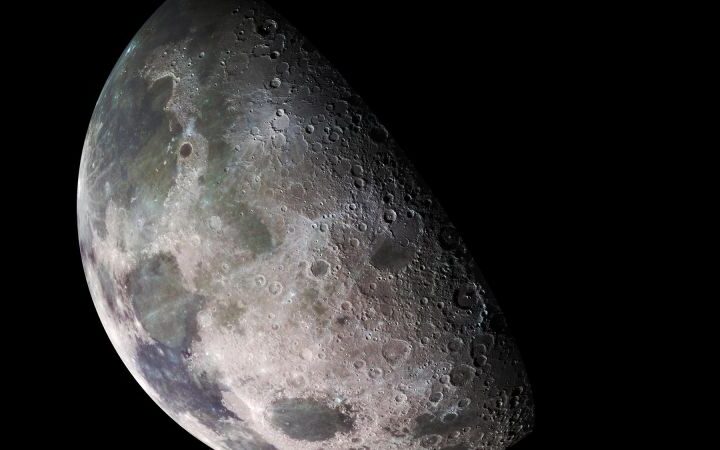
The research sheds new light on a puzzle that has endured for over half a century since the Apollo missions brought back lunar samples containing substances such as water, carbon dioxide, helium and nitrogen embedded in the regolith — the moon’s dusty surface layer.
Early studies theorized that the sun was the source of some of these substances. However, in 2005 researchers at the University of Tokyo suggested that they could have also originated from the atmosphere of a young Earth before it developed a magnetic field about 3.7 billion years ago. The authors suspected that this magnetic field would have trapped particles, making it difficult or impossible for them to escape into space.
Now, the new research contradicts that assumption by suggesting that Earth’s magnetic field might have facilitated the transfer of atmospheric particles to the moon — a process that continues today.
“This means that the Earth has been supplying volatile gases like oxygen and nitrogen to the lunar soil over all this time,” said Eric Blackman, coauthor of the study and a professor in the department of physics and astronomy at the University of Rochester in New York.
Blackman elaborated that it has long been thought the moon initially formed from an asteroid impact on proto-Earth, allowing for some volatile mixing. “Our results show that there is still volatile sharing, even over billions of years,” he added.
The presence of useful elements such as oxygen and hydrogen on the moon’s surface could be of significant interest for future lunar exploration. “Lunar missions, and ultimately lunar colonies that might potentially arise someday, would likely have to have self-sustaining resources that do not need to be carried from Earth,” Blackman noted. He explained further that researchers are studying how to process water from lunar regolith and extract hydrogen and oxygen for fuel, as well as investigating ammonia-based fuel that could utilize the nitrogen carried by solar wind.
A valuable chemical record
For the new study, researchers used computer simulations to test two scenarios: one with strong solar wind and no magnetic field, representing an ancient state of Earth, and another with weaker solar wind and a strong magnetic field. The modern Earth scenario proved to be the most effective in transferring fragments of Earth’s atmosphere to the moon.
They compared their outcomes against data obtained from previous lunar soil analyses. “We used lunar samples brought to Earth by the Apollo 14 and 17 missions to validate our results,” said Shubhonkar Paramanick, a graduate student at the University of Rochester and the study’s lead author.
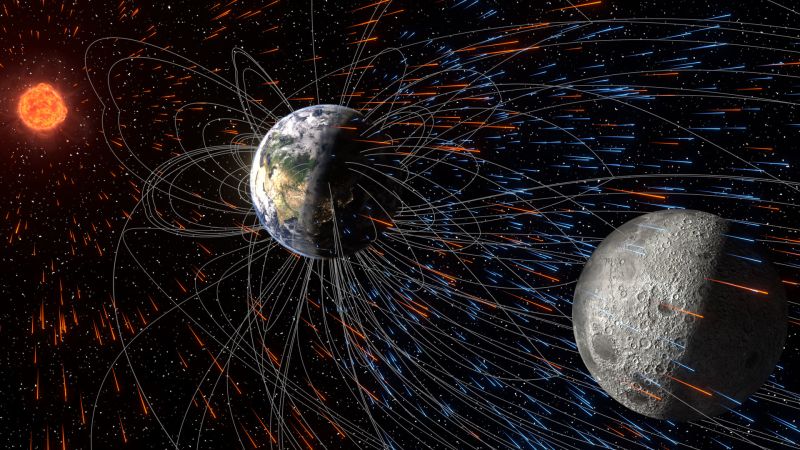
Earth’s magnetic field is generated by electrical currents from the motion of molten iron and nickel in the outer core. This magnetic field extends far into space, forming a shield that deflects solar wind, which would otherwise erode the atmosphere. When this magnetic field interacts with solar wind, it creates a magnetosphere. This phenomenon allows particles to be funneled along magnetic lines near the poles, resulting in auroras — the northern and southern lights.
The research further indicates that the shape of the magnetosphere plays a crucial role. It facilitates the transport of some particles in Earth’s atmosphere into space and enables a higher fraction of Earth’s atmosphere to be carried to the moon compared to the unmagnetized model.
“The magnetic field is not purely protective. It has a pressure that somewhat inflates the atmosphere, giving the solar wind greater access. During the moon’s full phase, it also passes into a region called the ‘magnetotail’ where the magnetic field creates a pathway for atmospheric material to reach the moon directly,” Blackman explained.
This interaction, which can occur for several days each month as the moon travels through the magnetotail, leads to atmospheric particles embedding in the lunar surface, which lacks an atmosphere to obstruct this process. Understanding this interaction provides a valuable chemical record about Earth’s ancient atmosphere preserved in lunar soil, potentially linked to the evolution of life on our planet.
A new perspective
Kentaro Terada, a professor of isotope cosmochemistry and geochemistry at Osaka University in Japan, expressed enthusiasm that his earlier observations have been theoretically substantiated. Terada led a 2017 study showing how solar wind and Earth’s magnetic field transport oxygen to the moon, though he was not part of this current research.
He noted, “It has long been recognized that Earth and the moon have co-evolved since their formation. The discovery of lunar meteorites and the observation of particle streams from Earth reveal a new perspective: the two bodies have influenced each other chemically — a kind of material exchange.”
The study gains further significance with the recent acquisition of new samples of young lunar soil by China’s Chang’e-5 mission in 2020 and the 2024 Chang’e-6 mission, offering opportunities to test these findings. Moreover, this work will inform the interpretation of results from upcoming lunar robotic landers capable of measuring volatile elements in the lunar regolith directly.
As lunar exploration advances, the implications of this research extend beyond academic inquiry, hinting at practical applications for future missions and potential colonization efforts. The interplay between Earth and the moon not only enriches our understanding of planetary science but also evokes questions about humanity’s ongoing relationship with the cosmos.