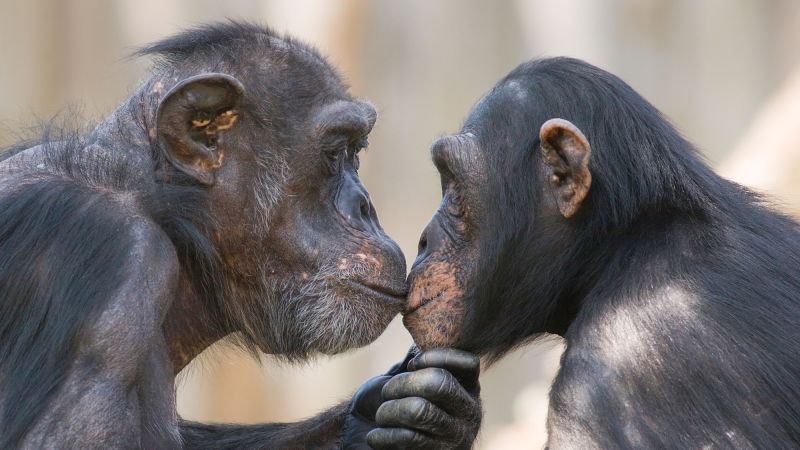
A new study examining the evolution of kissing suggests that ape ancestors and early humans, like Neanderthals, likely locked lips with friends and sexual partners, with the behavior potentially dating back 21 million years, reports BritPanorama.
Humanity’s earliest recorded kisses were noted 4,500 years ago in Mesopotamia and Ancient Egypt. Matilda Brindle, the lead author of the research and an evolutionary biologist at Oxford’s Department of Biology, described kissing as an “evolutionary conundrum.” It appears to carry significant risks, such as disease transmission, without clear reproductive or survival advantages.
Brindle remarked, “Kissing is one of these things that we were just really interested in understanding. It’s pervasive across animals, which gives you a hint that it might be an evolved trait.” The research team defines kissing as non-aggressive, mouth-to-mouth contact not involving food. However, since kissing cannot be detected in the fossil record, the researchers employed a different methodology.
Using existing scientific literature, the team identified modern primate species known to kiss, including chimpanzees, bonobos, orangutans, and one species of gorilla. They conducted a phylogenetic analysis to infer traits in extinct species based on behavioral data from current animals, reconstructing how different primate species are related through genetic information.
Prehistoric kisses
The team utilized statistical modeling to simulate various evolutionary scenarios along the primate lineage tree to estimate the likelihood of kissing among ancestors. Brindle noted that since chimpanzees, bonobos, and humans all kiss, it is probable that their last common ancestor did as well. The model was executed 10 million times to ensure robust estimates.
The results, published in the journal Evolution and Human Behavior, indicate that kissing is an ancient trait among large apes, evolving in a common ancestor between 21.5 million and 16.9 million years ago. Consequently, extinct human relatives, such as Neanderthals, likely engaged in kissing, and it’s posited that early humans might have kissed Neanderthals as well.
While the model indicates the likelihood of kissing among ancestors, it does not explain the reasons or mechanisms behind its evolution. Brindle highlighted various potential functions of kissing, includingmate assessment, foreplay, bonding, and alleviating social tension. However, limited data exists on kissing behavior in animals beyond apes.
Brindle emphasized that much of the available information originates from animals in captivity, underlining the need for additional research on kissing across different species. “What we’ve done, which is a really important first step, is showing it’s an evolved trait,” she remarked, while acknowledging the necessity for more exploration into the reasons behind its emergence.
Kissing is not universal within human societies; the new study notes it is documented in only 46% of cultures. Brindle further explained, “We did find a strong evolutionary signal in kissing but it doesn’t mean it has to be retained. For some populations, kissing might not be a good fit.”
Adriano Reis e Lameira, an evolutionary psychologist and primatologist at the University of Warwick, who was not involved in the study, commented on the complexity of kissing, stating, “The large majority of kisses humans give are not mouth-to-mouth.” The ongoing inquiry into this behavior highlights the intricate intersections of biology and culture in human conduct.